Dubai has established itself as a global hub for manufacturing, processing, and industrial innovation. Entrepreneurs and investors looking to set up factories, production units, or assembly plants must obtain an industrial license to operate legally in the UAE. With the right guidance and structured approach, this process can be smooth and efficient.
With the UAE’s ambitious “Operation 300bn” strategy and the “Make it in the Emirates” initiative, there has never been a better time to launch. TAP Fiscal provides end-to-end support to help businesses secure approvals, comply with modern tax regulations, and launch operations with confidence.
This comprehensive guide explains what an industrial license in Dubai is, the activities it permits, the benefits, requirements, documents, costs, and the complete step-by-step process—so you can make informed decisions and move forward with clarity.
What is an Industrial License in Dubai?
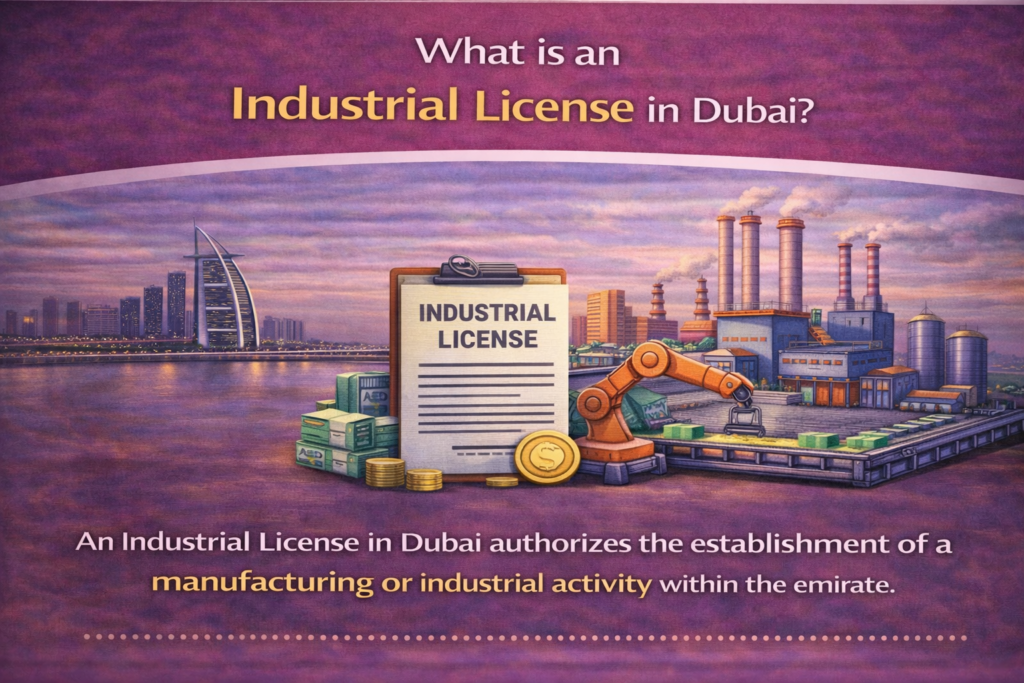
An industrial license is a legal authorization issued by the Department of Economy and Tourism (DET), formerly DED, that allows companies to engage in manufacturing, production, processing, packaging, or industrial assembly activities.
In 2026, this process is twin-tracked:
- Local Level: You obtain your license from the DET or a Free Zone.
- Federal Level: You register with the Ministry of Industry and Advanced Technology (MoIAT). This registration is the key to unlocking “Operation 300bn” incentives, such as customs exemptions and subsidized financing.
Understanding what an industrial license in Dubai is essential for investors planning to operate factories, food production units, textile plants, metal works, chemical processing units, or similar industrial ventures. Without this license, such activities are not permitted in mainland Dubai or industrial free zones.
Business Activities Permitted Under an Industrial License
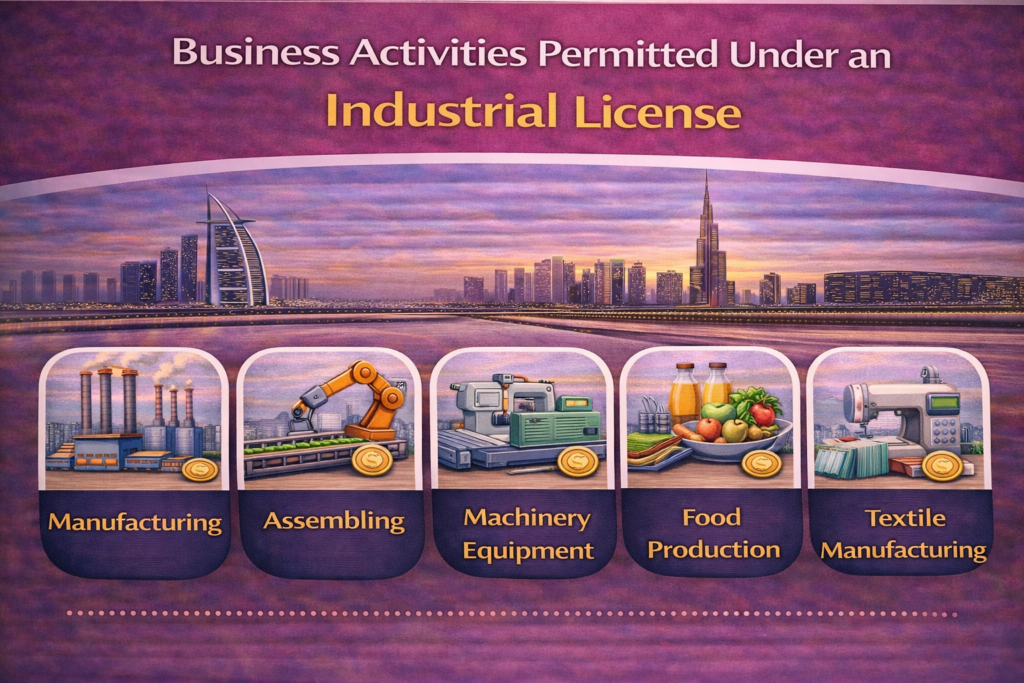
An industrial license covers a wide range of production and manufacturing activities, including but not limited to:
- Manufacturing and assembling machinery and equipment
- Food and beverage production and packaging
- Textile and garment manufacturing
- Chemical and pharmaceutical manufacturing
- Plastic, rubber, and polymer processing
- Metal fabrication and engineering works
- Electronics assembly and industrial equipment production
- Paper, printing, and packaging manufacturing
Each activity must be clearly defined at the time of application, as approvals depend on the nature of production, machinery used, and environmental impact.
Business Activities & Strategic Sectors
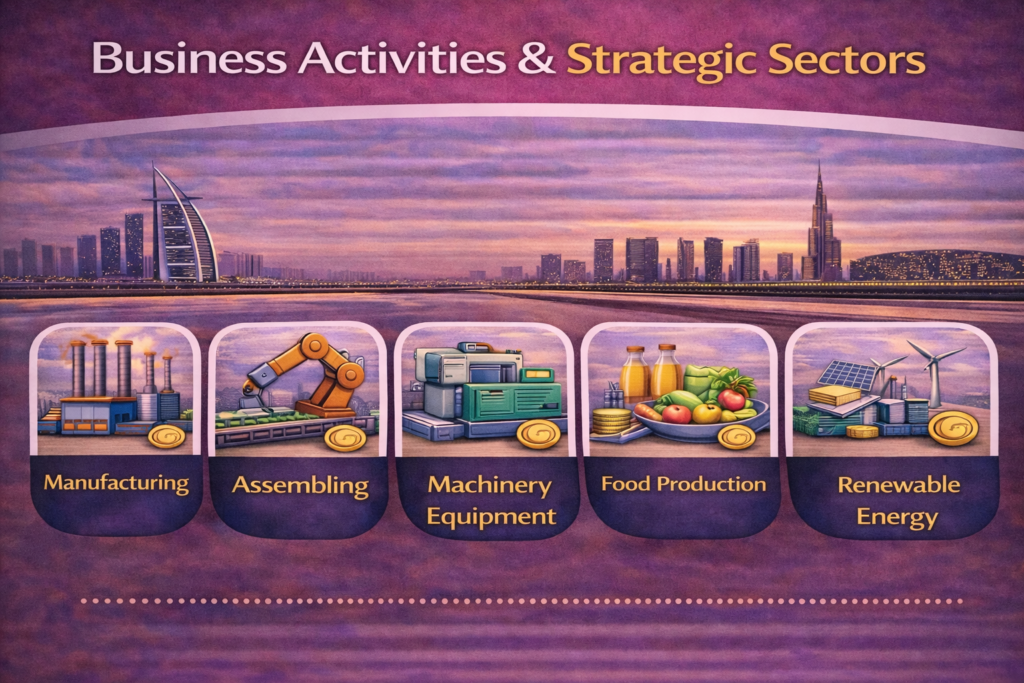
While the license covers everything from food production to textiles, the UAE is specifically prioritizing growth in 11 vital sectors, including:
- Food and Beverage technology (Agri-tech)
- Pharmaceuticals and Medical Technology
- Electrical equipment and electronics
- Petrochemicals, plastics, and rubber
- Space technology and clean energy
Benefits of Industrial License in Dubai
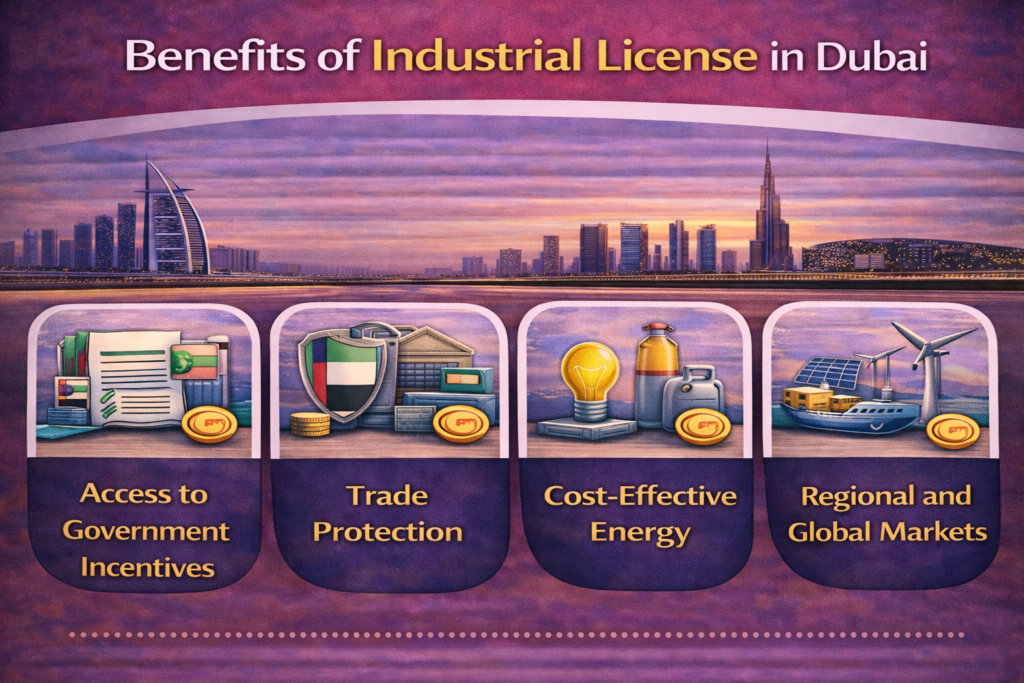
Obtaining an industrial license offers several strategic and financial advantages:
1. Access to a Global Market
Dubai’s strategic location allows manufacturers to serve markets across the Middle East, Africa, Europe, and Asia efficiently.
2. Government Support and Incentives
Industrial businesses may benefit from customs duty exemptions on imported machinery and raw materials, subject to approval.
3. In-Country Value (ICV) Program
Industrial license holders can apply for an ICV Certificate. This improves your “score” when bidding for government tenders and contracts with major entities like ADNOC.
4. Customs Duty Exemptions:
Through MoIAT, manufacturers can claim exemptions on imported raw materials and machinery used for production.
5. “Make it in the Emirates” Incentives:
Access to subsidized energy tariffs (electricity/water) and specialized industrial land at competitive rates.
6. 100% Ownership Options
Under current UAE laws, foreign investors can now enjoy 100% ownership of their industrial mainland companies for most activities.
7. Advanced Infrastructure
Dubai offers world-class industrial zones, logistics facilities, ports, and transportation networks.
8. Credibility and Growth Potential
Holding an industrial license enhances business credibility, enabling partnerships with government entities and large corporations.
Conditions to Obtain an Industrial License in the UAE

To qualify for an industrial license in 2025, businesses must meet specific technical and regulatory conditions:
- Physical Facility: A warehouse or factory is mandatory. Virtual offices are not permitted.
- Minimum Resources: Authorities typically look for a minimum of 10 workers and specific “powerhouse” machinery to qualify as a factory.
- Power Requirement Plan: You must submit your KVA (electricity) requirements for approval by DEWA.
- Thresholds: To register with MoIAT, you generally need a minimum capital of AED 250,000 and at least 10 employees.
- Waste Management Plan: An approved plan for the disposal of industrial waste or hazardous materials is required by Dubai Municipality.
- Corporate Tax Compliance: All industrial companies must now register for the 9% UAE Corporate Tax (on profits above AED 375,000).
Meeting these conditions ensures sustainable and compliant industrial operations within the UAE.
Documents Required for an Industrial License in Dubai

Applicants must submit several documents during the licensing process, including:
- Passport copies of shareholders and managers
- UAE residence visa copies (if applicable)
- Emirates ID copies
- Business plan outlining manufacturing activities
- Trade name reservation certificate
- Initial approval certificate
- Lease agreement for warehouse or factory (Ejari)
- No Objection Certificate (if required)
- Environmental Impact Assessment (EIA) approval
- Civil Defense Certificate (for fire safety compliance)
We ensure that all documents are prepared accurately to avoid delays or rejections.
How to Obtain an Industrial License in Dubai
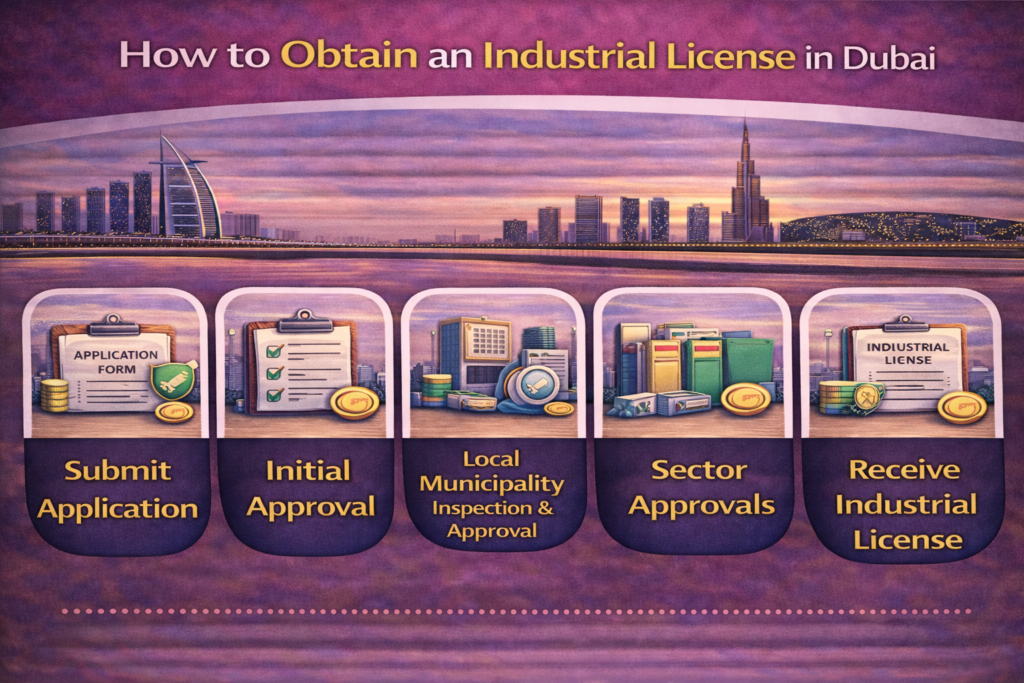
The process of obtaining an industrial license involves multiple steps and approvals. With professional guidance each stage can be completed efficiently.
Step 1: Select the Right Business Activity
The first step is to identify the exact industrial activity your company will undertake. Authorities require precise classification, as approvals and regulations vary based on activity type.
Step 2: Choose the Legal Structure
Select the appropriate legal structure, such as:
- Limited Liability Company (LLC)
- Branch of a foreign company
- Free zone industrial entity
We advise on the most suitable structure based on ownership goals and operational needs.
Step 3: Choose a Trade Name
Your trade name must comply with UAE naming conventions and reflect your industrial activity. It must be approved and reserved through the relevant authority.
Step 4: Obtain Initial Approval from DED
Initial approval confirms that authorities have no objection to your proposed business activity. This approval is mandatory before proceeding further.
Step 5: Apply for an Industrial License
Once initial approval is secured, the formal application for the industrial license is submitted along with all required documents and technical details.
Step 6: Rent a Warehouse and Office Space
Industrial businesses must lease suitable warehouse or factory space that meets safety, zoning, and operational requirements. The tenancy contract must be registered through Ejari.
Step 7: Obtain External Approvals
Depending on the activity, approvals may be required from:
- Dubai Municipality
- Civil Defense
- Ministry of Climate Change and Environment
- Specialized regulatory bodies
We coordinate with these authorities to streamline the approval process.
Step 8: Receive Your Industrial License
After all approvals are completed and fees are paid, the industrial license is issued, allowing you to commence operations legally.
Step 9: Register with MoIAT: The final step to claim your customs and tax exemptions.
Step 10: Apply for Employee and Investor Visas
With a valid license, the company can apply for investor visas, employee visas, and labor cards as per operational requirements.
Step 11: Open a Corporate Bank Account
The final step is opening a corporate bank account in the UAE to manage business transactions, payroll, and supplier payments.
Responsibilities of an Industrial Licence Holder in Dubai
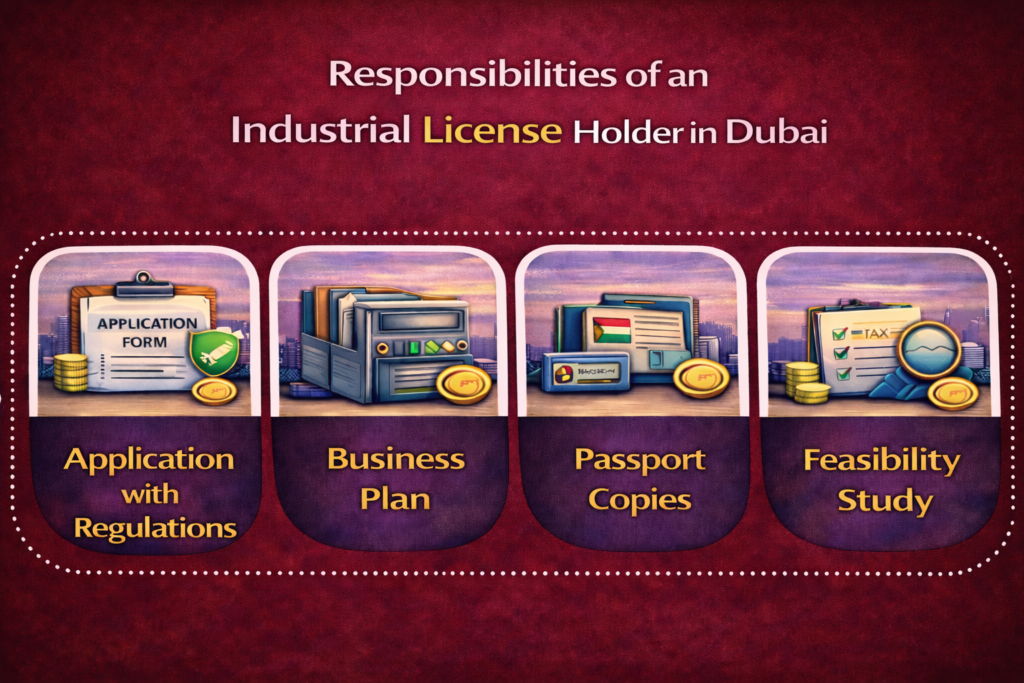
An industrial licence holder in Dubai must comply with all regulations set by economic authorities and industrial zones. Key responsibilities include operating only approved manufacturing or industrial activities, maintaining proper factory premises, and following health, safety, and environmental standards. The licence holder must ensure the timely renewal of the industrial licence and related permits. You must maintain accurate financial records and allow inspections by relevant authorities. Compliance with labour laws, workers’ safety regulations, and product quality standards is also mandatory.
Privileges of Holding an Industrial License in Dubai
Holding an industrial license in Dubai offers several strategic advantages. It allows businesses to legally conduct manufacturing, processing, and industrial activities within the UAE. License holders can benefit from access to industrial zones, advanced infrastructure, and logistics facilities. They may also enjoy customs duty exemptions on imported machinery and raw materials, depending on approvals. An industrial license enables companies to expand locally and internationally while gaining credibility and support from government initiatives promoting industrial growth.
Industrial Trade License Dubai vs Industrial License
Many investors ask about the difference between an industrial trade license Dubai and a standard industrial license. While both involve industrial activities, a trade license focuses on buying and selling manufactured goods, whereas an industrial license is required for actual production or manufacturing processes. Choosing the correct license is critical to compliance and long-term success.
Industrial License Dubai Requirements Explained
Understanding the industrial license Dubai requirements helps businesses plan effectively. These requirements typically include minimum space, machinery specifications, workforce planning, and environmental compliance. TAP Fiscal ensures that every requirement is met before submission, minimizing risks and delays.
Industrial License Renewal Dubai

An industrial license is valid for one year and must be renewed annually. Industrial license renewal in Dubai involves:
- Updating lease agreements
- Renewing external approvals if required
- Paying renewal fees
- Ensuring compliance with regulations
We offer renewal management services to ensure uninterrupted business operations.
Cost of Obtaining the Industrial License
The industrial license in Dubai generally ranges from AED 25,000 to AED 50,000. However, through recent fee reductions, many administrative costs for quality marks and standards are now significantly lower or even free. TAP Fiscal provides transparent cost breakdowns to ensure you don’t overpay.
Total setup costs will vary based on:
- Size and location of the factory.
- Power consumption requirements.
- Staffing: Instead of a mandatory AED 3,000 bank guarantee per worker, companies can now opt for low-cost Workplace Insurance (Taa-meen).
Why Choose TAP Fiscal for Your Industrial License?
TAP Fiscal is your trusted partner for industrial setup. We go beyond just the license; we help you navigate the federal MoIAT registration, Corporate Tax enrollment, and the ICV certification process to ensure your business is profitable and compliant from day one. We specialize in turning the UAE’s industrial strategy into your business success. Our expertise ensures:
- Loan Readiness: We prepare the “Bank-Ready” financials required for EDB funding.
- Customs Optimization: We manage your HS Code registrations for 0% duty on imports.
- ICV Score Boosting: We help you structure your spending to get the highest score possible for government contracts.
- 2025 Compliance: From Corporate Tax registration to environmental standards, we keep your business safe.
Whether you are a startup manufacturer or an expanding industrial group, we simplify the entire journey.
Industrial License Dubai: Key Considerations for Investors
Before applying for an industrial license in Dubai, investors should consider long-term scalability, operational costs, workforce requirements, and regulatory compliance. Strategic planning at the outset can save time and money while ensuring sustainable growth.
Common Challenges and How TAP Fiscal Solves Them
Some common challenges include approval delays, unclear documentation requirements, and compliance issues. We address these challenges by:
- Conducting pre-application assessments
- Coordinating directly with authorities
- Providing compliance checklists
- Offering ongoing advisory support
Get Your Industrial License in Dubai with TAP Fiscal Expertise!
Setting up an industrial business requires careful planning, regulatory knowledge, and professional execution. We stand as your reliable partner, ensuring a smooth and compliant setup process from start to finish. If you are ready to secure your industrial license in Dubai and establish a strong manufacturing presence in the UAE, we are here to guide you every step of the way.
Let TAP Fiscal turn your industrial vision into a successful reality.
Frequently Asked Questions
What is an industrial license in Dubai?
An industrial license in Dubai is a legal permit that allows businesses to carry out manufacturing, production, processing, or assembly activities. It is mandatory for companies that convert raw materials into finished or semi-finished products within Dubai or the UAE.
Who issues the industrial license in Dubai?
The license is primarily issued by the Department of Economy and Tourism (DET) for mainland businesses or the respective Free Zone Authority. Additionally, all industrial setups must register with the Ministry of Industry and Advanced Technology (MoIAT) to be recognized on the National Industrial Register.
What types of businesses need an industrial license?
Businesses involved in manufacturing, assembling, processing, packaging, or industrial production require an industrial license. This includes factories, food production units, textile manufacturers, metal fabrication companies, chemical processing plants, and other industrial operations.
What are the main requirements to obtain an industrial license in Dubai?
Key requirements include selecting an approved industrial activity, leasing a suitable factory or warehouse, obtaining external approvals, submitting a business plan, meeting environmental and safety standards, and securing initial approval from the Department of Economy and Tourism.
How long does it take to get an industrial license in Dubai?
The timeline typically ranges from four to eight weeks, depending on the business activity, required external approvals, and document readiness. With professional support from TAP Fiscal, the process can be completed more efficiently.
What is the cost of obtaining an industrial license in Dubai?
The industrial license in Dubai generally costs from AED 25,000 to AED 50,000 or more. The final cost depends on the activity type, approvals, facility size, and government fees involved.
Do I need a physical factory or warehouse for an industrial license?
Yes, a physical factory or warehouse is mandatory to obtain an industrial license. The facility must comply with zoning, safety, and operational requirements and be registered with Ejari as part of the licensing process.
Can I get an industrial license in a free zone?
Yes. Free zones like JAFZA or Dubai Industrial City offer excellent infrastructure. While free zones allow 100% ownership and easy customs, mainland licenses are often preferred if you plan to sell your products directly into the local UAE market without a distributor. TAP Fiscal helps determine whether a mainland or a free zone setup is more suitable.
What are the benefits of having an industrial license in Dubai?
An industrial license provides legal authorization to manufacture in Dubai, access to global markets, government incentives, advanced infrastructure, and business credibility. It also enables visa issuance and long-term growth opportunities within the UAE.
Can a foreigner own 100% of a factory on the mainland?
Yes. Since the 2021 reforms, 100% foreign ownership is now the standard for the majority of industrial activities in the UAE.
What is the minimum investment for an industrial license?
To qualify for a MoIAT Industrial Production License, businesses typically need a minimum capital of AED 250,000, at least 10 employees, and a physical facility in a zoned industrial area.
How do I get Customs Duty Exemptions?
If you have a valid MoIAT Industrial Registry, you can apply for an exemption from the 5% customs duty on imported machinery and raw materials. This is one of the biggest cost-saving benefits of an industrial license
Is there a “Golden Visa” for factory owners?
Yes! If your facility adopts “Industry 4.0” (advanced technology/robotics), investors, top engineers, and executives may be eligible for a 10-year Golden Visa.
How can I get a startup loan from the Emirates Development Bank (EDB)?
EDB offers “Greenfield” financing for new factories. You will need a solid 3–5 year business plan and a feasibility study. TAP Fiscal specializes in preparing “Bank-Ready” documentation for these applications.
Do industrial companies pay Corporate Tax?
Mainland industrial companies pay 9% Corporate Tax on profits exceeding AED 375,000. However, many free-zone manufacturers can still qualify for a 0% rate if they meet “Qualifying Income” criteria.
Do I need a physical factory or warehouse?
Yes. A physical, inspected facility is a non-negotiable requirement. Virtual offices or “flexi-desks” are not permitted for industrial activities. The lease must be registered via Ejari.
What is the “In-Country Value” (ICV) Certificate?
It is a certificate that measures your company’s contribution to the UAE economy. A high ICV score is essential if you want to win government tenders or work with major semi-government entities.