
Dubai has emerged as one of the favourite destinations for global investors and entrepreneurs. Top reasons include the ease of setup, tax benefits, and unmatched infrastructure. However, as we move through 2026, choosing the right business activities in Dubai is no longer just about operational scope; it is now a tax and digital compliance decision. A business activity refers to the services you can provide or products you can export, import, and manufacture. Depending on the chosen activity, it is also critical to determine the required government approvals.
New investors often face delays due to factors like:
- Broad Activity Selection
- Wrong category selection
- Confusion between free zone and mainland rules
Business activities in Dubai are directly influenced by factors like license type, cost, office requirements, expansion plan, and visa needs. In this guide, we will talk in detail about the official business activity framework, how authorities regulate activities, and other aspects
Business Activity List in Dubai
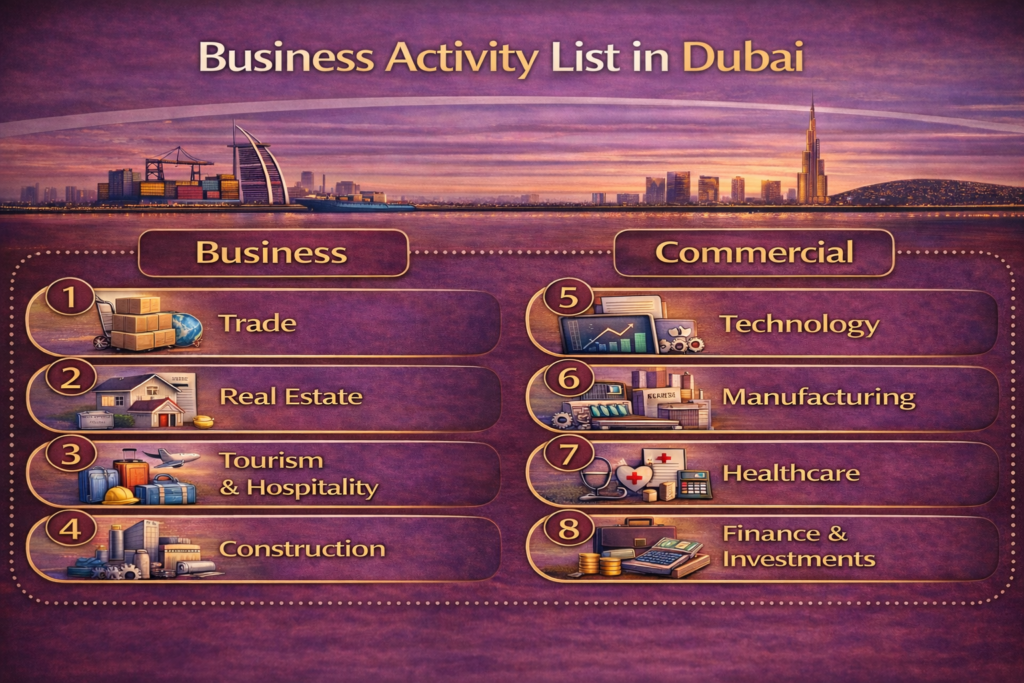
There is a list of business activities in Dubai that the government defines. A specific code and scope of work mark activities. Investors must also check the documents required for business activities in Dubai to understand aspects related to industry regulation and compliance with UAE laws.
Activities are mapped to Mainland licenses (DED) or Free zone licenses. Selecting the wrong one can mean further complex amendments, additional compliance costs, or even license rejection.
What Is a Business Activity in Dubai?
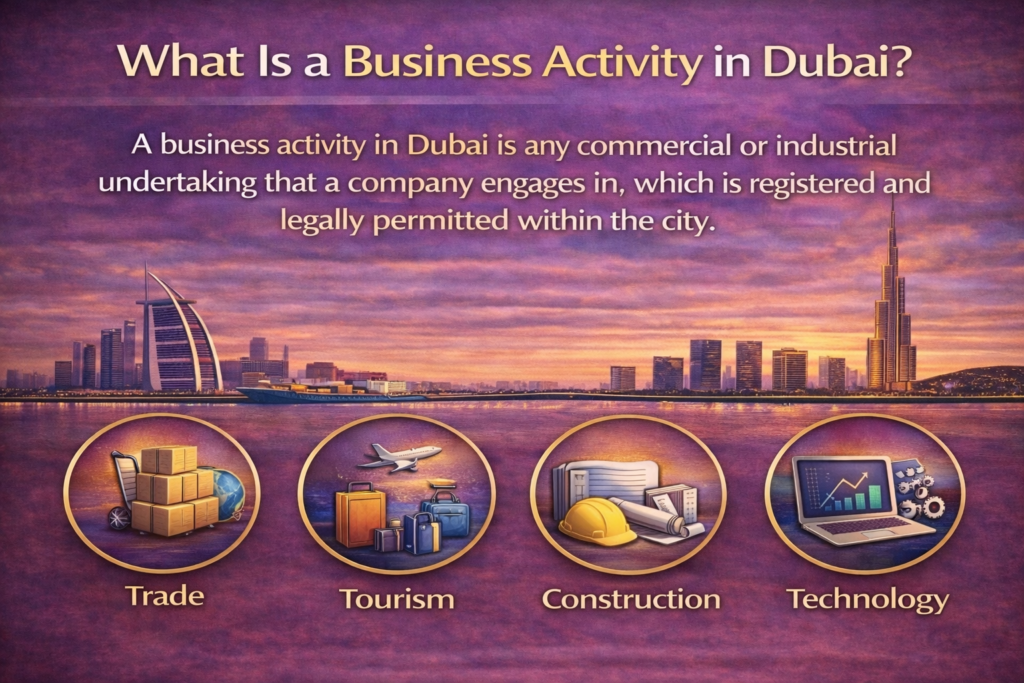
A business activity refers to the classification of operations as per law, which further outlines what a company can do and what it cannot. Business activities in Dubai should be clear about:
- The actual work that will generate revenue
- Services offered to customers/clients
Entrepreneurs and investors often miss out on smaller details about the list of business activities in Dubai. This leads to confusion and operational hurdles. A simple example of that would be selecting general trading where the company is a service-based one. Authorities rely on the list for many things, including monitoring compliance, assigning regulatory approvals, and controlling risks unique to each sector.
There are also a few mistakes that investors usually make when selecting between activities. The first one is selecting the activity based on the company name alone. Many entrepreneurs choose broad activities instead of the actual one that generates revenue. Another mistake is copying activities from another company without considering other aspects. Investors also confuse business activities in Dubai and free zones.
Investors should also consider banking norms when reviewing approved activity lists. All banks will check approved activities in Dubai under the license before opening a corporate account. The activities in the license must match income payments, client invoices, and contracts.
Any mismatch between the licensed activities and transactions has consequences. There can be a delay in account approval and account restrictions. In other words, activity selection is critical for the license and smooth banking.
Difference Between Business Activity and Business License
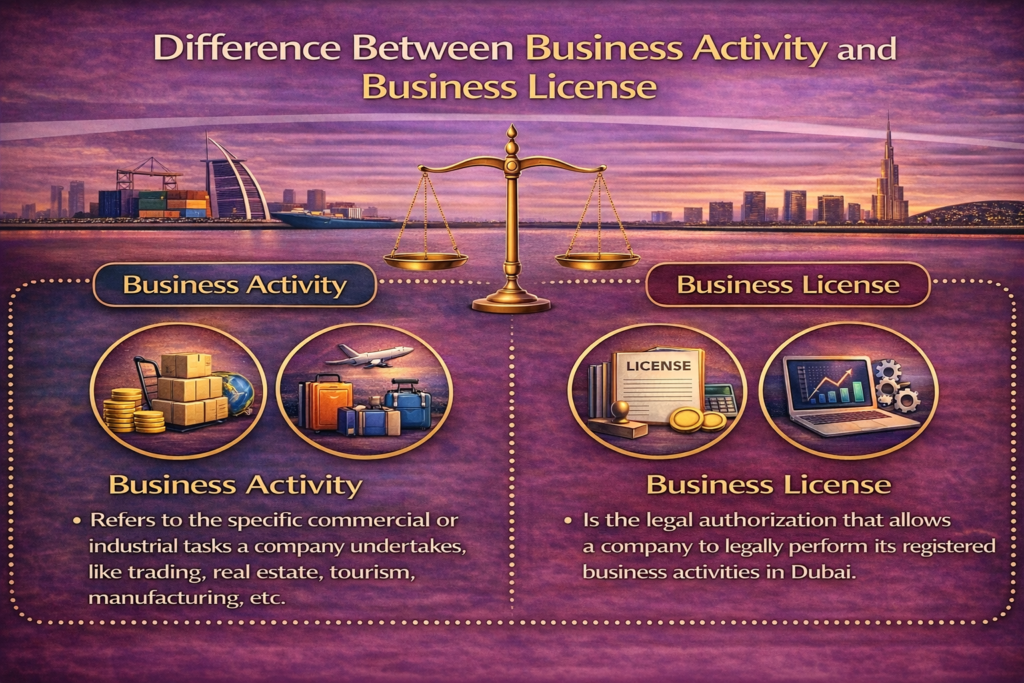
A business activity refers to the specific operations that investors have to select from the official list. There can be one or many, but the choice is subject to compliance requirements and external approvals. A business license, on the other hand, offers the legal permission to a company to operate, and it is only issued after the activity is approved. Categories include:
- Commercial
- Professional
- Industrial
- Tourism
Note that one license can include multiple business activities in Dubai, but it is critical that activities align with the license category. Mismatch can mean further delays in setup, an increase in costs, and even rejection.
Investors must keep in mind that business activities are reviewed again during the license renewal time. Authorities will check if the entity is operating within the scope of approved activities. Any change between licensed activities and actual operations can delay the renewal process. Investors may have to request amendments and adhere to compliance needs. Companies related to regulated activities will also need to renew external approvals. Additional requirements may include submitting updated professional credentials.
Who Regulates Business Activities in Dubai?

The Dubai Department of Economy & Tourism (DET / DED) is responsible for regulating all mainland business activities. The department maintains the Dubai DED business activity list and is the authority for issuing trade licenses. DED is also the authority for approving additions and amendments, if any.
There are 40+ free zones in the UAE, and each one is governed by its respective authorities. The activities are limited to the focus of the concerned free zone. For instance, DMCC is for trading & commodities, while IFZA is for professional services and DSO for technology-based activities.
Some business activities in Dubai also needs special approvals. Businesses in the healthcare sector need DHA approval, while KHDA approval is a must for companies in the education sector. Approval from the Central Bank is mandatory for financial services. Timelines for approval depend on the paperwork and activity type.
Approval timelines may vary and depend on several factors, including the number of approvals, activity type, and how thoroughly the documentation has been done. Approvals are usually fast for professional activities. Getting a license for regulated activities takes longer, as external authorities are involved. Also, the paperwork verification may take time.
Businesses in certain fields, especially healthcare, finance, and education, may also need to comply with site inspections and the checking of professional credentials.
Having a clear idea of the timeline will help plan the setup schedule, visa process, and other steps, such as leasing offices.
Complete List of Business Activities in Dubai, UAE
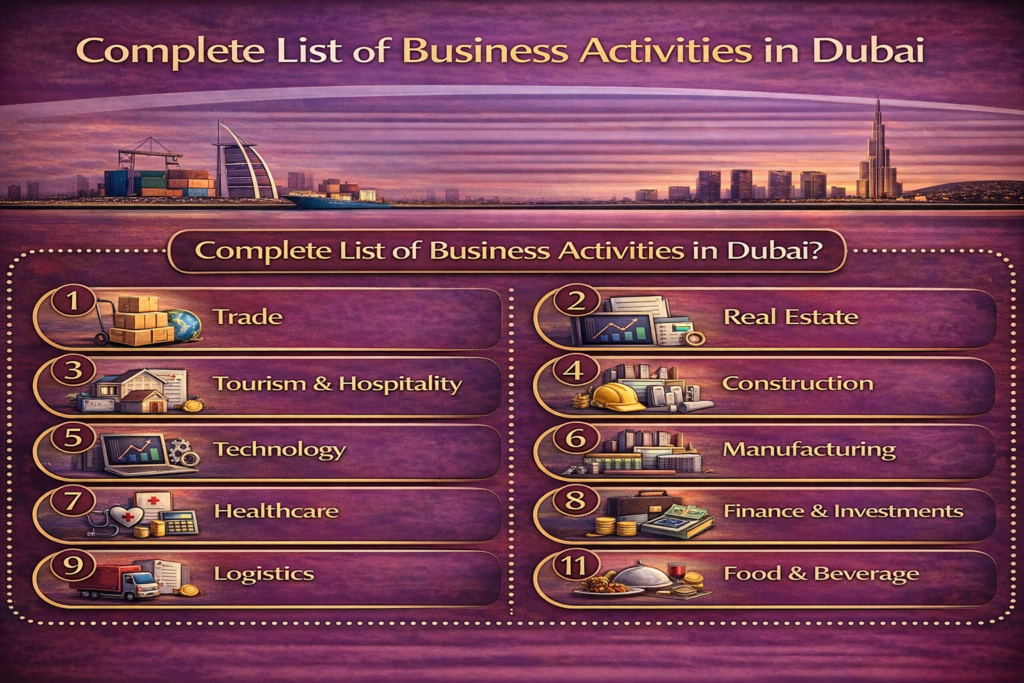
Here is a breakdown of activities according to sector:
Commercial Activities
- General trading
- Import and export
- E-commerce trading
- Real estate brokerage
- Wholesale trading
- Retail trading
- Logistics and freight
Professional Activities
- Management consultancy
- Business consultancy
- Accounting and bookkeeping
- HR consultancy
- IT and software services
- Marketing and advertising services
Industrial Activities
- Manufacturing units
- Assembly and fabrication
- Industrial production facilities
- Packaging operations
- Food processing
Tourism & Hospitality Activities
- Travel agencies
- Tour operators
- Tourism consultancy
- Event management
- Holiday home rental management
Technology & Digital Activities
- Software development
- App development
- Media production
- IT infrastructure services
- Digital marketing services
Education & Training
- Professional skill development
- Corporate training services
- Training institutes
Restricted & Regulated Activities
- Healthcare services
- Medical trading
- Financial advisory
- Legal consultancy
Beyond the standard commercial and professional activities, 2026 has seen a surge in specialized sectors driven by the Dubai Economic Agenda (D33):
Virtual Asset Activities (VARA Regulated):
-
- Virtual Asset Broker-Dealer
- VA Management and Investment Services
- VA Lending and Borrowing
- Note: Requires a VARA license before DET/Free Zone issuance.
Green & Sustainable Activities:
-
- Green Manufacturing
- Circular Economy Consultancy
- Sustainable Packaging Operations
Technology & Advanced AI:
-
- AI Model Training & Deployment
- Blockchain Infrastructure Services
- Metaverse Content Production
So, what do recent trends say about in-demand activities in Dubai? IT and software services are booming, and so are online services, including digital marketing. E-commerce support services, business consultants, and management experts are also in demand.
As the digital economy expands, remote work models are getting popular in Dubai. Another pertinent factor that has influenced foreign investment is the growth of international trade.
All these business activities in demand don’t need extensive capital requirements and get faster approvals. Many segments don’t require physical offices, which is attractive to foreign investors and startups.
How to Choose the Right Business Activity in Dubai?

- First, any investor should start by defining what activity or service will generate revenue. In other words, activities shouldn’t be “just in case”. The activity has to match the business model and the expected client contracts.
- Next, check the license requirement for Dubai business activity. Ask two basic questions. Is the activity allowed in the free zone and on the mainland? Are external approvals required?
- The third aspect to consider is scalability. It is critical for investors to compare business activities in Dubai based on how they see the future of the company. If there is scope to open additional branches in the future, the initial setup process should include that aspect.
Investors should consider aspects other than legal requirements before initiating the setup. The first aspect is the overall demand for the service/product, which determines growth opportunities. The next thing to consider is capital investment needs.
As we discussed earlier, entities in the field of digital marketing and online services don’t require as much investment. Tax optimization has also become an important factor when choosing a business activity and structure. With the introduction of corporate tax, investors must ensure that the selected activity aligns with the qualifying criteria, especially when setting up in a free zone.
Free zone companies can benefit from a 0% corporate tax rate only if the business activity qualifies and the structure is set up correctly. Selecting the wrong activity or free zone can result in unnecessary tax exposure and future restructuring costs.
Visa eligibility linked to activity is another critical factor, and some sectors have office space or warehouse requirements. Understanding options requires thinking beyond usual aspects. What works for a solo entrepreneur may not be suitable for a company planning regional or global expansion.
Tap Fiscal Guide supports investors at this stage by reviewing business activities, managing external approvals, optimizing tax exposure, and helping select the right company structure and free zone based on long-term business goals. This ensures the setup is compliant, scalable, and aligned with UAE regulations from the beginning.
Can You Add Multiple Business Activities Under One License?
Yes, it is possible to add multiple activities under one license in Dubai, but there are certain conditions. Firstly, the chosen activities must be related to one another.
Secondly, the license category has to be the same for all activities. There are some acceptable combinations. For instance, if a company offers consultancy services in Dubai and also wants to include advisory services, those two can be included in one license. Another example would be having IT services and software development together.
There are also a few unacceptable combinations of business activities in Dubai. Like trading cannot be combined with medical practice. Having additional activities may increase the license cost and complicate the compliance process for some entities.
Some free zones have costs that are added for each activity. Adding more activities may also increase compliance checks, besides requiring new approvals.
Adding too many activities can also complicate license renewal, besides the concern of delay in getting approvals. The planning process needs to be simple and strategic to avoid unnecessary costs.
How Many Activities Can You Add Under One License?
There is no legal limit to the number of business activities in Dubai that one can add to a license. However, there are practical aspects that can create limitations. These limits depend on factors like the activity type, jurisdiction, and the need for external approvals. In general, mainland licenses have more flexibility. Free zones, on the contrary, often have caps on activities. As we mentioned, added activities influence cost and approval timeline.
What Affects After Changing Business Activities in Dubai?
Changing business activities in Dubai requires amending the license. The investor/entrepreneur may have to pay a revised license fee and must further apply for updated approvals, as required. This can also impact the visa quota. Please note that some activities cannot be added later, which is why early planning is critical to ensure smooth operations and reduce amendment costs.
Requirements & Documents for Business Activities in Dubai
Let’s divide this into segments:
Basic Requirements
- Reservation of trade name.
- Selection of activity
- Initial approval
Documents required for business activities in Dubai will vary. Investors must submit passport copies, visa/entry stamps, and educational certificates (in some cases). Other documentation includes experience letters and external authority approvals.
Note that selecting business activities in Dubai also has a role in visa eligibility and planning workforce requirements. Depending on the approved activity, there may be restrictions on how many visas a company can get and which office is required. Office requirements are flexible for professional and service-based activities, but such companies also have limited visas.
Companies in the trading, logistics, and industrial sectors are required to have offices/warehouses/facilities, which can affect visa allocation. Visas and related documentation are also linked to professional roles.
In other words, besides licensing and compliance, staff planning should be considered during the setup and documentation process.
Which Business Activities Are Restricted or Require Special Approvals?

In Dubai, certain high-demand sectors are considered regulated activities, meaning they require a No Objection Certificate (NOC) or special approval from specific government authorities. Some of the key regulated sectors include:
- DHA (Healthcare)
Clinics, medical centers, and medical trading companies must comply with strict facility standards and professional staff licensing requirements. - Central Bank / DFSA (Financial Services)
Mandatory approvals are required for activities such as currency exchange, insurance services, investment advisory, and other financial services. - VARA (Virtual Assets Regulatory Authority)
Companies dealing with cryptocurrencies, NFTs, or other virtual assets must obtain a specialized license issued by VARA. - Dubai Customs
Import and export businesses must register for a customs code before conducting any trading activities. - Dubai Municipality
Required for businesses such as laundry services, food trading, restaurants, and other activities related to public health and safety. - FIRS or ZAD Portal (Food Import/Export)
Food-related businesses must register every individual product on the FIRS or ZAD portal before importing or exporting.
Each authority has its own compliance framework, documentation standards, and approval timelines. Failure to obtain the correct approvals can result in license rejection or operational delays.
Navigating the New 2026 Regulatory Landscape

Setting up a business in Dubai in 2026 requires close attention to two major regulatory updates:
1. Corporate Tax (September 2026 Deadline)
The UAE has introduced a 9% Corporate Tax on taxable profits exceeding AED 375,000.
- Why it matters for your business activity:
Free Zone companies are eligible for a 0% tax rate only if their business activity falls under the “Qualifying Activities” list. Selecting an incorrect activity code can result in your profits being taxed at 9%. - Tax filing deadline:
For most companies, the first corporate tax return must be filed by September 30, 2026.
This makes correct activity selection critical—not just for licensing, but also for long-term tax efficiency.
2. Mandatory E-Invoicing (Launching July 2026)
From July 1, 2026, the UAE will roll out its Electronic Invoicing System (EIS).
- The requirement:
Businesses must use an Accredited Service Provider (ASP) to issue invoices that are transmitted to the tax authorities in real time. - Activity-code linkage:
Invoice data must exactly match the approved business activity codes registered under the license and within the digital tax portal.
Any mismatch may result in penalties of up to AED 5,000 per month.
This reinforces the importance of choosing accurate and well-defined business activities from the outset, as licensing, taxation, and digital compliance are now closely interconnected.
Choose Tap Fiscal as Your Partner
Before considering business activities in Dubai, the first step is to understand how the ecosystem works in the mainland. Mistakes can be expensive, leading to additional costs, delays, and even license suspension. With Tap Fiscal, you have the best experts who can guide you on shortlisting activities based on investment interests, coupled with assistance for mapping approvals. The team at TAP Fiscal can also help with license structuring, especially for entrepreneurs who need more guidance or have never operated out of Dubai. Expert support only means a smoother setup, which will further ensure you can start operations at the earliest.
Learn more about business activities in Dubai with TAP Fiscal today!
Frequently Asked Questions (FAQs)
What are business activities in Dubai?
A business activity clearly defines the scope of the company, i.e., what it can do and what it cannot. This is the first decision for setting up a company in Dubai.
How are business activities classified in Dubai?
There are four major classifications of business activities in Dubai, namely commercial, professional, industrial, and tourism. Each one includes a set of activities that are related to an extent to the concerned sector.
Why is it important to choose the right business activity?
Choosing the right business activity matters, as the decision can impact many aspects, including license approval and cost. Any mistake during the initial phase can impact operations and scalability.
Can a company have multiple business activities in Dubai?
Yes, a company can engage in multiple business activities in Dubai, but only when these activities are compatible and in sync with the approved list.
How do I select the correct business activity for my company?
The best way to start is to work with Tap Fiscal consultants who can guide on how to match activity with the real business operations. Unless there is clarity on what a company would do, licensing and other requirements can be confusing. Investors should also consider scalability, long-term goals, and the nature of operations before deciding on the activity.
Are there restrictions on certain business activities in Dubai?
Yes, special approvals are required for certain activities, while business activities in Dubai cannot be freely licensed. For instance, approval from the Dubai Health Authority (DHA) is mandatory for setting up a healthcare service, while the UAE Central Bank must give approval before a financial company can start operating. Selected activities like legal consultancy, auditing, and engineering may require relevant degrees, certification, and experience letters. Also, some activities are limited to specific free zones, while others may be permitted only under mainland licenses.
How does the business activity affect my license fee?
Adding more activities under one license may increase the overall costs. Also, there could be an impact on the review process and approval time, although a lot depends on the sector and selected free zone.
Can I change my business activity after company registration?
Yes, a license amendment is possible. However, changing the activity can mean dealing with a complex set of requirements and approvals. That’s the reason why consultants at Tap Fiscal recommend focusing on goals when comparing business activities in Dubai.
Where can I find the official list of business activities in Dubai?
You can find the list on the Dubai DED website. Free zones, on the other hand, have complete official lists on respective authority sites.
Do free zone companies have different rules for business activities?
Yes, all free zones operate independently and have different authorities. Selected business activities are permitted in each free zone, and the lists can vary.