
Introduction
Corporate tax has changed the business landscape for companies doing business in the Emirates. The introduction of federal corporate taxation has shifted how businesses approach their financial responsibility. As such, UAE corporate tax filing services have become integral to helping businesses comply and remain operational.
Every company in the UAE must calculate its tax liability and ensure proper procedures for filing corporate tax returns. No matter the size of your company, if you’re doing business in the UAE, you need to file taxes—even if taxable income falls within the zero-rate band up to AED 375,000.
The corporate tax filing process isn’t without its challenges. Whether it’s poor document management, financial discrepancies, or misinterpretation of tax codes, many pitfalls can lead to fines, penalties, or government notices—such as AED 1,000 per month for late filing initially, or AED 20,000+ for non-registration. Missing or incomplete information can even cause more delays. With shifting guidelines and increased compliance infrastructure, filing your corporate taxes in the UAE is an all-year-round activity.
What is Corporate Tax Filing in the UAE?

The UAE corporate tax filing procedure refers to filing a business’s annual income tax return. This return summarizes your business’s profit or loss over the course of a financial year and establishes whether or not you need to pay corporate tax in the UAE, with 0% on taxable income up to AED 375,000 and 9% above that threshold. UAE corporate tax filing services guide businesses through the filing procedure.
Corporate tax return services include preparing financial statements, calculating taxable income, determining corporate tax liability, and making any adjustments according to corporate tax rules in the UAE.
It’s important to be accurate and thorough. Mistakes or discrepancies from one financial period can lead to complications in future tax filings and possible audits.
Is it Mandatory to File Corporate Tax Returns in the UAE?

Is corporate tax registration mandatory in the UAE?’ It is the most frequently asked question by corporate entities doing business in the UAE. All taxable persons are required to file a corporate tax return in the UAE, even if no corporate tax is due for that financial year (e.g., under small business relief for revenue ≤ AED 3M until end-2026) . This is where most business owners get confused: although corporate tax registration and corporate tax return filing are two separate processes, they are interrelated compliance requirements.
Non-filing of the corporate income tax return for a financial year (whether tax is due or not) will lead to non-compliance penalties. If you fail to file tax returns repeatedly, then your business compliance status is likely to suffer as well. You are still required to file annual returns even if you do not do any business or have earned very little.
Completing your business registration doesn’t exempt you from having to comply with your corporate tax filing obligations. It’s vital to continue to file your return on time and correctly.
When it comes to running a successful business, being aware of your tax filing UAE requirements and ongoing obligations—including 2025/2026 changes like the Domestic Minimum Top-up Tax (15% for large MNEs with €750M+ global revenue)— help you stay on top of things and avoid unwanted pitfalls.
Who is Required to File Corporate Tax in the UAE?

Corporate taxes are levied on various entities, such as mainland companies, free zone companies(as Qualifying Free Zone Persons eligible for 0% on qualifying income if meeting substance, TP, and audited accounts tests; 9% on non-qualifying), branch offices, partnerships, and joint ventures operating in the UAE. UAE Corporate tax filing services cater to businesses of all sizes and across different ownership structures operating in the UAE.
In the UAE, filing corporate tax returns is based on the nature of your business and revenue. It does not matter whether you are operating a small business or have just incorporated your company; you may be required to file a corporate tax return if your business meets the criteria set out in the UAE corporate tax law. Every entity is responsible for determining its own tax filing requirements according to the UAE corporate tax law.
Step-by-Step Corporate Tax Filing Procedure
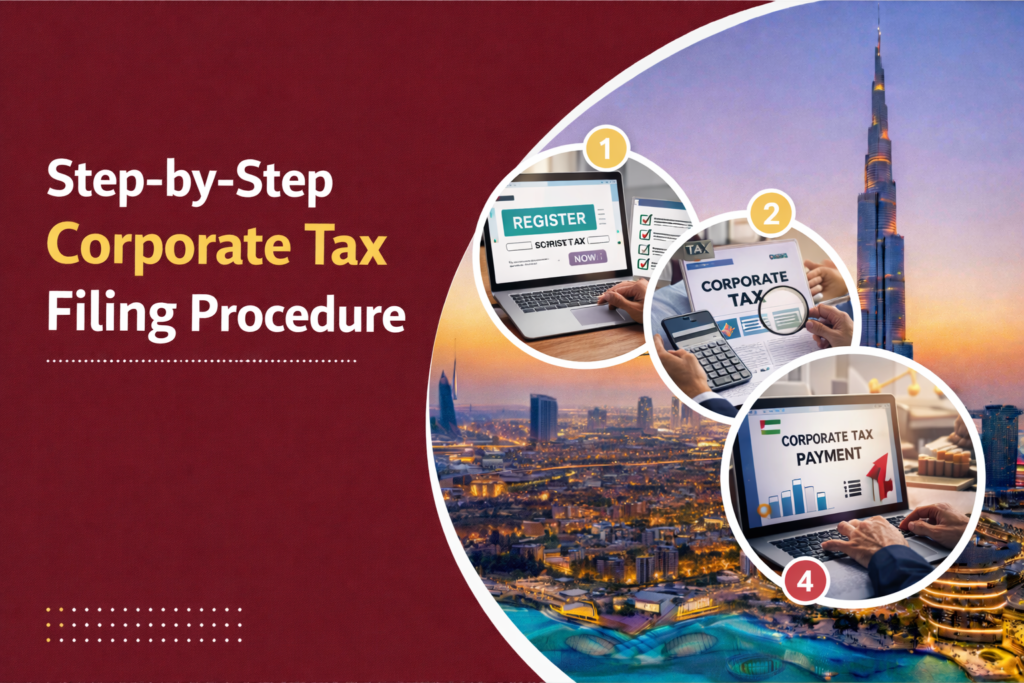
Corporate tax in the UAE must be filed by companies through a systematic process within prescribed timelines. The income tax filing procedure is carried out in steps to maintain consistency and avoid discrepancies.
Step 1: Corporate Tax Registration
Each tax-paying entity must register for corporate tax with the Federal Tax Authority via the online portal. It is mandatory for even those businesses that have zero payable corporate tax for that particular financial year. It’s the right time for you to know about UAE corporate tax registration so that you are 100% compliant.
Step 2: Maintain Accurate Financial Records
Businesses are mandated to maintain a complete and accurate record of all financial transactions for the entire financial year. They should show real financial transactions and substantiate the tax return filed.
Key records typically include the following:
- Sales/purchase invoices
- Bank statements
- General ledger and trial balance
Keeping accurate records enhances transparency. There are fewer chances of discrepancies arising when assessing.
Step 3: Preparation of the Financial Statements
After the financial records are closed, the statements can be prepared in accordance with accounting standards. These provide a good insight into the business’s financial situation and operations.
Documents required for corporate tax filing in the UAE include:
- Profit and Loss Statement
- Balance Sheet
- Supporting notes and schedules
These documents serve as a basis for computing taxable income and verifying the reported amount.
Step 4: Calculation of Taxable Income
It is possible to determine taxable income by adjusting the accounting profit in accordance with the prevailing UAE tax legislation. These adjustments reflect the applicable tax bands of 0% on taxable income up to AED 375,000 and 9% on income exceeding this threshold, along with available exemptions and reliefs, such as the small business relief (applicable to qualifying entities with revenue ≤ AED 3M in each tax period ending on or before 31 December 2026).
In addition, other exemptions or reliefs should be considered, as well as the 2026 transfer pricing rules for related-party transactions exceeding AED 200,000. Companies should also take into account the applicable corporate tax rate in the UAE.
Understanding the distinction between taxable and non-taxable items is essential to avoid understating or overstating income, ensuring accurate and compliant tax returns.
Step 5: Filing the Corporate Tax Return
After calculating taxes, the corporate tax return is prepared and then filed on the government tax portal.
Steps involved in filing are:
- Entering the corporate tax number
- Upload financial statements
- Review all information and file return.
The corporate tax return should be filed on or before the due date, complying with the UAE regulations.
Payment of Corporate Tax, if Applicable
Corporate tax liability should be paid on or before the date given by the tax authority. Taxes must be paid through authorised bank accounts connected to the tax portal. Paying your taxes on time will allow you to stay in good standing.
Key UAE Corporate Tax Penalties
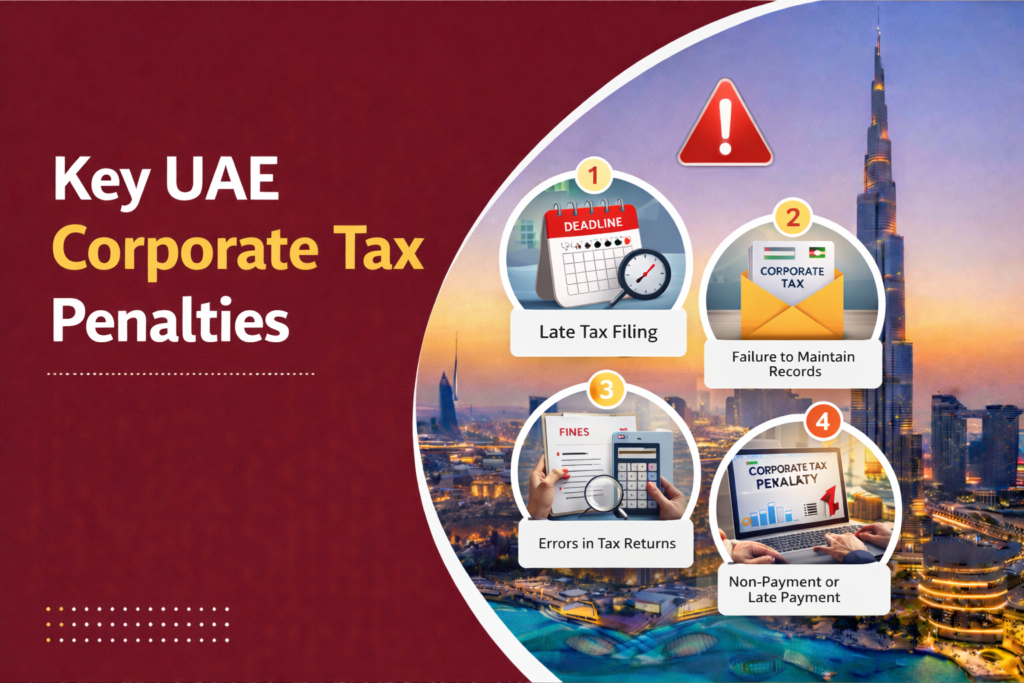
Non-compliance with the UAE corporate tax law can lead to administrative penalties that accumulate quickly and affect your business’s compliance status with the FTA.
Common penalties include:
- Late corporate tax registration: AED 10,000 lump sum per violation.
- Late filing of tax returns: AED 500 per month (or part thereof) for the first 12 months after the deadline, increasing to AED 1,000 per month from month 13 onward.
- Late submission of required declarations: AED 500 per month for the first 12 months, and AED 1,000 per month thereafter.
- Delay in providing FTA-requested information: AED 1,000 per day of delay.
- Incorrect or incomplete returns: Additional fixed penalties (e.g., 15% on tax difference) plus monthly interest where reasonable care was not taken.
Even dormant businesses must file, or they risk these penalties regardless of taxable income. Professional UAE corporate tax filing services, such as TAP Fiscal, help avoid them through timely processes and accurate documentation.
Even dormant businesses must file, or they risk these penalties regardless of taxable income. Professional UAE corporate tax filing services, such as TAP Fiscal, help avoid them through timely processes and accurate documentation.
How TAP Fiscal Tax Assists with Corporate Tax Filing in the UAE
Corporate tax filing UAE support services are based on accuracy, rigorous documentation, and well-defined process standards, not marketing hype. At TAP Fiscal, we provide structured corporate tax compliance support to help businesses meet their obligations without disrupting normal operations, including optimisation through legally available deductions and reliefs.
Our services include guidance on corporate tax registration, preparation and compilation of tax returns for client review and submission, and verification of financial information to ensure accuracy and consistency. We also assist businesses in understanding the documentation required for UAE corporate tax registration and help organise supporting records for compliance purposes.
Business owners may require additional guidance on corporate tax compliance, tax return preparation, and free-zone-specific considerations, including UAE free zone corporate tax requirements. With the right professional guidance in place, businesses can approach their corporate tax responsibilities with confidence and respond effectively to authority queries.
Learn more about the corporate tax filing process by exploring the detailed guidance on corporate tax compliance at TAP Fiscal.
Call: +971502890630
WhatsApp: +971502890630
Email: Aina.k@tapfiscal.com
Frequently Asked Questions (FAQs)
1. What are UAE corporate tax filing services?
UAE corporate tax filing services assist clients with registering, preparing, and filing corporate tax returns in accordance with UAE law. They help ensure complete and accurate reporting, timely filing, and adherence to documentation requirements.
2. Who needs corporate tax filing services in the UAE?
Taxable entities such as mainland companies, qualifying free zone persons, branches, partnerships, and joint ventures may require assistance; natural persons/freelancers are generally exempt below AED 1M revenue unless electing taxable status
3. Is corporate tax filing mandatory in the UAE?
Yes, corporate tax filing is mandatory in the UAE even when the tax payable is zero.
4. What is included in UAE corporate tax filing services?
These typically include registration support, return preparation and review, and submission.
5. Do free zone companies need corporate tax filing services?
Yes, free zone entities established as Qualifying Free Zone Persons must file returns, qualifying for 0% on income meeting substance/TP criteria or 9% on non-qualifying income.
6. What documents are required for corporate tax filing in the UAE?
Copies of financial statements or ledgers, commercial invoices, and compliance records must be present.
7. What is the deadline for corporate tax filing in the UAE?
Returns are to be submitted within 9 months of the end of a financial year.
8. How much does the UAE corporate tax filing service cost?
Costs vary depending on business size, transaction volume, and record complexity.
9. Can corporate tax filing services help reduce tax liability?
They can help determine which claims are eligible and the extent of tax relief within legal thresholds.
10. What happens if corporate tax returns are filed late?
Late submission results in monthly penalties of AED 500 (first 12 months) rising to AED 1,000 per month thereafter, even for partial months, plus risks to compliance status.
11. What are the main penalties for corporate tax non-compliance?
Key fines include AED 10,000 for late registration, AED 500–1,000 monthly for late filing/declarations, and AED 1,000 daily for delayed information responses, with repeats often doubling.
12. Is corporate tax filing different from VAT filing in the UAE?
Yes, corporate tax is charged on income, while VAT is charged on transactions.
13. Do startups and small businesses need corporate tax filing services?
Yes, particularly to understand thresholds and compliance obligations.
14. Can corporate tax filing services assist with audits or FTA queries?
Yes, UAE corporate tax filing services can assist with audits as well as respond to FTB notices/inquiries. They can assist in preparing documentation, explaining filings, and communicating accurately with the FTA.
15. What is the corporate tax rate in the UAE?
0% on taxable income up to AED 375,000; 9% above that threshold (plus 15% DMTT for large MNEs from 2025)
16. Why should I choose professional UAE corporate tax filing services?
A professional UAE corporate tax filing service helps businesses with accurate calculations, on-time payments, and staying updated with the changing laws. It helps you avoid mistakes that could lead to penalties and business interruptions.