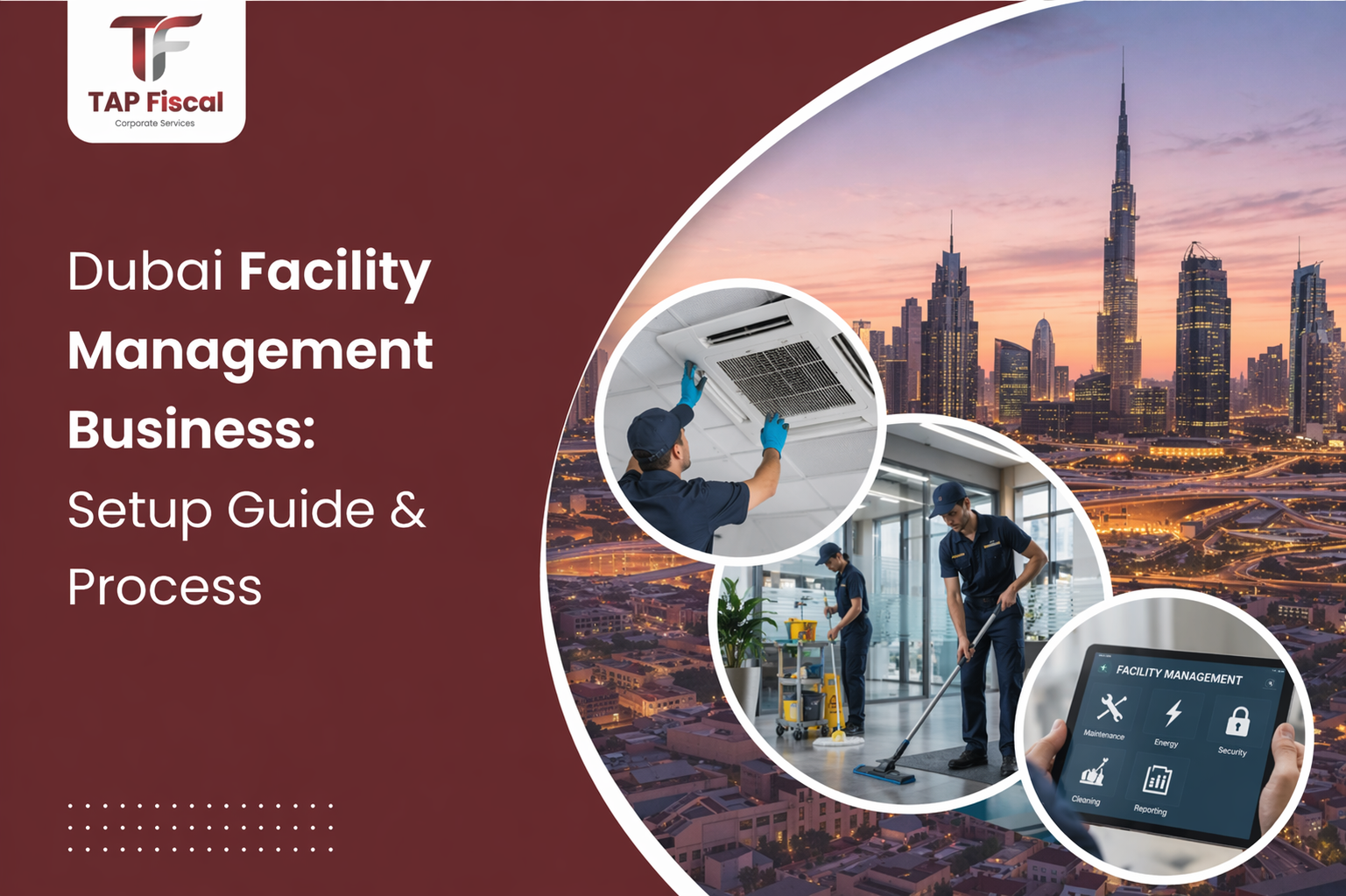
Learn how to start a Facility Management Company in Dubai — license costs from AED 18,000, RERA registration, required documents, and a step-by-step setup guide for 2026.
1. Introduction
The UAE’s fast-growing cities have reshaped the land with bold new structures. Sitting right in the middle of keeping them running is facility management. Anyone starting an FM business in Dubai now might find strong opportunities, thanks to rising demand across property and corporate spaces.
2. Why Dubai is a Prime Market for Facility Management Services
Dubai’s commitment to becoming the world’s smartest city drives a constant demand for high-end maintenance. With a constant influx of residential skyscrapers, sprawling malls, and industrial zones, the need for professional upkeep is non-negotiable. The city’s harsh climate further necessitates specialized HVAC and structural maintenance, making it a sustainable market for long-term service providers.
3. Understanding the Scope of Facility Management Services
FM services are generally divided into two categories:
- Hard FM: Physical structures, electrical systems, plumbing, and HVAC maintenance.
- Soft FM: Cleaning, security, landscaping, waste management, and pest control.
A comprehensive Dubai facility management company list typically features entities that offer an integrated approach, combining both categories to provide a “one-stop-shop” solution for property owners.
4. Types of Clients for a Facility Management Company in Dubai
Identifying the types of clients for facility management company operations is crucial for marketing. These include:
- Residential Sector: Gated communities, apartment towers, and villa compounds.
- Commercial Sector: Corporate offices, co-working spaces, and retail outlets.
- Hospitality & Tourism: Hotels, resorts, and theme parks.
- Industrial Sector: Warehouses, factories, and logistics hubs.
- Public Infrastructure: Hospitals, schools, and government buildings.
5. Smart Building Facility Management
Dubai is a leader in IoT-integrated buildings. Modern FM involves managing automated lighting, climate control, and occupancy sensors. Navigating this tech-heavy environment is what distinguishes a standard provider from the best facility management company in Dubai.
6. How to Start a Facility Management Company in Dubai
The process involves selecting a legal structure (Mainland or Free Zone) and obtaining a professional license.
Documents required for facility management company registration:
-
- Passport copies of shareholders.
- No Objection Certificate (NOC) if currently employed.
- Trade Name Reservation certificate.
- Initial Approval from the Department of Economy and Tourism (DET).
Requirements required for a facility management company setup:
-
-
- A physical office space (Ejari).
- Appointing a qualified manager.
- Approval from the Dubai Municipality for specific soft FM activities.
-
6A. Mainland vs Free Zone: Which is Right for Your FM Company?
This is one of the most important and most misunderstood decisions when starting a facility management company in Dubai. Both options offer 100% foreign ownership, but they serve very different operational needs.
| Factor | Mainland (DET License) | Free Zone License |
| Serve mainland Dubai, clients | Yes — directly | No — requires dual license or a mainland agent |
| RERA registration | Fully compatible | Restricted; most free zone FM companies cannot register |
| Government contracts | Eligible | Generally ineligible |
| Office requirement | Physical office mandatory (Ejari) | Flexi-desk options available in some zones |
| Best suited for | Full-service FM, OA contracts, large commercial portfolios | Consulting, FM software, or export-focused FM services |
For the vast majority of entrepreneurs looking to operate an active facility management company in Dubai — maintaining buildings, managing Owners’ Associations, or bidding on commercial contracts — a Mainland license is the correct and recommended choice. A Free Zone license creates significant operational restrictions that most FM businesses cannot work around.
TAP Fiscal business setup team will assess your specific service scope and recommend the optimal legal structure before you commit to any registration fees.
6 B. RERA Registration: A Mandatory Step for Every FM Company in Dubai
Beyond obtaining a trade license from the Department of Economy and Tourism (DET), every facility management company operating in Dubai must register with the Real Estate Regulatory Agency (RERA) under the Dubai Land Department (DLD). This is a non-negotiable requirement — not an optional upgrade.
Why RERA Registration Matters
- It is legally required for any company providing property management or facility management services for residential or commercial towers in Dubai.
- Without RERA registration, your company cannot legally enter into contracts with Owners’ Associations (OAs) or manage multi-unit residential buildings.
- Many large-scale FM tenders, especially government and semi-government contracts, require RERA registration as a baseline qualification.
Key Documents Required for RERA Registration
- Valid DET trade license (issued first)
- Tenancy contract (Ejari) for your office
- Passport copies and Emirates IDs of all partners/directors
- Qualified manager certificate (Dubai-based FM experience required)
- Company profile and scope of services
TAP Fiscal handles the full RERA registration process on your behalf, coordinating directly with the Dubai Land Department to avoid delays and ensure compliance from day one.
6 C. How Long Does It Take to Set Up a Facility Management Company in Dubai?
A realistic timeline for a standard mainland FM company setup in Dubai is 3 to 5 weeks, assuming all documents are submitted correctly and no additional government approvals are pending.
| Phase | Timeline | Key Actions |
| Week 1 | Days 1–5 | Trade name reservation, initial DET approval, document preparation |
| Week 2 | Days 6–10 | Office lease signing & Ejari registration, license application submission |
| Week 3 | Days 11–15 | Trade license issuance (3–5 business days once docs complete), Dubai Municipality approvals |
| Week 4 | Days 16–20 | RERA registration, bank account opening, investor visa application |
| Week 5 | Days 21–25 | Employee visa processing, SIRA certification (if security services), operational launch |
Delays most commonly occur during bank account opening (1–3 additional weeks is common) and RERA registration if documentation is incomplete. Working with an experienced business setup consultancy like TAP Fiscal significantly reduces these delays.
6 D. How Much Does It Cost to Start a Facility Management Company in Dubai?
One of the most-searched questions before launching an FM business in Dubai is the total setup cost. While exact figures depend on company size and scope of activities, here is a realistic breakdown for a standard mainland FM company in 2026.
| Cost Item | Estimated Amount (AED) | Notes |
| Trade License Fee (DET) | 18,000 – 22,000 / year | Mainland professional license |
| Office Space (Ejari) | 18,000 – 40,000 / year | Physical office mandatory; no virtual offices |
| Visa Cost per Employee | 4,000 – 6,000 / person | Includes medical & Emirates ID |
| Public Liability Insurance | 2,500 – 5,000 / year | Mandatory for FM operations |
| Name Reservation & Approvals | 500 – 1,000 | DET name reservation fee |
| RERA Registration (DLD) | 2,000 – 3,500 | Mandatory for all FM companies |
| Bank Account Opening | 10,000 – 50,000 (min. deposit) | Varies by bank and company profile |
| Estimated Total (Year 1) | AED 55,000 – 120,000+ | Depends on headcount & office size |
TAP Fiscal tip: Costs vary significantly based on the number of visa allocations, your chosen office location, and whether you require a warehouse for equipment storage. Contact TAP Fiscal for a customised cost estimate tailored to your FM business plan.
7. Core Operational Pillars of a Facility Management Company in Dubai
Success in this industry rests on three pillars:
- Responsiveness: 24/7 emergency support.
- Reliability: Consistent quality in routine inspections.
- Cost-Efficiency: Optimizing energy and resource consumption for the client.
8. Technology Adoption in Dubai’s Facility Management Sector
Utilizing Computerized Maintenance Management Systems (CMMS) is mandatory for scaling. These platforms track work orders, manage asset lifecycles, and provide real-time data to clients, ensuring transparency and accountability.
9. Human Resource Requirements for a Facility Management Company in Dubai
The workforce is the backbone of FM. You require a mix of:
- Skilled Labor: Electricians, plumbers, and HVAC technicians.
- Specialized Staff: Security personnel (SIRA certified) and cleaning supervisors.
- Management: Operations managers and facility coordinators.
10. Key Business Departments of an FM Company
- Operations & Maintenance: Executing the core services.
- Sales & Marketing: Securing new contracts and renewals.
- Procurement: Sourcing high-quality spare parts and cleaning supplies.
- Finance & HR: Managing payroll, visas, and budgeting.
11. How to Build a Strong Client Base in Dubai
Networking through property management firms and real estate developers is key. Offering specialized packages for Owners’ Associations (OA) and showcasing a portfolio of successfully managed sites will help build a reputable presence in the Dubai facility management company list.
12. How to Price Your Facility Management Services
Pricing models generally include:
- Fixed Fee: Monthly or annual contracts for routine maintenance.
- Cost-Plus: Billing for labor plus a percentage for materials.
- Performance-Based: Incentives for hitting specific energy-saving or uptime targets.
12 A. Annual Maintenance Contracts (AMC): The Backbone of FM Revenue in Dubai
An Annual Maintenance Contract (AMC) is a fixed-term service agreement between a facility management company and a property owner or Owners’ Association. AMCs are the primary revenue model for FM companies in Dubai and are widely searched by property managers and building owners looking to budget their maintenance costs annually.
Also Read: Business Setup in Dubai: Complete Process
What Does an AMC Typically Cover?
- Scheduled preventive maintenance visits (monthly, quarterly, or bi-annual)
- HVAC inspection and servicing
- Electrical and plumbing system checks
- Fire alarm and suppression system testing
- Common area cleaning and pest control
- Emergency call-out response (with defined SLA response times)
Typical AMC Pricing in Dubai
AMC pricing varies based on the size of the property, number of service visits, and the scope of Hard and Soft FM services included. As a benchmark:
- Small commercial office (up to 5,000 sq ft): AED 15,000 – 35,000 per year
- Mid-size residential tower (50–100 units): AED 80,000 – 180,000 per year
- Large mixed-use development: AED 300,000+ per year
Transparency in AMC pricing is a key differentiator for the best facility management companies in Dubai. Clients expect a clear breakdown of labour, materials, and emergency response charges. TAP Fiscal can advise on structuring your AMC agreements to maximise client retention.
13. Risk Management for Facility Management Companies in Dubai
FM companies must carry comprehensive Public Liability Insurance. Additionally, strict adherence to Health, Safety, and Environment (HSE) protocols is vital to prevent workplace accidents and legal liabilities.
14. Sustainability Strategies for FM Companies in Dubai
With the UAE’s “Net Zero by 2050” initiative, FM companies must focus on:
- Water recycling for landscaping.
- Energy-efficient LED retrofitting.
- Sustainable waste segregation and disposal.
15. How to Expand a Facility Management Company in Dubai
Expanding a facility management company in Dubai requires a dual focus on service diversification and geographic scaling. To capture a larger market share, companies should transition from basic maintenance to specialized niches, such as green energy auditing, fire safety systems, or advanced façade cleaning using drone technology. This high-value positioning helps your firm stand out in the Dubai facility management company list.
Additionally, expanding into the growing industrial sectors of Abu Dhabi or the residential hubs in Sharjah allows for broader regional reach. By maintaining a reputation as the Dubai best facility management company, businesses can leverage their local success to secure cross-emirate contracts, ensuring long-term sustainability and operational growth across the UAE’s diverse real estate landscape.
16. Why Quality Certification Matters in Facility Management
Obtaining ISO 41001 (Facility Management System) and ISO 9001 (Quality Management) certifications is essential. These credentials prove to high-end clients that your facility management company in Dubai adheres to international standards.
17. Contract Management for FM Companies
Effective contract management hinges on robust Service Level Agreements (SLAs) that define specific response times and quality standards. By establishing clear Key Performance Indicators (KPIs), a facility management company in Dubai can objectively measure performance, ensuring transparency. This alignment minimizes disputes and fosters the long-term trust required to become the best facility management company in Dubai.
18. Future Growth Trends for Facility Management in Dubai
The future lies in “Predictive Maintenance.” Using AI to predict when a chiller or elevator might fail—before it actually happens—will be the hallmark of the best facility management company in Dubai in the coming years.
19. Authorities and Organisations Related to Facility Management
- Department of Economy and Tourism (DET): For licensing.
- Dubai Municipality (DM): For health and safety regulations.
- Middle East Facility Management Association (MEFMA): For networking and industry standards.
20. Advantages of Running a Facility Management Company in Dubai
- High demand due to continuous real estate development.
- 100% foreign ownership in many jurisdictions.
- A business-friendly environment with world-class infrastructure.
Conclusion
Establishing a successful facility management venture requires a balance of technical expertise and administrative precision. Navigating the legalities, from understanding the documents required for facility management company registration to fulfilling all the requirements required for facility management company operations, can be complex.
TAP Fiscal specializes in streamlining this entire process. As a leading consultancy in the UAE, we provide end-to-end support in business setup, corporate licensing, and compliance. Partnering with TAP Fiscal can ensure their entry into the Dubai FM market is compliant, efficient, and positioned for long-term growth.
BOOK FREE CONSULTATION With TAP Fiscal
Call: +971502890630
WhatsApp: +971502890630
Email: [email protected]
Frequently Asked Questions
What is a facility management company?
A facility management company is a professional entity that oversees the functionality, safety, and efficiency of a built environment. It integrates people, place, and process to ensure that residential or commercial properties are well-maintained, operationally sound, and compliant with local regulations, ultimately preserving the long-term value of the physical asset.
What services do facility management companies in Dubai offer?
Companies in the dubai facility management company list provide a suite of “Hard” and “Soft” services. These include HVAC maintenance, electrical and plumbing repairs, fire safety, and elevator servicing, alongside cleaning, security, waste management, and landscaping. Comprehensive providers often offer integrated solutions tailored to high-rise and luxury developments.
Why should I hire a facility management company in Dubai?
Hiring a facility management company in Dubai ensures professional upkeep in a challenging desert climate. It reduces operational costs through preventive maintenance, guarantees compliance with Dubai’s strict safety codes, and enhances occupant satisfaction. Professional management allows property owners to focus on their core business while experts handle technical infrastructure.
Who needs facility management services in Dubai?
The facility management company services are diverse, ranging from individual villa owners and residential homeowners’ associations to large-scale commercial entities. This includes shopping malls, hotels, hospitals, educational institutions, and industrial warehouses that require specialized maintenance to sustain 24/7 operations and high footfall.
What is the difference between hard and soft facility management services?
Hard FM refers to the physical fabric of the building that cannot be easily removed, such as mechanical, electrical, and plumbing (MEP) systems. Soft FM focuses on services that make the environment pleasant and secure, such as cleaning, pest control, and security. Both are essential for a holistic management approach.
Are facility management companies in Dubai licensed?
Yes. To operate legally, firms must possess a valid trade license from the Department of Economy and Tourism (DET) or a relevant Free Zone authority. Specific requirements required for facility management company operations also include approvals from Dubai Municipality and, for security services, certification from the Security Industry Regulatory Agency (SIRA).
How much do facility management services cost in Dubai?
Costs vary based on property size, the scope of services, and the frequency of maintenance. Most firms offer annual maintenance contracts (AMC) or one-time call-out fees. Transparency in pricing is a hallmark of the dubai best facility management company, often involving a detailed breakdown of labor, materials, and emergency support.
Can a facility management company handle emergency maintenance?
Most reputable companies provide 24/7 emergency response teams for critical issues like major plumbing leaks, electrical failures, or AC breakdowns. Rapid response is a key performance indicator in Dubai’s FM sector, as the extreme summer heat makes immediate HVAC repair a matter of health and safety for all residents.
Do facility management companies offer customized service packages?
Yes. Providers understand that a boutique office has different needs than a sprawling residential complex. They offer tailored packages where clients can select specific services—such as prioritizing “Hard FM” or adding specialized “Soft FM” like concierge services—ensuring they only pay for what is necessary for their specific facility.
How do I choose the best facility management company in Dubai?
Identify a provider by checking their presence on a verified dubai facility management company list, reviewing their ISO certifications, and assessing their track record with similar properties. The dubai best facility management company will demonstrate technical expertise, use modern technology like CMMS, and provide transparent Service Level Agreements (SLAs).
Are facility management services mandatory in Dubai?
While not always legally mandated for private villas, professional FM is practically essential for commercial buildings and multi-unit residential towers to meet civil defense and health regulations. Owners’ Associations are legally required to ensure proper building maintenance to protect the safety of occupants and the integrity of the city’s infrastructure.
Do facility management companies support sustainability and energy efficiency?
Modern FM firms are vital in achieving the UAE’s sustainability goals. They implement energy-saving retrofits, optimize HVAC performance to reduce electricity consumption, and manage water recycling systems. Leading companies use IoT sensors to monitor real-time resource usage, helping clients reduce their carbon footprint and lower utility bills significantly.