
Managing your finances well is the foundation of every successful business. But for most companies in the UAE, maintaining a full in-house accounting team is expensive, time-consuming, and often inefficient. That is why more and more businesses are choosing to outsource accounting services in Dubai and seeing real results in cost savings, accuracy, and compliance.
Whether you are a startup, an SME, or an established company looking to reduce overhead, outsourcing your accounting function is one of the highest-impact decisions you can make. This guide covers everything you need to know about accounting outsourcing services in Dubai: the benefits, the process, the risks, and how to choose the right partner.
What Does It Mean to Outsource Accounting in Dubai?
When you outsource accounting in Dubai, you hand over some or all of your financial management to an external professional firm. This can include everything from daily bookkeeping and VAT return preparation to full financial reporting, payroll, and CFO advisory.
Unlike hiring in-house staff, outsourced accounting teams bring immediate expertise, scale with your needs, and cost a fraction of maintaining a full-time finance department. In the UAE, where corporate tax compliance, VAT obligations, and FTA requirements are all in play, this expertise is not just convenient — it is essential.
What Services Are Included in Accounting Outsourcing?
Good accounting outsourcing companies in Dubai offer a comprehensive range of financial services. These typically include:
- Bookkeeping: Recording all financial transactions accurately and consistently
- VAT return preparation and filing: Ensuring timely and accurate submissions to the FTA
- Payroll processing: Calculating salaries, deductions, and compliance with WPS requirements
- Financial statement preparation: Monthly P&L, balance sheets, and cash flow statements
- Accounts payable and receivable management: Keeping cash flow under control
- Bank reconciliation: Matching your books to your bank statements every month
- Corporate tax compliance: Preparation and filing of corporate tax returns under UAE law
- Management reporting: Custom reports that help owners and management make better decisions
- Audit readiness: Ensuring your books are always clean and ready for inspection
Why Businesses Are Choosing to Outsource Accounting Services in Dubai
The shift toward outsourced accounting is not a trend — it is a strategic decision driven by real business benefits. Here is why companies across the UAE are making the move:
- Cost Efficiency
Hiring even one qualified accountant in Dubai can cost AED 8,000–15,000 per month in salary alone, plus benefits, visa costs, and equipment. Outsourcing gives you a full team of qualified professionals for a fraction of that cost.
- Access to Expertise
Outsourced firms employ specialists across VAT, corporate tax, IFRS reporting, and financial analysis. You get deep expertise across multiple disciplines rather than relying on a single generalist.
- Scalability
Your outsourced team grows with your business. During busy periods, they handle the extra workload. During quieter months, you are not paying for idle capacity.
- Compliance Peace of Mind
With VAT and corporate tax both in play, UAE businesses face more regulatory pressure than ever. An outsourced accounting team ensures you are always compliant and always ready for an FTA audit.
- Better Business Decisions
When your books are accurate and your reports are timely, you make better decisions. Outsourced accounting partners often provide management insights that go beyond just filing returns.
Outsourced Accounting Services vs In-House Accounting: A Comparison
|
Factor |
Outsourced Accounting |
In-House Accounting |
|
Monthly Cost |
AED 2,000–6,000 (typical SME) | AED 10,000–20,000+ (salary + Visa and other costs) |
| Expertise Level | Team of specialists across multiple disciplines |
Single accountant with limited specialisation |
|
VAT & Tax Compliance |
Fully managed with expert oversight | Dependent on individual skills |
|
Scalability |
Scales up or down as needed |
Difficult and costly to scale |
| Audit Readiness | Ongoing — books are always audit-ready |
Depends on individual capability |
|
Technology |
Access to cloud-based tools (Xero, Zoho, QuickBooks) | Varies by hire |
| Management Reporting | Available with advanced packages |
Basic reporting typical |
| TAP Fiscal note: TAP Fiscal outsourced accounting packages start from AED 500/month — significantly below the typical market range shown above. VAT filing from AED 500/quarter. Corporate Tax registration is AED 350 one-time. See https://tapfiscal.com/ for a full quote based on your transaction volume. |
How Bookkeeping Services in Dubai Fit Into the Picture
Bookkeeping is the foundation of all good accounting. Without clean, accurate books, your VAT returns will have errors, your financial reports will be unreliable, and your business decisions will be based on bad data.
Professional bookkeeping services in Dubai ensure that every transaction is properly recorded, categorized, and reconciled—on time, every month. This is usually the starting point for businesses that are new to outsourcing, and it forms the basis for more advanced accounting and reporting services as the relationship develops.
UAE law requires all businesses to maintain financial records for a minimum of 5 years. Cloud-based bookkeeping platforms — such as Xero, Zoho Books, and QuickBooks — make this straightforward and ensure your records are audit-ready at all times.
Corporate Tax and UAE Compliance in 2026: What Your Accountant Must Handle
Corporate tax is now the highest-priority compliance obligation for UAE businesses, and getting it right requires more than just a tax return at year’s end. Here is what every UAE business needs to have in place:
• Corporate tax registration is mandatory — for virtually all UAE businesses regardless of profit level. Registration with the FTA via the EmaraTax portal is required even if your business makes no profit. Non-registration carries escalating penalties.
• The 9% corporate tax rate — applies to net annual profits above AED 375,000. For most SMEs in their early years, this will not apply immediately — but registration is still compulsory.
• Small Business Relief (SBR) until December 31, 2026 — businesses with total revenue below AED 3 million may elect for SBR, which treats taxable income as zero (0% corporate tax). You must actively elect for this via EmaraTax — it is not applied automatically.
• E-invoicing mandate for SMEs by July 2027 — businesses with revenue below AED 50 million must appoint an Accredited Service Provider (ASP) by March 31, 2027 and go live with mandatory e-invoicing by July 1, 2027. Building your accounting systems to be e-invoicing ready now is significantly cheaper than retrofitting later.
• FTA enforcement has intensified in 2026 — manual bookkeeping and spreadsheets no longer meet UAE compliance standards. Your accounting software must generate FTA-compliant Audit Files (FAF) and reconcile automatically with bank statements.
A professional outsourced accounting team handles all of this proactively – registration, return preparation, deadline alerts, and FTA correspondence, so you never face a penalty that could have been avoided.
How to Choose the Right Accounting Outsourcing Companies in Dubai
Not all firms are equal. Here is what to look for before you sign an agreement:
Relevant Qualifications
Look for firms with ACCA, CPA, or CA-qualified professionals.
Industry Experience
Some industries have unique accounting requirements — real estate, retail, hospitality, and healthcare all have nuances. Choose a firm that has worked in your sector.
Technology Stack
A modern outsourced accounting firm should work with cloud accounting software like Xero, QuickBooks, Zoho Books, or Sage. Cloud-based tools give you real-time visibility into your finances.
Communication and Reporting
You should receive clear, timely reports and have a dedicated contact who knows your business. Avoid firms that only appear at VAT filing time.
Data Security
Your financial data is sensitive. Ask about their data security policies, software encryption standards, and confidentiality agreements.
Step-by-Step: How the Outsourcing Process Works
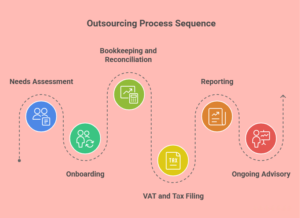
- Needs Assessment — The firm reviews your current financial situation, existing records, and compliance status. They identify what services you need and the best approach.
- Onboarding — Your accounts are transitioned to their system. This includes setting up cloud accounting software, migrating historical data, and establishing access to your bank statements and invoices.
- Bookkeeping and Reconciliation — Day-to-day transactions are recorded and reconciled on an agreed schedule — daily, weekly, or monthly depending on your business volume.
- VAT and Tax Filing — Your outsourced accountants prepare and assist in filing VAT returns quarterly and also assist in with corporate tax submissions annually.
- Reporting — Monthly management accounts are prepared and shared. These give you a clear view of revenue, expenses, profit, and cash flow.
- Ongoing Advisory — A good outsourced team goes beyond compliance. They flag cash flow concerns, suggest cost optimizations, and help you plan for growth.
Common Mistakes Businesses Make When Outsourcing Accounting
- Choosing based on price alone — The cheapest option often delivers late, inaccurate reports with minimal support
- Not providing documents on time — Outsourced accounting only works when you share invoices, bank statements, and receipts promptly
- Assuming outsourcing means zero involvement — You still need to review reports and make decisions
- Ignoring data security — Always check how your financial data is stored and who has access to it
- Not clarifying scope — Be specific about what is included in your agreement to avoid surprise charges
Best Practices for a Successful Accounting Outsourcing Relationship
- Set up a cloud accounting system from day one so you always have visibility
- Agree on a monthly reporting schedule and stick to it
- Review your management accounts every month — even briefly
- Notify your outsourced team immediately about significant business changes
- Treat your accounting partner as a strategic advisor, not just a data entry service
- Do a quarterly review of your financial performance together
Why TAP Fiscal Is a Trusted Name in Accounting Outsourcing Services in Dubai
TAP Fiscal provides comprehensive accounting outsourcing services for businesses across all industries in the UAE. Their team combines qualified accountants, VAT specialists, and corporate tax advisors under one roof — so your finances, tax, and compliance are always aligned.
From day-to-day bookkeeping to board-level financial reporting, TAP Fiscal delivers the accuracy, timeliness, and strategic insight that growing businesses need. They work with Xero, Zoho Books, and other leading cloud platforms to give clients real-time access to their financial data at all times.
TAP Fiscal Accounting Outsourcing Packages
- Bookkeeping Survival Package — from AED 500/month. Monthly P&L, bank reconciliation, cloud filing, dedicated accountant. Tiered by transaction volume.
- VAT & Tax Compliance Package — from AED 500/quarter. Quarterly VAT return preparation and FTA submission, corporate tax registration in Dubai, and proactive deadline alerts.
- Corporate Tax registration — AED 350 one-time. Mandatory for all UAE businesses. Included free with setup packages.
- Full Compliance Bundle — from AED 1,100/month. Bookkeeping + VAT + Corporate Tax + strategic advisory. Everything handled under one roof.
Every TAP Fiscal client receives free strategic business advisory—on structure, tax exposure, and regulatory positioning—at no additional charge. No lock-in contracts. No hidden fees.
Conclusion
Outsourcing your accounting is not just a cost-saving measure—it is a strategic upgrade. You get a team of qualified professionals, reliable compliance, and timely financial insights — all without the overhead of building an in-house finance department.
In a business environment as dynamic and regulated as the UAE, having the right accounting partner is not a luxury. It is a necessity.
Take control of your finances today. Contact TAP Fiscal to learn how our accounting outsourcing services in Dubai can save you money, ensure compliance, and give you the financial clarity your business needs to grow.
| Take control of your finances today.
Contact TAP Fiscal to learn how our accounting outsourcing services in Dubai can save you money, ensure compliance, and give you the financial clarity your business needs to grow. Website: https://tapfiscal.com/ Phone / WhatsApp: +971 50 289 0630 Email: Aina.k@tapfiscal.com |
FAQs:
1. How much does it cost to outsource accounting services in Dubai?
Costs depend on the volume of transactions, the services required, and the size of your business. For a small to medium-sized business, outsourced accounting typically starts from AED 500–3,000 per month for basic bookkeeping and VAT filing. Comprehensive packages including management reporting and corporate tax support cost more but are still far less expensive than maintaining an in-house team. TAP Fiscal’s Bookkeeping Survival Package starts from AED 500/month.
2. Is outsourcing accounting safe in the UAE?
Yes, provided you choose a reputable firm with proper data security practices. Reputable accounting outsourcing companies in Dubai use encrypted cloud platforms, sign confidentiality agreements, and have strict data governance policies. Always verify these before sharing financial information.
3. Can an outsourced accountant represent me before the FTA?
If the firm is also registered as a tax agent with the FTA, yes. TAP Fiscal, for example, combines outsourced accounting with FTA-registered tax advisory, so your financial records and tax filings are always in sync.
4. What accounting software do outsourced firms in Dubai use?
Most professional firms in Dubai work with cloud-based platforms such as Xero, QuickBooks, Zoho Books, or Sage. These tools allow you to log in at any time and see your financial position without waiting for a monthly report. In 2026, FTA-compliant accounting software is a regulatory requirement, not optional.
5. How quickly can I transition to an outsourced accounting firm?
Onboarding typically takes 1–4 weeks, depending on the volume of historical data and the state of your existing records. A good outsourced firm will manage the transition smoothly with minimal disruption to your business.
6. How do I choose the right business setup consultant in Dubai?
Check their experience with your business type. Review client feedback and past work. Confirm they handle licensing, visas, and compliance end-to-end.
7. Do business setup consultants in Dubai help with license approval?
Yes. They guide you on the right license and activity. They prepare and submit documents and follow up with authorities to speed up approval.
8. Can I start a business in Dubai without visiting the UAE?
Yes. Many consultants offer remote setup. They manage paperwork, approvals, and coordination while you complete steps from your home country.
9. What documents are required for company formation in Dubai?
You need passport copies, visa details, and business activity info. Some cases need NOCs or additional forms based on jurisdiction.
10. How long does it take to set up a company in Dubai?
Usually, 3 to 10 working days. Timing depends on activity, approvals, and whether you choose mainland or freezone.
11. Do consultants help with visa and bank account setup?
Yes. They assist with investor visas and guide bank account opening. They help prepare documents and reduce the chances of rejection.
12.What is the difference between a mainland and a freezone setup?
The mainland allows trade across the UAE. Freezone offers full ownership and tax perks, but limits direct local trade without a distributor.
13. Are there any hidden charges in business setup services?
Some providers add fees later. Ask for a full breakdown upfront, including government fees, visas, and service charges.
14. Can consultants help with choosing the right business activity?
Yes. They match your model to approved activities. This avoids compliance issues and delays during licensing.
15. Do business setup consultants provide post-setup support?
Most top firms offer ongoing help. This includes renewals, VAT registration, compliance, and advisory support.