
Introduction
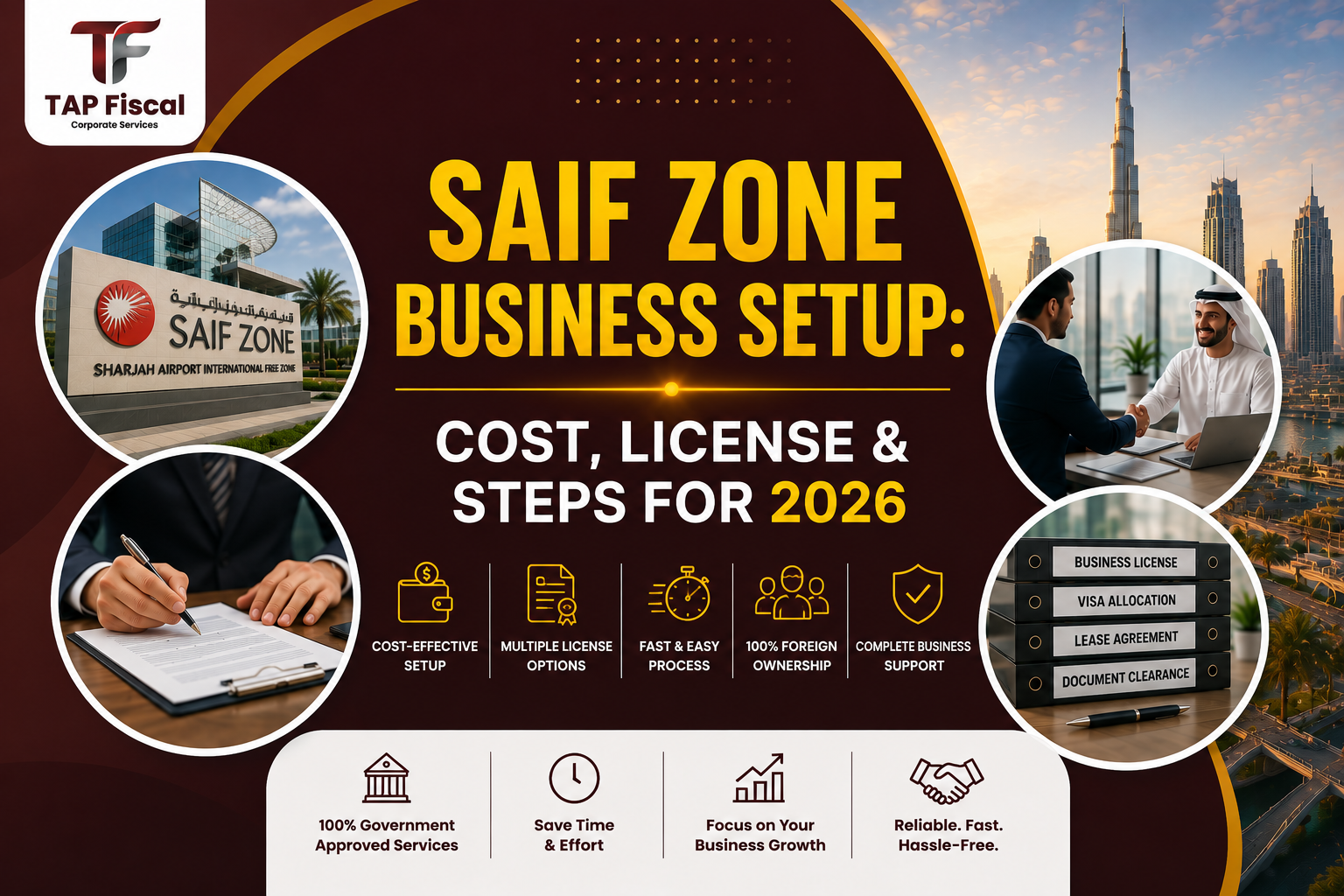
Planning a SAIF Zone business setup in 2026? You have picked one of the UAE’s most established and strategically positioned free zones. SAIF Zone, the Sharjah Airport International Free Zone, sits directly adjacent to Sharjah International Airport, just 20 minutes from Dubai, giving businesses direct access to air cargo infrastructure at a cost that is typically 30 to 40% below comparable Dubai airport zones.
SAIF Zone stands for Sharjah Airport International Free Zone. It opened in 1995. Today it is home to over 7,000 registered companies from more than 160 countries across logistics, manufacturing, and services, according to the official SAIF Zone Authority. The zone offers 100% foreign ownership, zero personal income tax, full profit repatriation, and an in-house customs point that lets goods clear faster and cheaper than at most other UAE free zones. Packages can start from around AED 10,800.
This guide keeps things simple and clear. We cover the cost, the license types, and the steps. You will also see how SAIF Zone compares to others. By the end, you will know if it fits your plan. Let us begin.
Quick Overview Table
Here is a fast look at SAIF Zone in 2026. Read it first, then explore the details below.
|
Point |
Detail (2026) |
|
Location |
Next to Sharjah International Airport |
|
Founded |
1995 |
|
Companies |
7,000+ registered businesses from 160+ countries |
|
Starting package |
From about AED 10,800 |
| Foreign ownership |
100% |
| Personal income tax |
0% |
| Best for |
Trading, logistics, manufacturing |
| Setup speed |
License issued same day / 1–3 days |
| Special feature |
Airport access + in-house customs |
What is SAIF Zone?
The SAIF Zone is a free zone in Sharjah. The Sharjah Airport International Free Zone Authority runs it, and it is also listed as an official Sharjah investment destination on the UAE Ministry of Economy & Tourism portal. It sits right beside Sharjah International Airport. That gives it a strong edge for trade and logistics. In fact, company formation in SAIF Zone is a popular choice for firms that move goods by air, land, or sea.
The zone has been operating since 1995 and hosts over 7,000 companies from more than 160 countries, covering everything from general trading and light manufacturing to professional services and e-commerce. Its in-house customs clearance capability is a genuine operational advantage: cargo clears on-site without needing external transport to a separate customs point, which reduces both cost and handling time.
SAIF Zone offers full foreign ownership. You also get 0% personal income tax and full profit repatriation. On top of that, it has an in-house customs point. This makes clearing goods cheaper and faster.
Why Choose SAIF Zone for Your Business?
So why do founders pick SAIF Zone? The reasons are clear and practical. Here is why a SAIF Zone company formation makes sense.
- Direct airport access—Your business sits adjacent to Sharjah International Airport, with 24-hour cargo handling and cold storage on-site.
- In-house customs—goods clear faster and cheaper than at zones that require external customs facilities.
- 100% foreign ownership—no local partner or sponsor required.
- Zero personal income tax—all personal earnings in the UAE are untaxed.
- Same-day license issuance—SAIF Zone processes licenses within one hour to one working day for straightforward applications.
- Lower cost than Dubai zones— 30 to 40% cheaper than DAFZA for comparable airport-adjacent setups.
- Full facility range— fitted offices, warehouses from 125 sq m, land plots, and staff accommodation are all available on-site.
These advantages suit trading, logistics, and light manufacturing businesses best. If your business depends on fast cargo movement or affordable warehousing near an airport, SAIF Zone is one of the most practical options in the UAE.
SAIF Zone License Types & Cost
SAIF Zone offers a few main license types. Each one fits a different business need. The prices below are entry-level 2026 rates. Visa and facility costs may vary.
|
License Type |
Best For | Notes (2026) |
| Import, export, distribution | Up to 3 similar product lines | |
|
General Trading License |
Multi-product trading | Broad product range |
|
Service license |
Consultancy, IT, technical |
Service activities only |
| Industrial license | Manufacturing, assembly |
Needs warehouse or plot |
| E-commerce license | Online selling, Amazon, Noon |
Fast-growing sector |
| Aviation license | Aviation-related services, cargo, logistics |
Purpose-built for airport-adjacent operations |
- SAIF Zone does not publish its full activity list publicly. Confirm your specific activity is approved before submitting your application.
- A starter package with a desk and three visa eligibilities begins at AED 10,800. Service or trading with a small office runs around AED 13,500. E-commerce and general trading packages with more visas run around AED 21,000.
SAIF Zone Company Setup Cost Breakdown
The license fee is only part of the SAIF Zone business setup cost. A few more fees apply. Here is a simple guide for 2026 — see our full company formation cost breakdown for how this compares across other UAE zones.
|
Cost Item |
Typical 2026 Range |
|
Starter package (desk + 3 visas eligible) |
From about AED 10,800 |
|
Service/trading license + small office |
Around AED 13,500 |
|
E-commerce / general trading package |
Around AED 21,000 |
| One residence visa (per person) |
AED 3,500 – 5,500 |
| Medical + Emirates ID |
AED 700 – 1,000 |
| Establishment card |
AED 1,500 – 2,300 |
| First-year total (small setup) |
AED 18,500 – 24,000 |
- Larger setups with warehouses cost significantly more—warehouse rent starts from around AED 60,000/year.
- Immigration and visa fees are charged separately on top of all package prices. Always ask for a fully itemized quote.
Not sure which package fits your visa count and activity?
TAP Fiscal provides a free, itemized quote for your SAIF Zone setup before any fees are paid—covering licence, facility, visas, establishment card, and corporate bank account. No surprises.
SAIF Zone License Cost Explained
The SAIF Zone license cost depends on your license type, package, and visa count. The headline prices above are for year one. But your ongoing cost matters too. Here is what to expect beyond the first year.
Renewal. Renewal is usually a little lower than year one, since one-time visa processing is not repeated. A minimal license renews from around AED 13,350, and a package with visas renews higher.
Per visa. Each residence visa costs roughly AED 3,500 to AED 5,500 all-in, including the medical test, Emirates ID, and stamping. Health insurance is added on top. See our visa services in Dubai guide for the full breakdown by visa type.
Warehouse or plot. Industrial setups need space. Warehouse rent starts from about AED 60,000 per year, so budget for this if you plan to manufacture.
In short, plan for the full life of your license, not just day one. Our team can prepare a clear, itemised quote through our accounting and audit support.
SAIF Zone Legal Structures
SAIF Zone offers a few company types. Pick the one that fits your plan. Here are the main choices — for a deeper look at how these compare, see our FZE vs FZCO comparison guide.
1. FZE (Free Zone Establishment): A single-shareholder company. Great for solo founders.
2. FZC (Free Zone Company): For multiple shareholders. Good for partnerships.
Branch office: For an existing local or foreign firm.
Most new founders pick an FZE. Choose an FZC if you have partners. A branch suits firms that already exist elsewhere.
Documents Required for SAIF Zone Setup
SAIF Zone asks for very few documents. That is one reason setup is so fast. Prepare these before you apply.
- Passport copies of all shareholders.
- Passport-size photos (white background).
- Proof of residential address.
- A completed application form.
- A shareholder certificate or resolution.
- A business plan (for some activities).
Step-by-Step SAIF Zone Registration Process
The SAIF Zone company registration is quick and simple. Here is the path from start to finish.
Step 1: Choose your business activity and license type. Confirm your activity is on SAIF Zone’s approved list before proceeding.
Step 2: Pick your legal structure. FZE, FZC, or branch, depending on your ownership arrangement.
Step 3: Submit your application and documents. SAIF Zone’s single-window process handles this efficiently.
Step 4: Pay the license and package fees. Payment triggers processing.
Step 5: Receive your trade licence. Issued the same day for straightforward applications; 1–3 days for others.
Step 6: Lease your desk, office, or warehouse. Facility type depends on your activity and visa count.
Step 7: Apply for visas and open a bank account. Emirates NBD, Mashreq, ADCB, and Sharjah Islamic Bank all work regularly with SAIF Zone companies. Account opening takes 2–4 weeks with a complete documentation pack.
Total timeline: the full setup, including visas and banking, typically completes within 3 to 5 weeks. TAP Fiscal manages every stage, from license application to bank account opening.
TAP Fiscal manages your SAIF Zone setup from license to bank account.
We handle activity confirmation, documents, authority submissions, visa processing, and corporate banking—so your setup completes in the shortest possible time with no back-and-forth. Get in touch with our team.
SAIF Zone can issue your license on the day of application. Standard processing takes one to three days. The full setup, including visas and banking, often finishes in three to five weeks. Our team can help with UAE visa assistance and corporate bank account opening.
SAIF Zone vs SHAMS vs DAFZA: Which Free Zone Is Right for You?
Founders comparing SAIF Zone to other options are most commonly considering SHAMS (Sharjah Media City) and DAFZA (Dubai Airport Free Zone). Here is an honest side-by-side—see our Dubai free zone cost comparison for how DAFZA and other Dubai zones stack up in detail:
|
Feature |
SAIF Zone | SHAMS | DAFZA (Dubai) |
|
Emirate |
Sharjah | Sharjah |
Dubai |
|
Starting package |
AED 10,800 | AED 9,000 – 12,000 |
AED 18,000 – 25,000+ |
|
Airport access |
Direct — adjacent to SHJ Airport | No |
Direct — adjacent to DXB Airport |
|
In-house customs |
Yes | No |
Yes |
|
Best for |
Trading, logistics, manufacturing | Media, consulting, digital services, startups |
Aviation, logistics, Dubai address required |
|
Warehouse available |
Yes (from ~AED 60,000/yr) | No | Yes (premium pricing) |
| Setup speed | Same day / 1–3 days | Same day |
1–3 days |
| Cost vs Dubai zones | 30–40% cheaper than DAFZA | Cheapest in Sharjah |
Premium |
- Choose SAIF Zone if— your business involves trading, logistics, import-export, or light manufacturing, and you want direct airport access at a price 30–40% below DAFZA.
- Choose SHAMS if— you run a consultancy, media, marketing, or digital services business and want the lowest-cost free zone in Sharjah without a logistics requirement.
- Choose DAFZA if— a Dubai address is specifically required by your clients or contracts, or your operations are aviation-specific to Dubai International Airport.
SAIF Zone vs Mainland Company
Should you pick SAIF Zone or the mainland? It depends on your market. This table makes the choice clear. If you need to sell directly across the UAE, see our mainland company setup guide or our dedicated Sharjah mainland business setup page.
|
Point |
SAIF Zone | Mainland |
|
Setup cost |
Lower to mid | Higher |
|
Ownership |
100% |
100% (most activities) |
| Trade in UAE market | Via distributor/agent |
Full access |
| Airport / customs access | Direct, in-house customs |
Varies by location |
| Best for | Trade, logistics, light industry |
Local retail, UAE contracts |
SAIF Zone fits trade and logistics firms best. The mainland suits firms that sell directly in the UAE. Many founders start in SAIF Zone to save money. They can appoint a distributor later for mainland sales.
SAIF Zone Compliance and Renewal
UAE federal corporate tax applies to SAIF Zone companies like all UAE free zone entities. Per the UAE Federal Tax Authority, the 9% rate applies to taxable profits above AED 375,000. However, SAIF Zone companies may qualify for a 0% rate on qualifying free zone income if they meet the Qualifying Free Zone Person (QFZP) conditions — primarily demonstrating adequate economic substance, earning qualifying income, and not conducting business directly with the UAE mainland.
Corporate tax compliance: what every SAIF Zone company must do
- Register with the FTA within 90 days of incorporation— this is mandatory for all UAE companies regardless of expected tax liability. Failure to register on time attracts an AED 10,000 penalty.
- Maintain audited financial records— SAIF Zone requires an annual audit report at the end of your financial year. Appoint an approved auditor.
- File annual corporate tax returns— due within 9 months of your financial year-end, regardless of whether you owe tax.
- Demonstrate qualifying income— for a trading company, income from qualifying activities with non-UAE customers typically qualifies for the 0% rate. Income from mainland UAE sources or certain excluded activities does not.
TAP Fiscal’s corporate tax and audit team handles FTA registration, annual returns, and assistance in audit for SAIF Zone companies—ensuring your 0% rate is correctly maintained and protected.
Renewal is quick and can be done in a day without a personal visit. Sign your lease and pay the fee on time — late renewal attracts penalties. A consultant can keep your renewal calendar on track.
Common Mistakes to Avoid
Founders often make the same errors. Avoid these to save time and money.
- Picking the wrong activity—SAIF does not publish its full list, so verify your activity is approved before applying.
- Mixing unrelated activities—this triggers additional license fees that founders do not budget for.
- Ignoring visa costs—visas are charged on top of the package price, and many founders underbudget this significantly.
- Missing the annual audit—SAIF Zone requires an audited financial report every year. It is not optional.
- Late FTA registration—the AED 10,000 penalty for missing the 90-day corporate tax registration window is entirely avoidable.
- Late license renewal—fines accumulate quickly. Renew at least 30 days before expiry.
Why Choose Your Business Setup Consultant
A SAIF Zone setup is fast, yet details still matter. A good consultant knows the real fees. They check your activity against the zone’s list. They also handle visas, audits, and banking for you.
At TAP Fiscal, we manage your SAIF Zone business setup from start to finish. From your license and facility to visas and compliance, we handle each step. Our pricing is clear, with no hidden charges. So you can focus on your trade.
Conclusion
SAIF Zone is a smart choice for trade and logistics firms. Packages start from around AED 10,800. You get airport access and in-house customs. And you pay less than in most zones in Dubai. That is why a SAIF Zone business setup stays popular in 2026.
Still, plan for the full cost, not just the license fee. Add visas, office space, and the annual audit to your budget. Then pick the right license and structure. Please do that, and SAIF Zone can deliver strong value in the UAE.
Ready to launch? TAP Fiscal can set up your SAIF Zone company with clear pricing and full support, or try our free cost calculator first.
Frequently Asked Questions (FAQs)
1. How much does a SAIF Zone business setup cost in 2026?
A SAIF Zone business setup starts from about AED 10,800 for a starter package with three visa eligibilities. A small setup, including one visa and workspace, runs from AED 18,500 to AED 24,000 in year one. Larger setups cost more.
2. What is the SAIF Zone company setup cost breakdown?
A starter package begins near AED 10,800. A service or trading license with a small office runs around AED 13,500. An e-commerce or general trading package is near AED 21,000. Visas are charged on top at AED 3,500 to AED 5,500 per person.
3. What is the SAIF Zone license cost?
The SAIF Zone license cost depends on your package and visas. A basic package with three visa eligibility starts near AED 10,800. A service or trading license starts around AED 13,500. Industrial setups with a warehouse cost more.
4. How do I complete a SAIF Zone company registration?
Choose your activity and license type, pick your legal structure, submit your documents, and pay the fees. SAIF Zone can issue your license the same day. You then lease your space and apply for visas and a bank account.
5. Can I get 100% ownership with a SAIF Zone company formation?
Yes. SAIF Zone allows 100% foreign ownership, like all UAE free zones. You need no local partner or sponsor. You also enjoy 0% personal income tax and full profit repatriation.
6. How long does an SAIF Zone company setup take?
SAIF Zone can issue your license on the day of application. Standard processing takes one to three working days. The full setup, with visas and banking, often finishes within three to five weeks.
7. What legal structures does SAIF Zone offer?
SAIF Zone offers the FZE (single shareholder), the FZC (multiple shareholders), and a branch office. Most new founders pick an FZE. Choose an FZC if you have partners. A branch suits existing firms.
8. Do I need an office for a SAIF Zone business setup?
It depends on your package. A desk package meets the rule for many small firms. Trading and industrial firms often need an office or warehouse. Your activity and visa count decide what you need.
9. Can an SAIF Zone company trade in the UAE mainland?
Not directly. A SAIF Zone license does not allow direct mainland sales. To sell in the UAE market, you work through a licensed distributor or agent. You can import and export freely.
10. Does SAIF Zone require an annual audit?
Yes. SAIF Zone requires an annual audit report at the end of your financial year. You must appoint an approved auditor. This is part of staying compliant in the zone.
11. What documents do I need for a SAIF Zone company setup?
SAIF Zone asks for very few documents. You need passport copies, white-background photos, and proof of address. You also need the application form and a shareholder certificate. Some activities ask for a business plan.
12. What is the SAIF Zone license renewal cost?
Renewal is close to your setup fee plus your lease and visa costs and often a little lower than year one. It can be done in a day without a personal visit. Renew on time to avoid penalties. A consultant can confirm your exact figure.
13. Which businesses are best suited to SAIF Zone?
SAIF Zone suits trading, logistics, and light industry firms best. Its airport access and in-house customs are a big plus for firms that move goods. It is also a cost-effective airport zone for SMEs and startups.