

The regulatory landscape in the UAE has undergone significant changes with the enactment of Federal Decree-Law No. 10 of 2025, strengthening anti-money laundering UAE compliance requirements across sectors. For businesses, operational efficiency is no longer just about speed—it is about integrating clear compliance guidelines that protect the organization from unprecedented legal risks.
Why the 2025-26 Update Matters for Global Market Access
The UAE’s removal from the FATF “Grey List” in 2024 was a milestone, but the new 2025 AML Law is what keeps the doors to international banking open. By aligning with these standards, Dubai-based organizations can maintain smooth operations with foreign partners, ensuring that their international financial activities remain uninterrupted and credible.
Benefits of AML Compliance Services
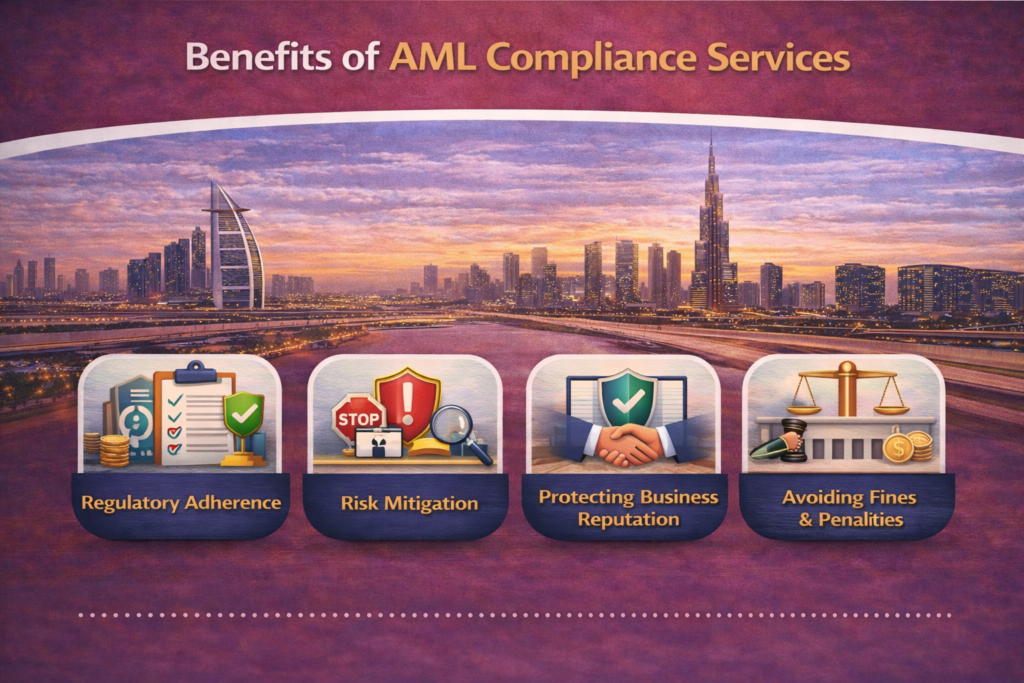
Anti-Money Laundering (AML) services provide businesses with essential support to meet regulatory requirements and protect their operations from financial crime. Below are the key benefits of implementing AML services, explained with clear subheadings.
Ensures Regulatory Compliance
AML services help businesses comply with applicable laws and regulations by establishing proper policies, procedures, and reporting mechanisms. This reduces the risk of regulatory violations, penalties, and legal actions while ensuring adherence to compliance standards.
Prevents Financial Crime
One of the primary benefits of AML services is the prevention of money laundering, fraud, and terrorist financing. Through customer due diligence, transaction monitoring, and risk assessments, AML services help identify and mitigate suspicious activities.
Protects Business Reputation
Strong AML practices demonstrate transparency and ethical business conduct. This helps build trust with regulators, financial institutions, clients, and partners while protecting the business from reputational damage caused by compliance failures.
Improves Risk Management
AML services assist in identifying high-risk customers, transactions, and business relationships. By implementing a risk-based approach, businesses can proactively manage potential threats and strengthen internal controls.
Avoids Financial Penalties
Non-compliance with AML regulations can result in heavy fines, license suspension, or business closure. AML services minimize these risks by ensuring ongoing compliance, accurate reporting, and timely regulatory updates.
Enhances Operational Efficiency
Well-structured AML frameworks streamline internal processes by providing clear guidelines for compliance activities. This improves employee awareness, reduces errors, and creates consistency across operations.
Supports Business Growth
Businesses with effective AML systems are better positioned to expand, partner with financial institutions, and access international markets. Strong compliance frameworks create confidence among stakeholders and support long-term sustainable growth.
Who Needs AML Services and Why
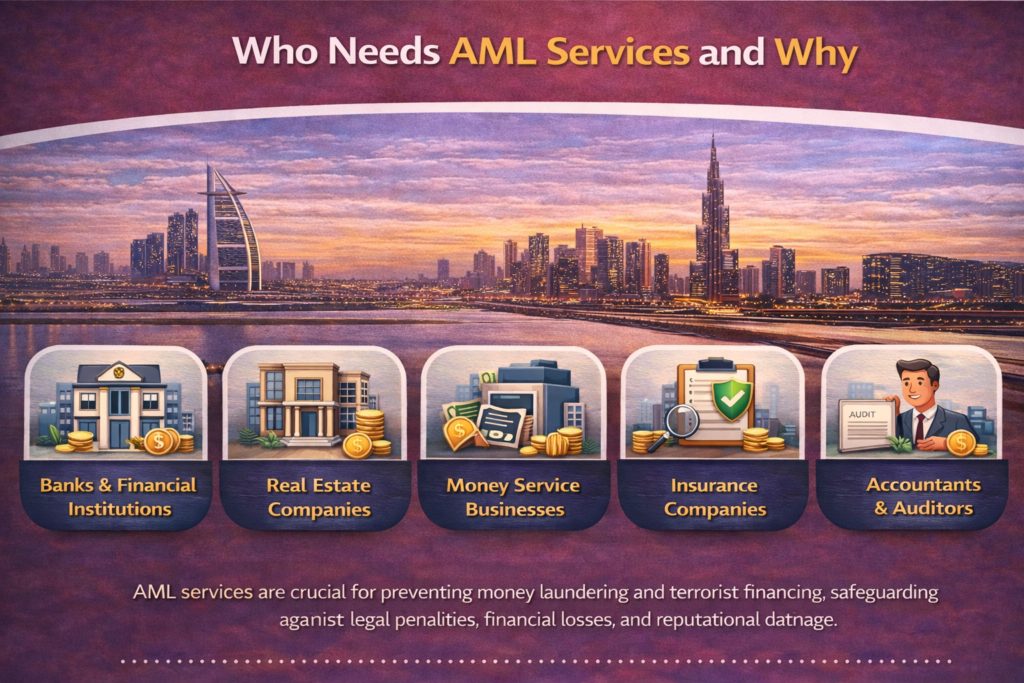
AML compliance is mandatory for various sectors operating in the UAE. Understanding who needs AML services and why is crucial for sustainable business operations under anti-money laundering uae regulations.
Financial Institutions
The financial sector includes banks and insurance companies and exchange houses and investment firms which must follow strict AML regulations. These organizations process large numbers of financial transactions which creates conditions for financial criminals to exploit.
Designated Non-Financial Businesses and Professions (DNFBPs)
This group is under the most scrutiny in 2025. It includes:
- Real Estate Brokers: Must report cash transactions over AED 55,000.
- Dealers in Precious Metals & Stones: High-risk for “trade-based money laundering.”
- Auditors and Legal Consultants: Essential for verifying Ultimate Beneficial Owners (UBO).
- NEW: Commercial Gaming Operators: Added as a new DNFBP category in 2025.
Virtual Asset and Crypto Businesses (VASPs)
Digital asset providers face increased scrutiny under Anti-Money Laundering UAE laws. The 2025 law fully integrates Virtual Asset Service Providers. Any platform dealing in digital assets must now have a license and implement AML controls equivalent to those of traditional banks.
Why AML Compliance is Necessary
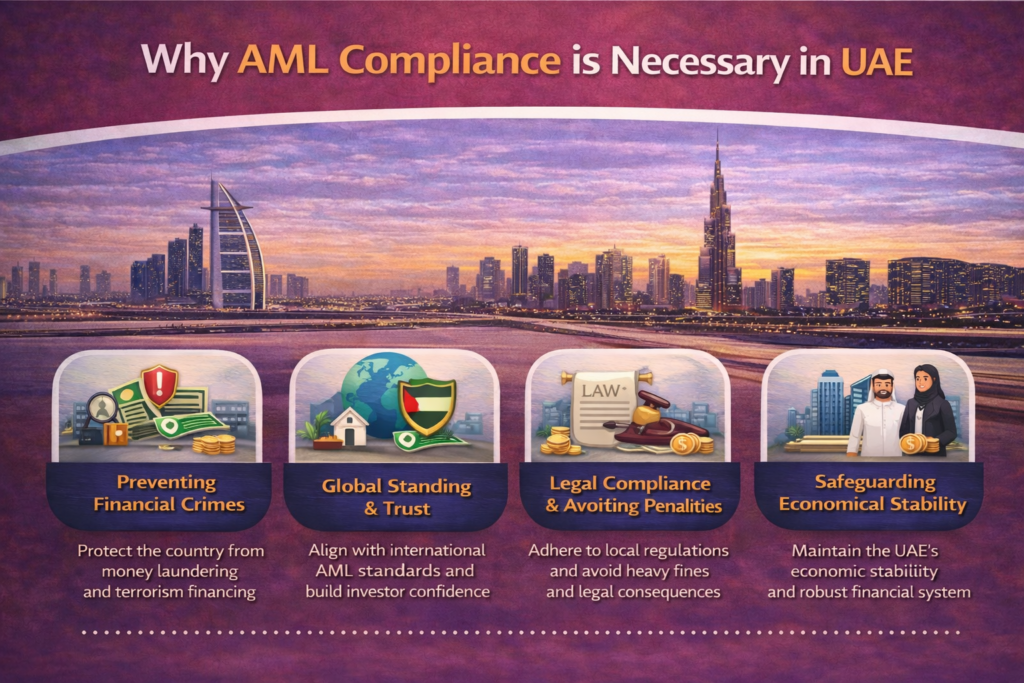
In 2025, AML compliance is no longer a choice—it is a requirement for survival under the new Federal Decree-Law No. 10.
- Avoid Massive Penalties: Prevent license revocation and corporate fines that can now reach AED 100 million.
- Mitigate Legal Risk: Protect directors and managers from personal criminal liability and potential imprisonment.
- Secure Global Banking: Maintain your ability to conduct international transfers and prevent bank account closures.
- Uphold Reputation: Build trust with the UAE Financial Intelligence Unit (FIU) and protect your brand from being linked to financial crime.
The Regulatory Expectation
The UAE government uses a Risk-Based Approach to monitor businesses. To meet their expectations, you must:
- Screen Clients: Conduct mandatory background checks against global and local sanction lists.
- Verify UBOs: Maintain accurate records of Ultimate Beneficial Owners.
- Report Suspicious Activity: Use the goAML portal to alert authorities immediately of any red flags.
Documents Required for AML Service
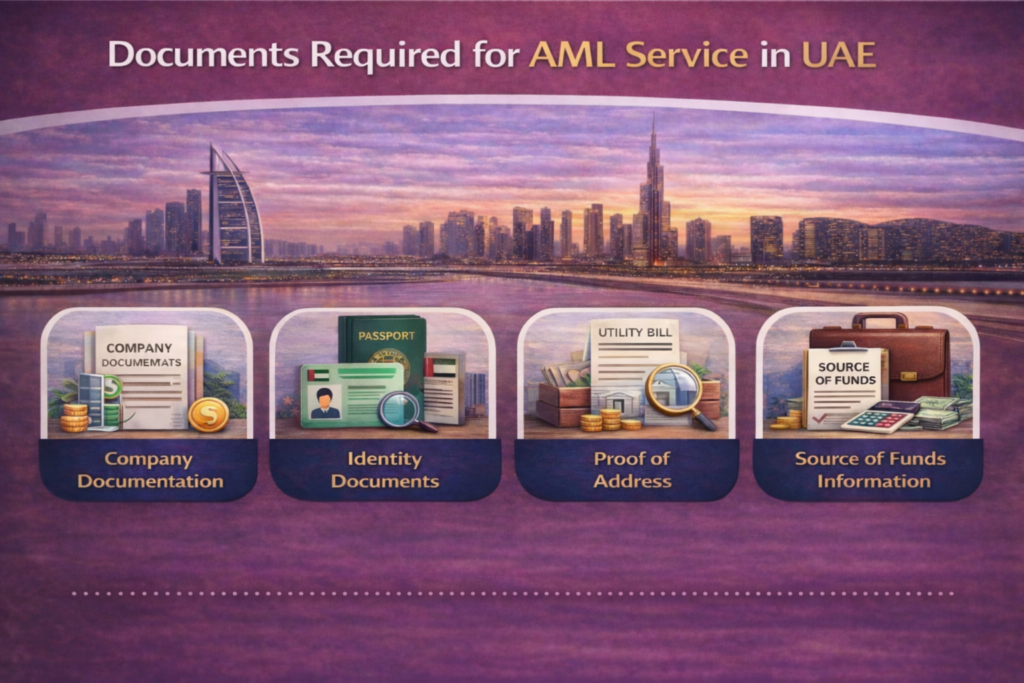
Organizations need to create appropriate documentation because it stands as their main requirement to achieve AML compliance. Businesses seeking AML services must maintain accurate and up-to-date records in line with anti-money laundering UAE regulations.
Corporate Records: Trade license, Memorandum of Association, and an updated UBO Registry (must be updated within 15 days of any change).
Identification: Passports and Emirates IDs of all directors and significant shareholders.
Compliance Framework: A written AML/CFT/CPF Policy, risk assessment reports, and Customer Due Diligence (CDD) records.
Regulatory Access: Proof of goAML registration and the appointment letter of a qualified Money Laundering Reporting Officer (MLRO).
How to Get Anti Money Laundering Certificate
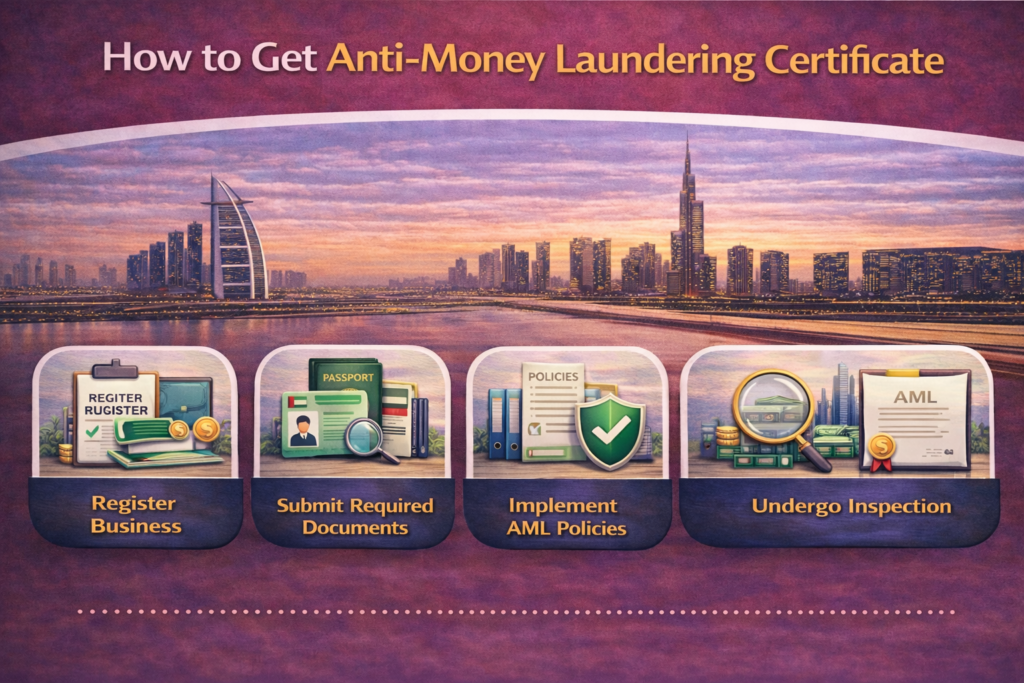
Obtaining a compliance certificate (or demonstrating “Good Standing”) requires a systematic approach:
- Draft Custom Policies: Policies must address Money Laundering, Terrorist Financing, and Proliferation Financing.
- Internal Risk Assessment: Document how your specific business could be exploited.
- Appoint an MLRO: This individual must have the expertise to liaise with the FIU.
- Register on goAML: This is the mandatory portal for filing Suspicious Transaction Reports (STRs).
- Ongoing Training: Conduct mandatory annual staff training to stay updated on 2025 regulatory changes.
An anti-money laundering certificate demonstrates that the business has implemented adequate AML controls in line with AML compliance in the UAE requirements.
Regulatory Expectations Checklist (2025 Updates)
The UAE government’s monitoring is now data-driven and automated. To meet their expectations, businesses must:
| Requirement | 2025 Regulatory Standard |
| Risk-Based Approach | A documented assessment of your business’s specific risks (Geographic, Product, and Client). |
| UBO Verification | Identifying the Ultimate Beneficial Owner and updating details within 15 working days of any change. |
| Transaction Monitoring | Real-time tracking of suspicious patterns, especially for Virtual Asset and high-value cash deals. |
| Immediate Reporting | Filing STRs (Suspicious Transaction Reports) on the goAML portal without “tipping off” the client. |
| Screening | Daily checks against the UAE Local Terrorist List and UN Consolidated List. |
Conclusion
In today’s highly regulated business environment, compliance with anti-money laundering uae regulations is no longer optional—it is essential. The protection of business operations and economic stability depends on AML compliance which fulfills two essential functions.
Financial institutions, DNFBPs, and expanding businesses need to create complete AML systems because these frameworks help them meet legal requirements, sustain business operations, and achieve enduring success. The path to compliance requires organizations to fulfill their regulatory duties while keeping their records precise and establishing strong internal control systems.
The UAE requires businesses to obtain specific knowledge for AML compliance services in the UAE because of increasing regulatory requirements and stronger monitoring systems. The correct implementation and continuous upkeep of compliance systems depend on working with skilled experts who will put these systems into practice.
TAP Fiscal provides organizations with tailored AML solutions that help them meet their regulatory needs and obtain vital certifications needed to maintain compliance. Organizations that choose suitable AML support solutions will achieve their growth targets while fulfilling all regulatory standards in the current strict business environment.
Frequently Asked Questions
What are Anti-Money Laundering (AML) services in the UAE?
Anti-Money Laundering services in the UAE help businesses comply with laws designed to prevent money laundering and terrorist financing. These services include risk assessment, AML policy development, customer due diligence, transaction monitoring, regulatory reporting, and continuous compliance management as per UAE regulations.
What is the major change in the UAE AML Law for 2025?
The new Federal Decree-Law No. 10 of 2025 explicitly criminalizes Proliferation Financing and introduces a “should have known” standard for management liability.
What are the fines for non-compliance in 2025?
Administrative fines range from AED 50,000 to AED 5 million, but criminal fines for legal entities can now reach AED 100 million for serious offenses.
Do I need to register for goAML?
Yes. All FIs, DNFBPs, and VASPs must register on the goAML portal to fulfill their reporting obligations to the UAE Financial Intelligence Unit
How often must I update my UBO (Beneficial Owner) details?
Under the latest 2025 executive regulations, any change in ownership must be updated in the registry within 15 working days.
Which businesses in the UAE must follow AML regulations?
AML regulations apply to banks, financial institutions, real estate brokers, auditors, dealers in precious metals and stones, virtual asset service providers, and other designated non-financial businesses. Both mainland and free zone entities operating in regulated activities must comply with UAE AML requirements.
Why is AML compliance important for businesses?
AML compliance is important to protect businesses from legal penalties, financial crime, and reputational damage. It ensures transparency, builds trust with regulators and financial institutions, and supports long-term business sustainability while meeting mandatory legal and regulatory obligations in the UAE.
What are the key AML requirements in the UAE?
Key AML requirements include conducting customer due diligence, maintaining AML policies, appointing a compliance officer, performing risk assessments, monitoring transactions, reporting suspicious activities, keeping accurate records, and providing employee training to ensure ongoing regulatory compliance.
What do AML service providers do?
AML service providers assist businesses in implementing and maintaining AML compliance frameworks. Their services include drafting AML policies, assessing risk exposure, supporting regulatory registrations, ensuring proper documentation, guiding reporting obligations, and helping businesses stay updated with evolving UAE AML regulations.
How can AML services help reduce compliance risk?
AML services help reduce compliance risk by identifying potential vulnerabilities, strengthening internal controls, and ensuring consistent monitoring. They support accurate reporting, regulatory alignment, and timely policy updates, minimizing the chances of non-compliance, penalties, and operational disruptions.
What is the UAE AML Law?
The UAE AML Law is a federal legal framework aimed at preventing money laundering and combating terrorist financing. It defines compliance responsibilities, reporting requirements, enforcement procedures, and penalties applicable to financial institutions and designated non-financial businesses operating in the UAE.
What documents are required for AML compliance setup?
AML compliance setup requires trade licenses, incorporation documents, ownership and identification records, AML policies, risk assessment reports, customer due diligence files, transaction records, compliance officer appointment letters, and regulatory registration details as mandated under UAE AML laws.
Do AML regulations apply to free zone companies?
Yes, AML regulations apply to free zone companies in the UAE. Entities operating in free zones must comply with federal AML laws and relevant authority guidelines, including implementing AML controls, maintaining proper records, and reporting suspicious transactions when required.
How often should AML policies be reviewed?
AML policies should be reviewed at least once a year or whenever there are regulatory updates, changes in business operations, or increased risk exposure. Regular reviews ensure continued compliance, effectiveness of controls, and alignment with UAE AML regulatory expectations, with support from tsp to fiscal when needed.