

Abu Dhabi, the capital of the United Arab Emirates, has emerged as a powerful global business hub. With strong government support, economic diversification, and investor-friendly policies, company formation in Abu Dhabi is an attractive option for startups, SMEs, and multinational corporations. The emirate offers a stable regulatory framework, access to regional and international markets, and multiple business setup options to suit diverse commercial goals.
This comprehensive guide explains everything you need to know about company formation in Abu Dhabi, including benefits, business entities, setup processes, costs, and compliance requirements.
1. Company Formation in Abu Dhabi
Company formation in Abu Dhabi refers to the legal process of registering a business entity under the laws and regulations of the Abu Dhabi government and the UAE. Businesses can be established in mainland jurisdictions through ADDED, free zones like ADGM, KEZAD, Masdar City, or twofour54, or as offshore entities, depending on operational needs and target markets.
Key highlights of company formation include:
- Flexible ownership structures, with 100% foreign ownership available for most activities in mainland and all free zones.
- Transparent legal procedures
- Government initiatives supporting foreign investment
- Access to one of the strongest economies in the Middle East
Entrepreneurs considering forming a company in Abu Dhabi benefit from a business environment focused on innovation, sustainability, and long-term growth.
2. Why Set up a Company in Abu Dhabi?
There are several compelling reasons why investors choose company formation in Abu Dhabi over other global destinations.
Key advantages include
• Strong and Stable Economy
Abu Dhabi has a diversified economy driven by energy, manufacturing, technology, finance, and tourism.
• Strategic Global Location
The emirate offers seamless connectivity to Asia, Europe, and Africa, supporting international trade and logistics.
• Foreign Ownership Opportunities
Many sectors allow 100% foreign ownership, especially in free zones and approved mainland activities under ADDED.
• Tax-Friendly Environment
No personal income tax; 9% federal corporate tax with exemptions for qualifying free zone income; no capital gains tax or withholding tax in most cases
• Advanced Infrastructure
World-class transport, ports, industrial zones, and digital infrastructure support business growth.
These benefits make company formation in Abu Dhabi a smart choice for investors seeking long-term stability and expansion.
3. Types of Business Entities in Abu Dhabi

Choosing the right structure is essential for successful company formation in Abu Dhabi. The emirate offers various legal entities to suit different business models.
1. Mainland
Mainland companies can trade freely across the UAE. Most activities now allow 100% foreign ownership, with no local sponsor required except for a limited list of strategic sectors; a Local Service Agent may apply for some professional activities.
Limited Liability Companies (LLCs) suit most startups, offering personal liability protection. Ownership can be held by one or more shareholders, with no strict minimum capital requirement for most activities.
Other options include sole establishments (for individuals) and public/private joint-stock companies.
2. Free Zone Company
Abu Dhabi free zone company formation allows businesses to operate within designated economic zones like ADGM (finance), KEZAD (industrial/logistics), Masdar City (sustainability), and twofour54 (media).
Key features:
- 100% foreign ownership
- Tax incentives and customs benefits
- Simplified setup process
3. Offshore Company
In Abu Dhabi, offshore company formation is a sophisticated strategy for high-net-worth individuals and international corporations.
Key features:
- No physical office required
- Ideal for international business activities, asset holding, and global trade
- Cannot operate directly within the UAE market
Selecting the correct entity type ensures compliance and operational efficiency during company formation in Abu Dhabi.
4. Company Formation Process in Abu Dhabi

Understanding the step-by-step process helps simplify company formation in Abu Dhabi and reduces approval timelines.
Step-by-step process:
Step 1: Select Business Activity
Choose activities approved by Abu Dhabi authorities based on your business objectives.
Step 2: Choose Legal Structure
Decide whether to establish a mainland, free zone, or offshore company.
Step 3: Trade Name Reservation
Reserve a unique business name that complies with UAE naming regulations.
Step 4: Initial Approval
Obtain preliminary approval from the relevant authority to proceed with registration.
Step 5: Prepare Legal Documents
Draft and notarize incorporation documents, including Memorandum of Association if required.
Step 6: Secure Office Space
Lease physical office space or flexi-desk facilities, depending on jurisdiction.
Step 7: Obtain Business License
Submit final documents and pay government fees to receive the license.
Step 8: Open Corporate Bank Account
After registration, open a corporate bank account to manage business finances.
This structured approach ensures smooth company formation in Abu Dhabi with full legal compliance.
5. What is the Cost of Company Formation in Abu Dhabi?
The cost of starting a company in Abu Dhabi has become increasingly competitive as of 2026. While a standard package ranges from AED 9,000 to AED 29,000, the final price is highly sensitive to your specific business model. Here is a breakdown of the primary factors that influence this cost:
Key Factors Influencing Your Total Investment
While the base registration fee is a significant portion of your budget, the final total is shaped by four primary variables:
1. Jurisdiction & Business Structure
The choice between Mainland and Free Zone is the most significant cost driver.
- Mainland (ADDED): Generally requires a higher initial investment due to local licensing mandates and administrative approvals. However, it offers the advantage of trading directly with the local UAE market and bidding for government contracts.
- Free Zones: Often offer lower entry costs and “all-in-one” packages, though they are geographically restricted in terms of local trade.
2. Visa Allocation (Staffing Needs)
Your total budget will scale with your team size. Each visa application involves government fees, medical screenings, and Emirates ID processing.
- Investor Visas: Typically have a slightly different fee structure and longer validity.
- Employee Quotas: On the mainland, your office square footage may dictate how many visas you are eligible to apply for, which indirectly impacts your real estate costs.
3. Activity Complexity & Special Approvals
Not all business activities are created equal.
- Standard Services: Consulting or general trading usually follows a streamlined, low-cost path.
- Regulated Industries: If your business involves healthcare, legal services, or heavy industry, you will require additional approvals from third-party authorities (such as the Department of Health or the Ministry of Industry). These “External Department” approvals often come with their own set of administrative fees.
6. Documents Required for Company Formation in Abu Dhabi
Having the correct paperwork ensures smooth approval. The documents required for company formation in Abu Dhabi may vary depending on business type and jurisdiction.
Commonly required documents include:
- Passport copies of shareholders and directors
- UAE visa copy (if applicable)
- Emirates ID (for residents)
- Trade name reservation certificate
- Initial approval certificate
- Memorandum and Articles of Association
- Proof of address
- Business plan (for certain activities)
Proper documentation helps avoid delays during company formation in Abu Dhabi.
7. Role of Company Formation Consultants in Abu Dhabi

Many investors choose to work with company formation consultants in Abu Dhabi to ensure accuracy and compliance.
Benefits of professional support:
- Expert guidance on legal structures
- Assistance with documentation and approvals
- Faster setup timelines
- Reduced risk of application rejection
Consultants like TAP Fiscal help simplify complex procedures, especially for foreign investors unfamiliar with local regulations.
8. Mainland vs Free Zone Company Formation in Abu Dhabi
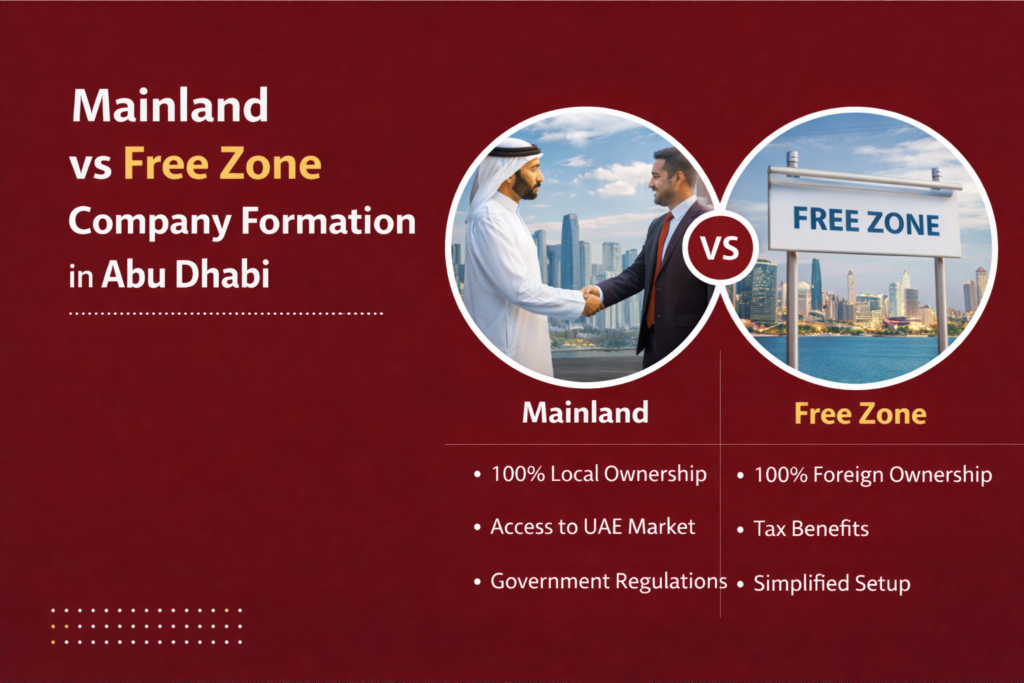
Understanding the difference between jurisdictions is crucial for company formation in Abu Dhabi.
Mainland Company Formation in Abu Dhabi
- Access to the entire UAE market
- Eligible for government contracts
- Wider activity options
Abu Dhabi Free Zone Company Formation
- 100% foreign ownership
- Tax incentives
- Restricted operations outside the free zone
Each option serves different business strategies and growth plans.
9. Compliance and Ongoing Requirements
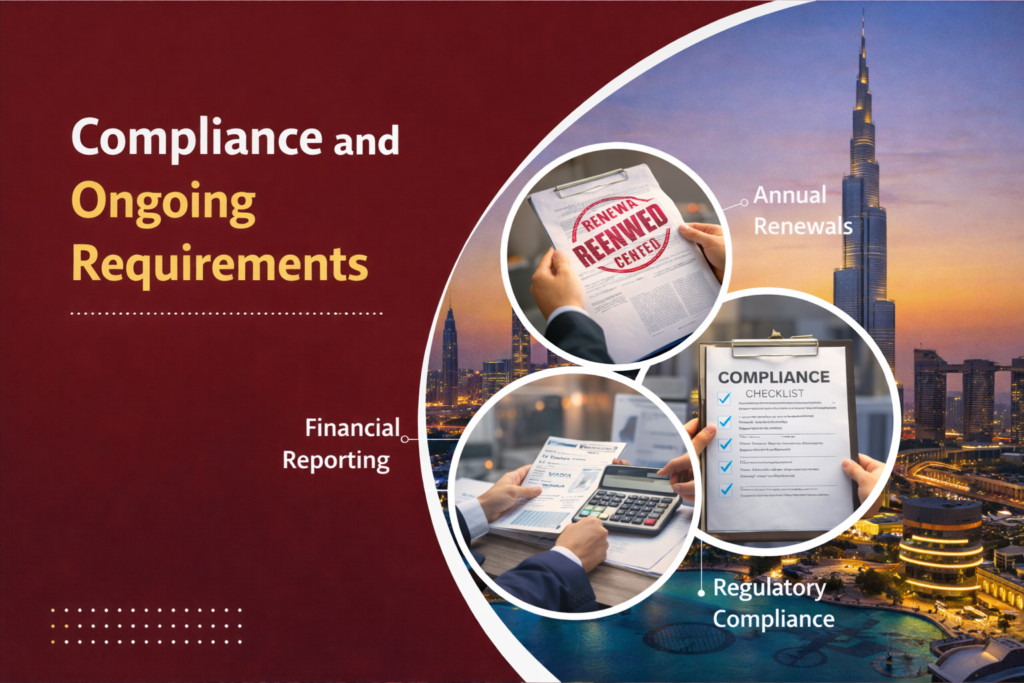
After company formation in Abu Dhabi, businesses must meet ongoing compliance obligations.
Key requirements include:
- License renewal
- Corporate tax compliance
- Accounting and bookkeeping
- Visa renewals
- Regulatory reporting
Staying compliant ensures uninterrupted business operations and legal security.
Conclusion
Company formation in Abu Dhabi offers exceptional opportunities for entrepreneurs and investors seeking a stable, growth-oriented business environment. With multiple setup options, flexible ownership laws, and strong government support, Abu Dhabi continues to attract global businesses. Understanding the types of business entities in Abu Dhabi, the company formation cost in Abu Dhabi, and the legal requirements is essential for a successful setup.
Whether you are planning mainland company formation in Abu Dhabi, Abu Dhabi free zone company formation, or offshore company formation in Abu Dhabi, professional guidance can simplify the journey and ensure compliance at every stage. For reliable support and end-to-end business setup solutions, TAP Fiscal provides expert assistance to help you establish your company in Abu Dhabi with confidence and clarity.
Learn more about Company Formation in Abu Dhabi with Tap Fiscal today!
Call: +971502890630
WhatsApp: +971502890630
Email: Aina.k@tapfiscal.com
Frequently Asked Questions (FAQs)
1. What is company formation in Abu Dhabi?
Company formation in Abu Dhabi is the legal process of registering a business under UAE laws. It includes selecting a business activity, choosing a legal structure, obtaining approvals, and securing a trade license to legally operate within Abu Dhabi and the UAE.
2. Why choose Abu Dhabi for company formation?
Abu Dhabi offers a stable economy, investor-friendly regulations, modern infrastructure, and access to global markets. The emirate supports foreign investment, provides tax advantages, and offers diverse business opportunities across multiple sectors, making it ideal for long-term business growth.
3. What are the types of company formation in Abu Dhabi?
The main types of company formation in Abu Dhabi include mainland companies, free zone companies, and offshore companies. Each structure differs in ownership rules, operational scope, and regulatory requirements, allowing businesses to choose based on market access and objectives.
4. Can foreigners own 100% of a company in Abu Dhabi?
Yes, foreigners can own 100% of a company in Abu Dhabi for many business activities. Full foreign ownership is allowed in free zones and for approved mainland activities, following recent UAE reforms that encourage international investment.
5. What documents are required for company formation in Abu Dhabi?
Documents required for company formation in Abu Dhabi typically include passport copies of shareholders, visa copies if applicable, Emirates ID for residents, trade name reservation, initial approval certificate, and incorporation documents such as the Memorandum of Association.
6. How long does it take to form a company in Abu Dhabi?
The time required to form a company in Abu Dhabi usually ranges from a few days to two weeks. Free zone companies are often registered faster, while mainland companies may take longer due to additional approvals and office space requirements.
7. What is the cost of company formation in Abu Dhabi?
The cost of company formation in Abu Dhabi varies based on business activity, jurisdiction, license type, office space, and visa requirements. Free zone packages are generally cost-effective, while mainland companies may involve higher licensing and operational expenses.
8. Is a physical office required in Abu Dhabi?
A physical office is mandatory for mainland company formation in Abu Dhabi. Free zone companies may operate with flexi-desk or shared office options, while offshore companies do not require physical office space within the UAE.
9. What types of business licenses are available in Abu Dhabi?
Abu Dhabi offers commercial licenses for trading activities, professional licenses for service-based businesses, and industrial licenses for manufacturing and production. Each license defines the scope of permitted business activities and regulatory obligations.
10. Can I open a corporate bank account in Abu Dhabi?
Yes, after completing company formation in Abu Dhabi, businesses can open a corporate bank account. Banks require company registration documents, shareholder information, and compliance checks before approving the account for business transactions.
11. Do I need a local sponsor for company formation in Abu Dhabi?
A local sponsor is not required for most business activities in Abu Dhabi. Foreign investors can fully own companies in free zones and many mainland sectors, although some regulated activities may still require local involvement.
12. Can an Abu Dhabi company operate across the UAE and internationally?
Yes, an Abu Dhabi company can operate across the UAE and internationally. Mainland companies have unrestricted UAE market access, while free zone and offshore companies are well-suited for international trade and cross-border business activities.
Company formation in Abu Dhabi offers exceptional opportunities. For reliable end-to-end support with ADDED, free zones, and compliance, TAP Fiscal provides expert assistance to establish your company with confidence.