

International investors choose the UAE as their top investment location in 2026 because the country offers them privacy protection, tax benefits, and asset security. The offshore company in Dubai allows businesses to expand worldwide because it operates from a secure financial zone in the world. This comprehensive guide explores everything from the Dubai offshore company formation cost to the intricate regulatory requirements of the Emirates, including mandatory Economic Substance Regulations (ESR) and Ultimate Beneficial Ownership (UBO) reporting for 2026 compliance.
1. What is an Offshore Company?
An offshore company is a legal business entity that operates outside its home base to serve international trade needs, protect assets, and manage wealth. Unlike mainland or free zone companies, an offshore entity is not permitted to trade locally within the UAE market but serves as a powerful vehicle for global investments, holding companies, IP ownership, yachts, aircraft, and more.
The International Business Company (IBC) structure exists to protect shareholder information through its design, which provides maximum confidentiality. It allows business owners to manage global assets under a secure UAE legal framework without the necessity of a physical office presence in the country, visa sponsorship, or local operations.
2. Advantages of Offshore Company Formation in Dubai
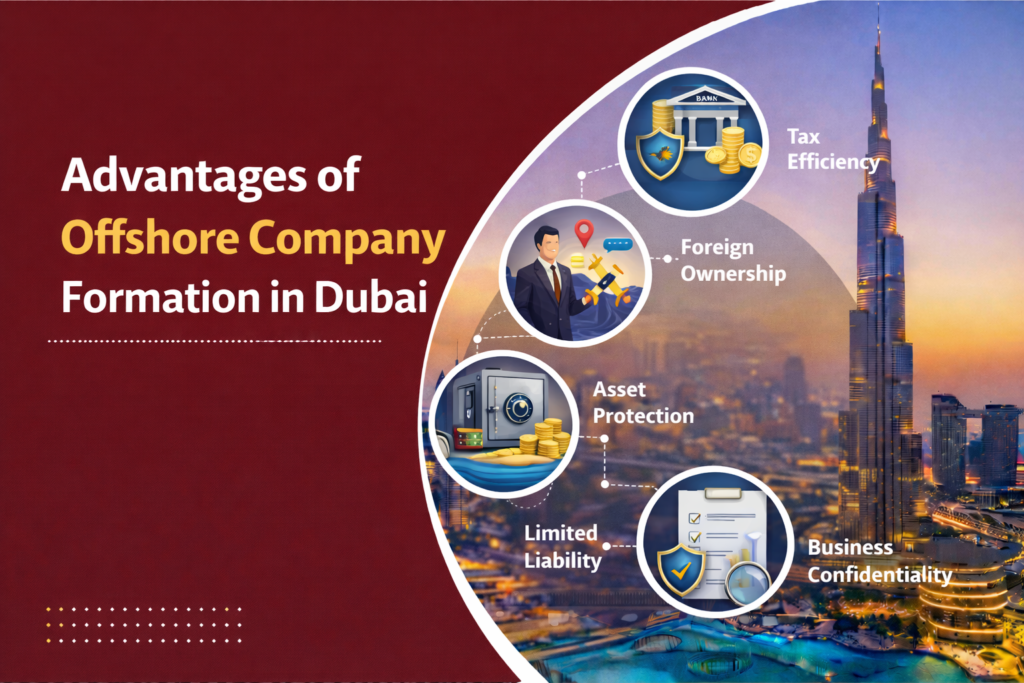
Choosing dubai offshore company formation provides a gateway to a world-class banking system and a tax-neutral environment. The UAE operates under financial standards that establish its offshore entities as trustworthy to international banking institutions and regulatory organisations with rigorous AML, CRS, and post-2024 Central Bank substance requirements.
- Tax Optimization: The 0% corporate and personal income tax rate allows investors to maximize their international business profits.
- Asset Protection: serves as a protective system that separates personal assets from business liabilities to defend wealth from legal attacks.
- 100% Foreign Ownership: International investors can own 100% of the shares without the need for a local UAE national partner or agent.
- Privacy: Benefits of an offshore company in Dubai provide their clients with absolute privacy because their shareholder information remains inaccessible to the public, with UBO filings only to the authorities.
3. The UAE Popular Offshore Jurisdictions
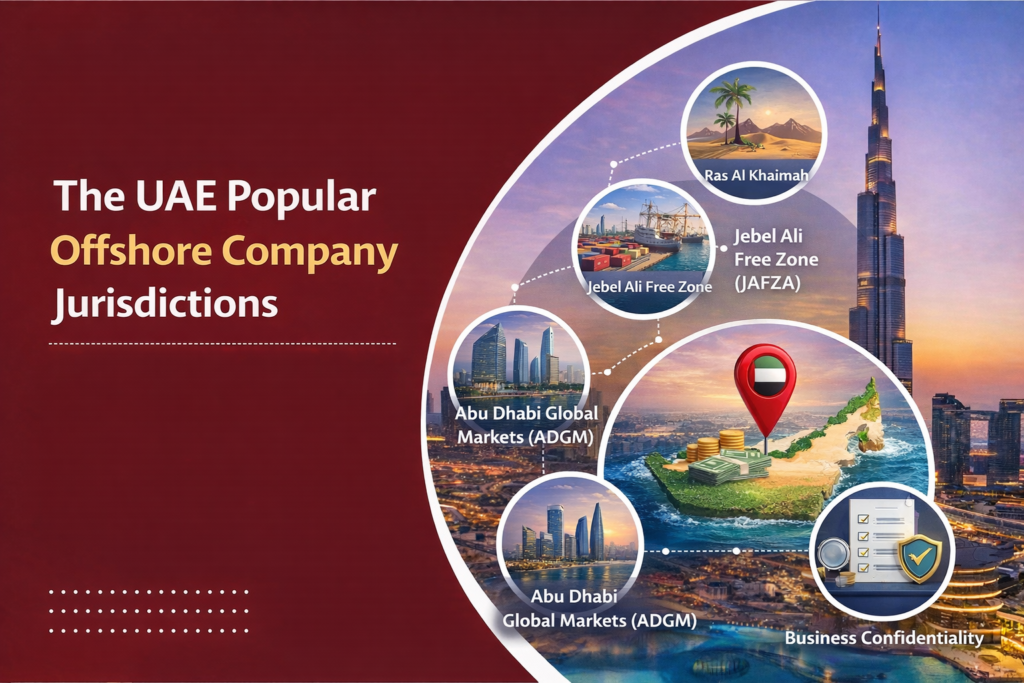
While many refer to the process as setup offshore company in Dubai, three primary jurisdictions within the UAE offer distinct regulatory environments for offshore activities.
- Jebel Ali Free Zone (JAFZA): This is the only offshore jurisdiction that allows companies to own real estate in the Emirate of Dubai under specific conditions, with setup costs of USD 7,000–10,000+, processing in 5–10 days, limited real estate allowed, and annual renewal at USD 3,000–5,000. JAFZA real estate ownership comes under specific conditions and DLD approval, while all now emphasize economic substance over shell structures per 2024–2026 updates.
- Ras Al Khaimah (RAK ICC): Known for being highly cost-effective and flexible, RAK ICC is the most popular choice for general offshore company formation in the UAE, costing USD 4,000–5,000 to set up in 3–7 days with no real estate option and renewals at USD 2,000–3,000
- Ajman Offshore: operates under the Ajman Free Zone Authority, which provides fast UAE offshore company registration through its easy documentation process at USD 3,000–4,000, processed in 2–5 days, also without real estate, and renewals from USD 2,000–3,000.
4. Uses of Offshore Companies: Common Uses
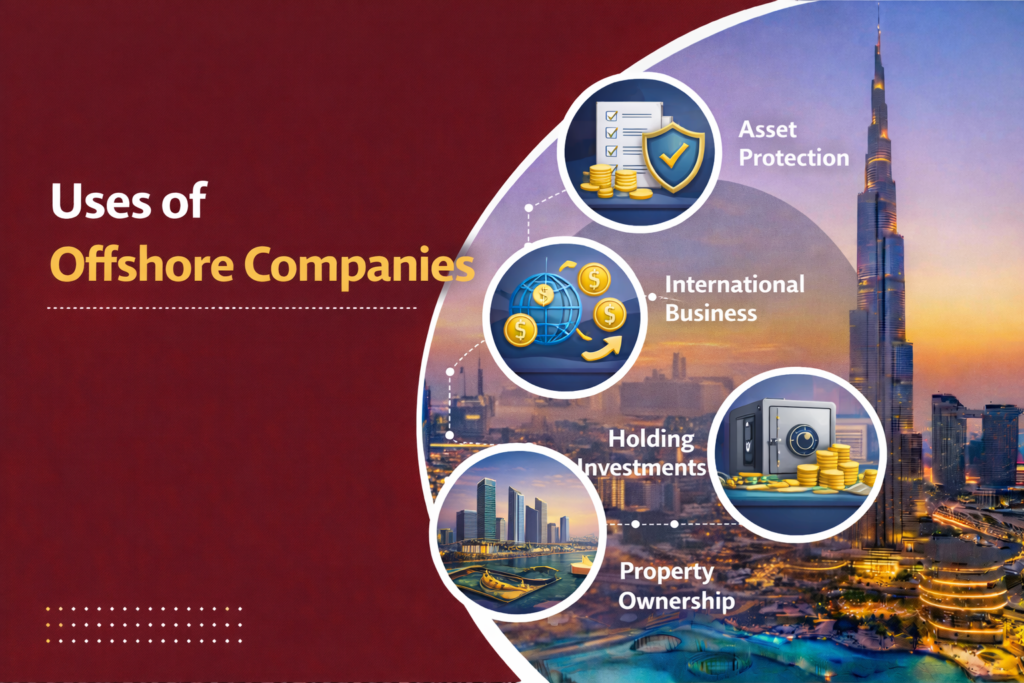
International business owners can use an offshore business setup in dubai through a process that requires them to understand these entities’ purpose. These tools serve multiple purposes by enabling people and businesses to develop financial plans. Prohibited activities include local UAE trading, banking/insurance without SCA/DFSA licenses, and visa issuance.
- International Trading: functions as a middleman that connects worldwide markets to facilitate international trade operations while enhancing supply chain efficiency and minimizing tax expenses.
- The Holding Company serves as a corporate structure that enables businesses to maintain ownership of their subsidiaries, along with their intellectual property and valuable assets, including aircraft and marine vessels.
- Real Estate Investment: The offshore entity allows investors to hold property titles, making it easier to plan for inheritance and transfer property ownership.
- Estate Planning: An effective customized method for transferring wealth, enabling families to control their assets through customized trust-based management systems. Crypto holding is permitted but regulated under ESR.
5. Procedures to Incorporate an Offshore Company in Dubai
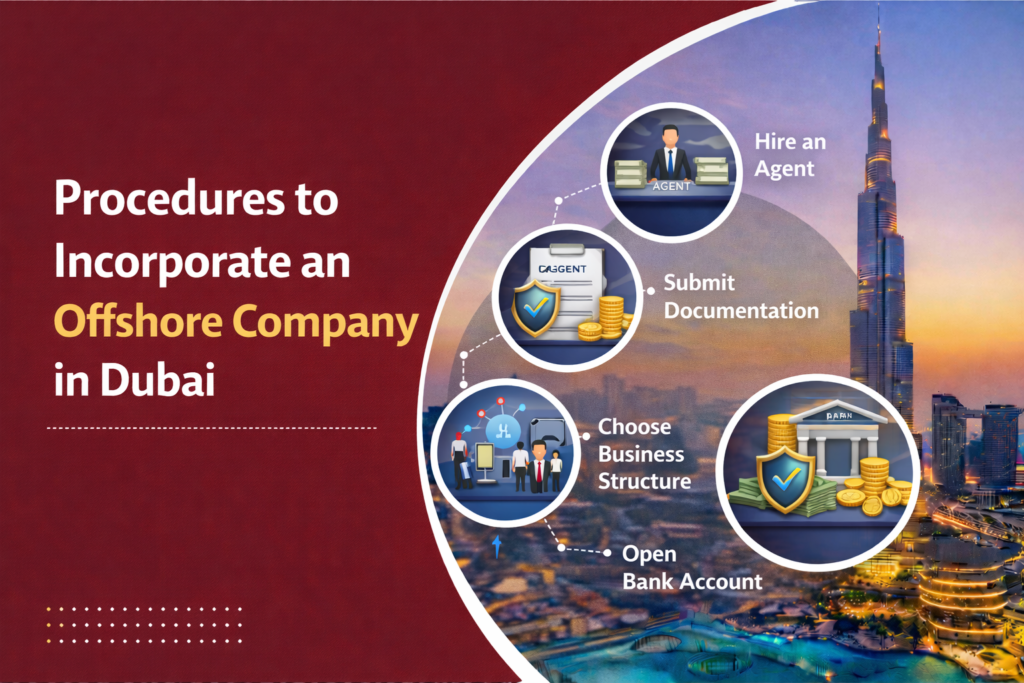
The offshore company setup process in Dubai is systematic and must be handled through a registered agent authorized by the relevant UAE jurisdiction. The full setup timeline is 1–2 weeks for registration, plus 4–8 weeks for banking.
- Name Approval: The process begins by selecting three distinct business names that must avoid any conflicts with existing trademarks and prohibited terms.
- Application Submission: The registrar will receive the dubai offshore company requirements through your agent, who will present the Articles of Association together with shareholder profiles.
- Due Diligence: The authorities conduct thorough KYC (Know Your Customer) checks of all directors and shareholders to verify their compliance with UAE laws.
- Registration: The registrar will issue the Certificate of Incorporation after approval to confirm the successful establishment of the offshore company in Dubai.
- Banking realities: UAE accounts (e.g., Emirates NBD) need proof of a source of funds and interviews; rejections are common for low-substance entities
6. Dubai Offshore Company Formation Cost
One of the most frequent queries involves the Dubai offshore company formation cost. In 2026, the financial outlay depends on the chosen jurisdiction and the complexity of the business structure.
A standard Dubai offshore company setup costs a range from USD 3,000 to 10,000+ for initial setup, covering government registration fees, registered agent fees, and the cost of a registered address. Annual renewal fees apply after the first year at USD 1,000–4,000, plus add-ons like banking support (USD 300–600) and compliance (USD 3,000+). While RAK offshore might offer a more competitive Dubai offshore company formation cost, JAFZA may involve higher fees due to its prestige and real estate ownership rights.
7. Corporate Tax Registration for Offshore Companies
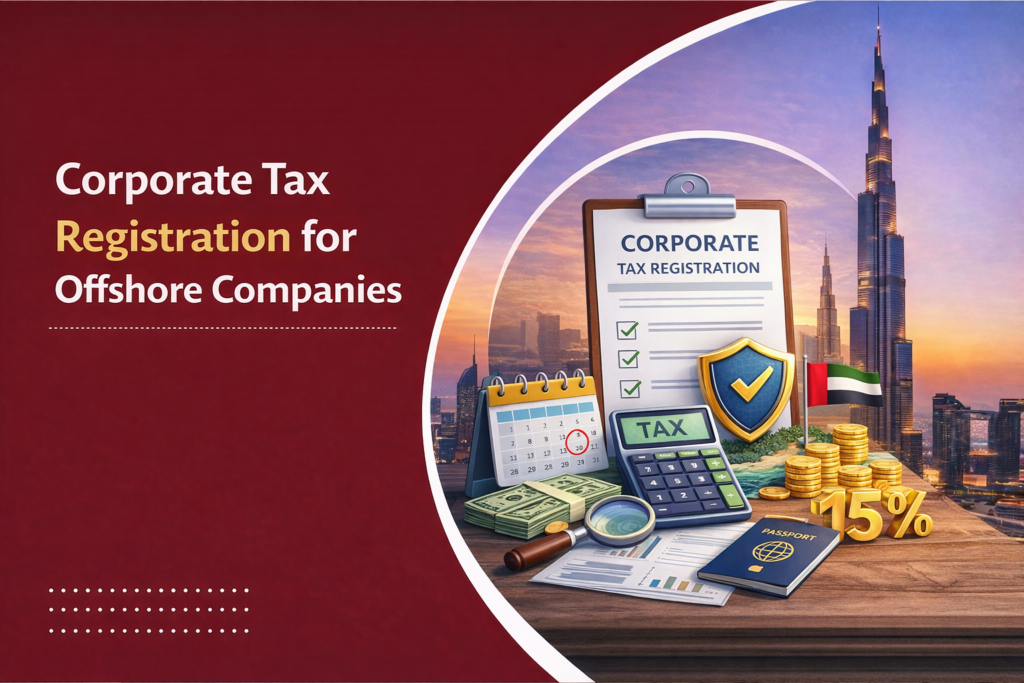
All UAE offshore companies must register for federal corporate tax with the FTA, even if claiming 0% liability on qualifying international income. The 9% rate applies to taxable profits over AED 375,000 from UAE-sourced or non-qualifying activities, with annual returns mandatory (including balance sheets and income statements). Use your incorporation certificate, director/shareholder details, and financials for EmaraTax registration—non-compliance risks AED 10,000+ fines. TAP Fiscal handles seamless CT setup alongside ESR/UBO for full 2026 compliance.
Key Compliance Points
- Who Registers: All offshore entities as UAE tax residents.
- Rate: 0% up to AED 375k; 9% above (QFZP exemptions possible but rare for pure offshore).
- Deadlines: Register in 3 months; file returns 9 months post-financial year-end.
- Documents: Cert of incorporation, UBO, financial statements.
- Penalties: AED 10k for late registration; higher for unreported income
8. What are the required documents for offshore company formation?
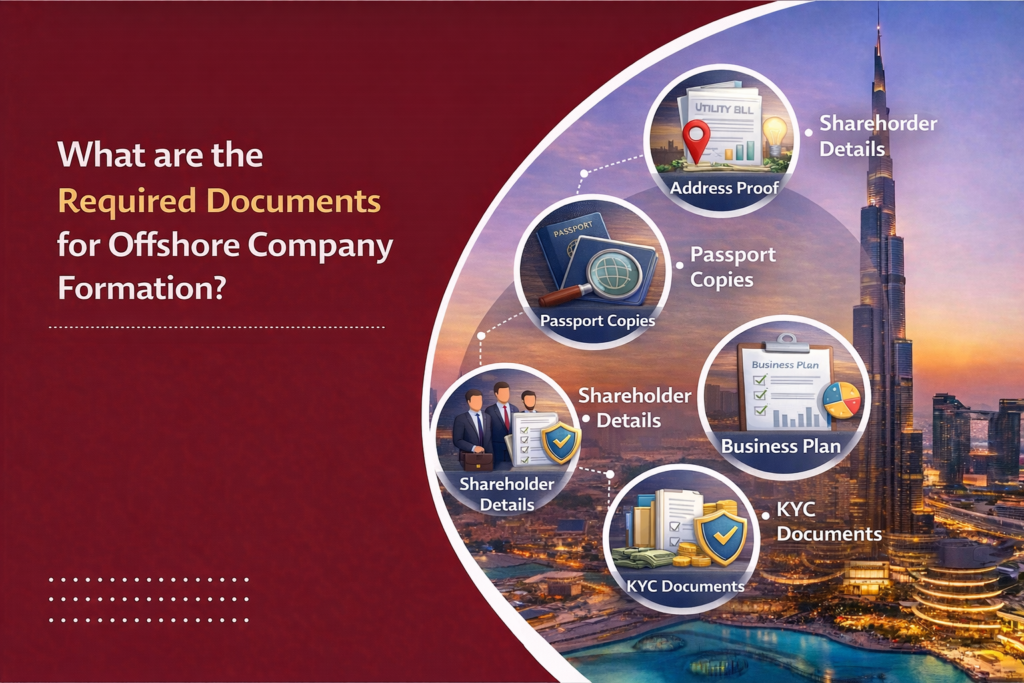
Shareholders need to prepare particular documents that must be legalized and attested for successful dubai offshore company formation services.
- Passport Copies: The organization requires passport copies, which should be clear color documents showing at least six months of validity for all shareholders and directors.
- Proof of Address: The applicants need to present a recent utility bill or bank statement that shows their current address and was printed between three months ago and the present day.
- Reference Letter: A bank reference letter serves as a document from an authorized financial institution that verifies the shareholder maintains positive financial status and banking relations.
- Professional Profile: The shareholders need to create a Curriculum Vitae (CV) that serves as their professional profile to show their business experience to the UAE authorities.
9. Post-Setup Obligations and Conclusion
Beyond incorporation, offshore companies require annual license renewal, ESR filings (for IP/holdings), UBO updates (25%+ owners), AML audits, FTA tax returns if thresholds met, and OECD CRS reporting. Non-compliance risks fines up to USD 13M and exemptions revocation.
You require a business partner who knows both Dubai’s domestic regulations and worldwide taxation rules to help you manage your offshore company in dubai operations. Your entity must comply with the Economic Substance Regulations (ESR) and UBO (Ultimate Beneficial Ownership) reporting requirements, as these rules are now essential for maintaining legal status in 2026.
TAP Fiscal stands at the forefront of the UAE’s corporate services industry, providing end-to-end support for international investors.
TAP Fiscal helps businesses achieve global expansion through their services, which include Dubai offshore company formation, cost management and exact compliance with all Dubai offshore company requirements. Our team provides complete Dubai offshore company formation services and support for your Dubai offshore company registration, which becomes a valuable financial tool for your future success.
Frequently Asked Questions (FAQs)
1. What is the cost of setting up an offshore company in Dubai?
The cost of setting up an offshore company in Dubai varies based on jurisdiction, documentation, and service provider fees. Typically, expenses include registration, government charges, documentation, and optional bank account assistance. Although prices differ, Dubai offshore formation remains more affordable compared to Free Zone or mainland structures, at USD 3,000–10,000+ initial.
2. Why is an offshore company cheaper than a Free Zone company?
Offshore companies are cheaper because they do not require physical offices, visas, or extensive regulatory compliance. Free Zone companies involve infrastructure, leasing, and operational requirements, increasing overall costs. Offshore setups are designed primarily for international activities, asset holding, and investment structures, resulting in significantly lower establishment and maintenance expenses.
3. What’s included in the offshore company formation cost?
The offshore company formation cost generally includes government registration fees, documentation, notarization, agent services, name reservation, and certificate issuance. Some packages also cover bank account support and compliance guidance. No physical office or visa costs apply, making the overall expense more predictable and straightforward compared to other company structures.
4. Which are the main offshore jurisdictions in the UAE?
The main offshore jurisdictions in the UAE are JAFZA Offshore, RAK ICC Offshore, and Ajman Offshore. Each offers unique advantages in terms of regulations, cost, processing time, and permitted activities. These jurisdictions are preferred for international business, asset protection, holding structures, and tax-efficient global operations.
5. What is the difference in cost between JAFZA, RAK ICC, and Ajman Offshore?
JAFZA Offshore is generally the most expensive due to stronger regulatory features and premium status. RAK ICC offers mid-range pricing with efficient processing and wide acceptance. Ajman Offshore is typically the most economical. Cost variations depend on documentation, ongoing compliance, and additional services selected during setup.
6. Do I need to pay annual renewal fees for an offshore company?
Yes, all UAE offshore companies require annual renewal fees. These fees usually include government renewal charges, agent fees, and documentation updates. Renewing on time ensures the company remains active and compliant. Costs differ by jurisdiction but are generally lower than Free Zone or mainland renewal requirements at USD 1,000–4,000.
7. Are there any hidden or additional costs in offshore company setup?
Hidden fees are uncommon when working with transparent providers, but additional costs may arise for bank account assistance, extra documentation, notarization, attestation, or express processing. Renewal fees also apply annually. Reviewing the full package before proceeding ensures clarity and avoids unexpected expenses throughout the setup process.
8. Do I need a local sponsor to set up a Dubai offshore company?
No, offshore companies in Dubai do not require a local sponsor or UAE national shareholder. Investors can hold 100% foreign ownership. This structure allows complete control over the company while complying with offshore regulations. It is one of the key reasons offshore setups are preferred by international entrepreneurs.
9. Is there a government fee included in the offshore setup cost?
Yes, government fees are included in the offshore setup cost. These typically cover the registration process, company name approval, certificate issuance, and official documentation. The exact amount varies depending on the chosen offshore jurisdiction but is included as part of the overall incorporation expenses.
10. Is a physical office required for offshore companies?
No physical office is required for offshore companies in the UAE. Offshore structures are designed for international operations and asset holding, eliminating the need for office leases. This makes offshore setups more cost-effective than free zone or mainland companies, where office space is a mandatory requirement.
11. Can I get a visa under an offshore company?
No, offshore companies in the UAE cannot issue visas. These entities are intended for international trade, asset management, and holding activities, not local operations or residency. Investors seeking visas typically choose free zone or mainland structures, as offshore jurisdictions do not provide visa eligibility.
12. Can offshore companies hold cryptocurrency?
Yes, offshore companies can hold cryptocurrency assets, but they must declare under ESR regulations and comply with UAE virtual asset rules.
13. What is the full timeline for offshore setup?
Registration takes 1–2 weeks, plus 4–8 weeks for UAE bank account opening if needed, subject to KYC approvals
14. Do offshore companies need to register for corporate tax (CT) in the UAE?
Yes, all UAE offshore companies in RAK ICC, JAFZA, or Ajman must register with the Federal Tax Authority (FTA) via EmaraTax, even if expecting 0% tax liability on qualifying international income.
15. When is CT registration required after offshore setup?
Register within 3 months of incorporation (post-March 2024 rules). Submit annual returns regardless of profit, 9 months after financial year-end.
16. What CT rate applies to offshore companies?
0% on profits up to AED 375,000 and qualifying non-UAE income; 9% on taxable profits above AED 375,000 from UAE-sourced or non-exempt activities. Free zone exemptions require strict substance proof.
17. What documents are needed for offshore CT registration?
Certificate of incorporation, Memorandum/Articles of Association, director/shareholder passports and details, UBO register, and initial financial statements.
18. Are there penalties for late CT registration or filing?
Yes—AED 10,000 for late registration; AED 500–10,000 monthly for late returns; up to AED 50,000+ for unreported income or non-compliance.
19. Does CT registration affect offshore tax neutrality?
No—registration maintains 0% status for pure international ops if compliant with ESR and no UAE nexus. It proves transparency to global banks and OECD CRS.
20. Can TAPFiscal handle offshore CT registration?
Yes, TAPFiscal ACCA-qualified team manages EmaraTax setup, nil returns, ESR linkage, and audits starting from AED 2,500 annually for seamless compliance.