
Introduction: Why Office Space in Dubai Matters for Your Business
Dubai is one of the fastest-growing global business hubs, attracting entrepreneurs, startups, multinational companies, freelancers, and investors from all over the world. Its investor-friendly regulations, world-class infrastructure, zero personal income tax, and strategic position between East and West make it an unrivalled destination for business
But before you can trade, hire staff, or open a business bank account in Dubai, you need one fundamental thing: a registered office address. Choosing the right office space is not just a practical decision; it directly affects your trade license, visa quota, banking eligibility, and long-term operational costs.
This guide covers everything businesses search for when exploring rental offices in Dubai: office types, specific pricing in AED, key business districts, Ejari registration, mainland vs free zone differences, visa quota rules, company registration requirements, and how TAP Fiscal helps you navigate all of it efficiently.
Why Choose Tap Fiscal for Office Space in Dubai?
TAP Fiscal Corporate Services specializes in end-to-end business setup across Dubai and the wider UAE. When it comes to office and desk space, we do far more than simply find you a room — we ensure your workspace is fully compliant, correctly registered, and aligned with your licensing authority’s specifications.
Strategic Location Options
We source office and desk spaces across all of Dubai’s key business districts — Business Bay, Sheikh Zayed Road, Downtown Dubai, DIFC, JLT, DMCC, TECOM clusters, and Dubai South — and match your location to your specific business activity, target market, and licensing authority requirements
Flexible Office Solutions
We provide comprehensive office solutions from co-working desks and flexi-desks to serviced offices, private cabins, and Grade A commercial spaces, tailored to your team size, visa requirements, and expansion timeline
Jurisdiction expertise
Our team navigates commercial real estate regulations across both mainland Dubai and free zone jurisdictions. We verify that your chosen office meets licensing authority specifications, supports the visa quota your business requires, and satisfies banking KYC and compliance standards, avoiding costly mismatches that delay your setup.
Cost-Effective Package
We structure packages to optimize total occupancy costs, including rent, service charges, Ejari/registration fees, fit-out expenses, and utilities, while ensuring regulatory compliance.
End-to-End Support
From office shortlisting and Ejari coordination to trade license alignment, visa quota verification, and lease registration, TAP Fiscal manages all documentation and authority coordination for seamless business setup.
Overview of Rental Offices in Dubai
Dubai’s office rental market is one of the most diverse and dynamic in the world. Whether you are a sole trader looking for a monthly desk, a growing SME needing a private office, or a multinational establishing a regional headquarters, the city offers a workspace solution at every price point and level of flexibility.
Rental offices in Dubai serve a dual purpose: they provide a physical working environment, and they fulfill a legal requirement. Your office address underpins your trade license, your visa applications, and your business bank account – making the right choice one of the most important steps in your business setup journey.
Why Having a Registered Office Address in Dubai Is Important and Legally Required
Every company registered in Dubai – whether on the mainland or in a free zone – must have a registered business address. This address is required for:—must
- Issuance of a trade licence by the relevant authority
- Processing employee and investor visa applications
- Opening a corporate bank account (banks verify the address during KYC)
- Receiving official government correspondence and legal notices
- Registering for VAT with the Federal Tax Authority
- Signing contracts and establishing commercial credibility
Without a valid, registered office address, none of these processes can proceed. This is why selecting the right workspace — one that meets regulatory requirements — is as important as any other aspect of your business setup.
Popular Office Locations in Dubai: Which District Is Right for Your Business?

Dubai is divided into multiple commercial zones, each attracting different industries, business models, and company sizes. Understanding these districts helps businesses choose an address that strengthens their brand, improves client access, and meets licensing requirements.
- Business Bay and Sheikh Zayed Road provide central locations ideal for corporates and trading companies with excellent connectivity.
- DIFC and Downtown Dubai cater to financial services, consultancies, and high-end enterprises seeking premium Grade A facilities.
- JLT and DMCC attract SMEs, tech firms, and commodity traders with mixed-use developments and flexible serviced office options.
- TECOM clusters, including Dubai Internet City, Dubai Media City, and D3, offer sector-specific hubs for IT, media, and design businesses.
- Dubai South and Jebel Ali Free Zone provide cost-effective solutions for logistics, manufacturing support offices, and export-oriented companies.
Choosing the right location depends on your target market, licensing authority, and operational requirements.
Types of Rental Offices in Dubai
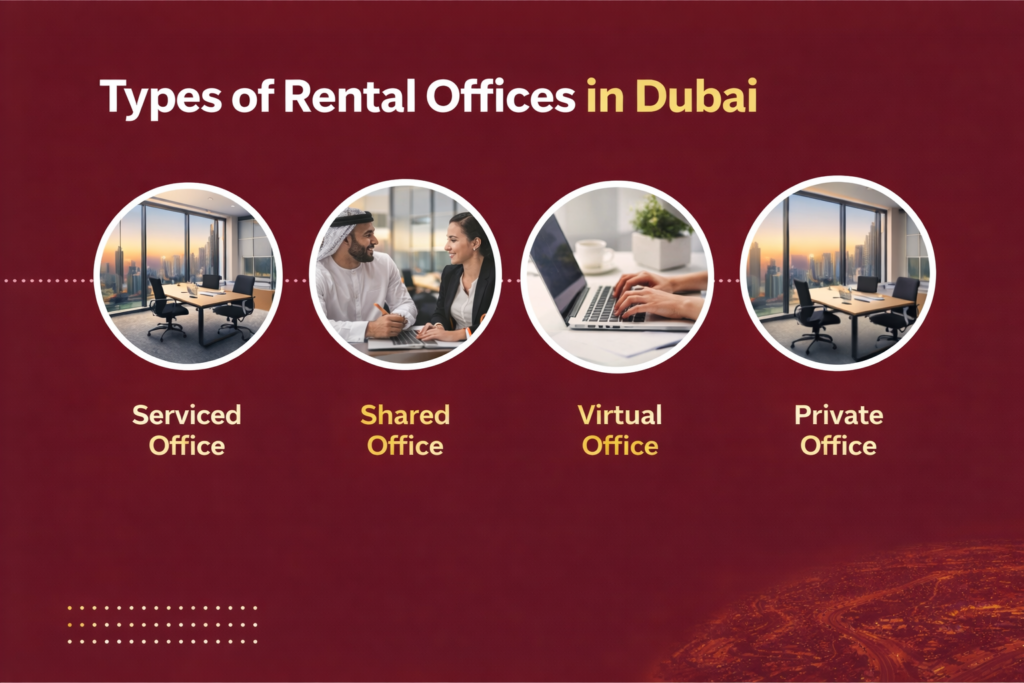
Dubai offers a wide variety of office rental options, each designed for different business models.
1. Co-Working Desks and Flexi-Desks
Co-working spaces in Dubai are shared, open-plan environments where individuals rent a desk rather than a private office. Flexi-desks are similar — a designated or hot-desk arrangement within a business centre — and are particularly popular in free zones as an affordable entry point for company formation.
Co-working and flexi-desk arrangements are ideal for freelancers, solo entrepreneurs, and startups that need a compliant business address without the cost of a dedicated private office. Many Dubai free zones accept a flexi-desk as a valid office for company registration purposes. However, businesses should be aware that flexi-desks typically support a maximum of 1 to 2 users, limiting team expansion.
Co-working spaces also offer networking benefits, collaborative work culture, and flexible membership plans — from daily passes to monthly or annual memberships.
2. Small Office for Rent in Dubai
A small private office for rent in Dubai — typically 200 to 500 square feet — is ideal for small teams of 2 to 6 people, consultants, and boutique service firms. These offices provide a professional, private working environment at a fraction of the cost of large commercial spaces, and are available across both mainland and free zone locations. They support a higher visa quota than flexi-desks and allow for greater privacy and brand identity than shared workspaces.
3. Furnished and fully furnished Offices for Rent in Dubai
A furnished office for rent in Dubai comes equipped with the essentials — desks, chairs, storage, and internet connectivity, allowing businesses to begin operations immediately upon signing the lease. A fully furnished office goes further, including reception services, meeting room access, kitchen facilities, printing, utilities, and IT infrastructure.
These offices are particularly suitable for international companies entering the Dubai market for the first time, as they eliminate the time and cost of fitting out a raw space. Fully furnished serviced offices can typically be operational within 24 to 48 hours of lease signing.
4. Serviced Offices for Rent in Dubai
Serviced offices for rent in Dubai represent one of the most popular workspace solutions for growing businesses. They are fully managed, professionally staffed environments where the building operator handles maintenance, reception, IT, cleaning, and utilities on behalf of tenants. Businesses pay a single monthly or annual fee that covers all these services, making cost management straightforward.
Serviced offices are available in business centres across every major Dubai district, with lease terms typically starting from one month and scaling to annual agreements. They are especially popular with businesses that need flexibility, the ability to upsize or downsize their space without being locked into a long-term lease.
5. Private Office Spaces in Dubai
Private office spaces in Dubai are dedicated, enclosed offices within a larger building or business centre, offering complete privacy and confidentiality. They are ideal for legal and financial firms, management teams, and any business handling sensitive client data. Private offices provide controlled access, a professional environment for client meetings, and the ability to brand and personalise the space.
6. Commercial Offices for Rent in Dubai
Commercial offices for rent in Dubai are standard leased spaces in office towers or business parks, typically occupied on annual lease agreements. These are the traditional model of office rental — the tenant leases a floor or unit directly from the landlord, pays an annual rent, and is responsible for fitting out, furnishing, and managing the space. Commercial offices are best suited to medium and large enterprises with stable, established teams and long-term operational plans in Dubai.
7. Virtual Offices
A virtual office in Dubai provides a registered business address, mail handling, and telephone answering services without requiring the business to maintain a physical workspace. Virtual offices allow companies — particularly international businesses, e-commerce operators, and freelancers — to establish a legitimate UAE presence at minimal cost.
However, businesses should note that virtual office acceptability varies by licensing authority. Mainland DET licences generally require a physically verifiable office address. Some free zones accept virtual office arrangements for specific licence types, but visa issuance under a virtual office is typically not possible. TAP Fiscal can advise on whether a virtual office is suitable for your specific business activity and licensing requirements.
8. Meeting Rooms
Meeting rooms in Dubai are available for hourly or daily hire across most business centres and co-working spaces. They are typically equipped with presentation screens, video conferencing facilities, whiteboards, and professional seating. Many office rental packages include a set number of meeting room hours per month, making them a cost-effective solution for businesses that need professional client-facing spaces without booking a full office.
9. Event Spaces
Event spaces in Dubai are suitable for corporate training sessions, product launches, workshops, seminars, and networking events. They are available in serviced office buildings, standalone event venues, and hotel conference facilities. Prices vary significantly based on capacity, location, and included services such as catering and AV equipment.
Dubai Office Rent Cost: Pricing Guide for 2025
Understanding the real cost of renting office space in Dubai is one of the most important steps in business planning. Prices vary significantly depending on office type, location, size, and included services. Below is a detailed pricing overview to help businesses budget accurately.
Indicative Price Ranges by Office Type
| Office Type | Price Range | Lease Term | Visa Quota |
| Co-working Desk (shared) | AED 500 – AED 2,000 / month | Daily / Monthly | 0–1 visa |
| Flexi-Desk (free zone) | AED 5,000 – AED 15,000 / year | Annual | 1–2 visas |
| Small Private Office (200–500 sq.ft.) | AED 25,000 – AED 70,000 / year | Annual | 2–5 visas |
| Serviced Office (per unit) | AED 4,000 – AED 15,000 / month | Monthly / Annual | 3–8 visas |
| Fully Furnished Office | AED 60,000 – AED 150,000 / year | Annual | 5–10 visas |
| Commercial Office – Standard | AED 80 – AED 180 / sq.ft. / year | Annual | Based on size |
| Commercial Office – Grade A (DIFC/Downtown) | AED 200 – AED 350 / sq.ft. / year | Annual | Based on size |
| Virtual Office | AED 3,000 – AED 8,000 / year | Annual | Not applicable |
Note: Prices are indicative ranges for 2025 and vary by specific location, building quality, included services, and negotiated terms. TAP Fiscal provides accurate cost assessments based on your specific requirements before you commit.
Price Ranges by District
| Location | Office Rent (per sq. ft./year) | Best Suited For |
| DIFC | AED 250 – AED 350 | Financial services, law firms, funds |
| Downtown Dubai | AED 180 – AED 250 | Premium corporate, luxury brands |
| Business Bay | AED 120 – AED 180 | Trading, consulting, SMEs |
| Sheikh Zayed Road | AED 130 – AED 200 | Corporations, holding companies |
| JLT / DMCC | AED 80 – AED 160 | Startups, tech, commodity trading |
| TECOM Clusters | AED 90 – AED 150 | IT, media, design, creative |
| Dubai South | AED 50 – AED 90 | Logistics, aviation, manufacturing |
Common Cost Components to Budget For
The headline rent figure is rarely the total cost of renting an office in Dubai. Businesses should also budget for the following:
- Security deposit: typically 5% to 10% of the annual rent, paid upfront and refunded at lease end
- Service charges: building maintenance and common area costs, typically AED 15 to AED 30 per square foot annually
- Utility costs: DEWA (electricity and water) charged separately for mainland offices; sometimes included in serviced office packages
- Ejari registration fee: approximately AED 220 per registration for mainland tenancy contracts
- Municipality fees: 5% of annual rent for residential-commercial addresses in some cases
- Fit-out costs: for unfurnished commercial offices, budget AED 100 to AED 300 per square foot, depending on specification
- Internet and telecom: AED 400 to AED 1,500 per month, depending on provider and package
Factors Affecting Office Rent
- Location (prime districts such as Downtown, DIFC, and Business Bay versus secondary areas)
- Office type and grade (co-working desk, flexi-desk, serviced office, standard or Grade A office)
- Office size and layout
- Furnished or unfurnished
- Lease duration and flexibility
- Included services (reception, utilities, internet, parking, meeting rooms)
Ejari Registration in Dubai: What It Is and How It Works
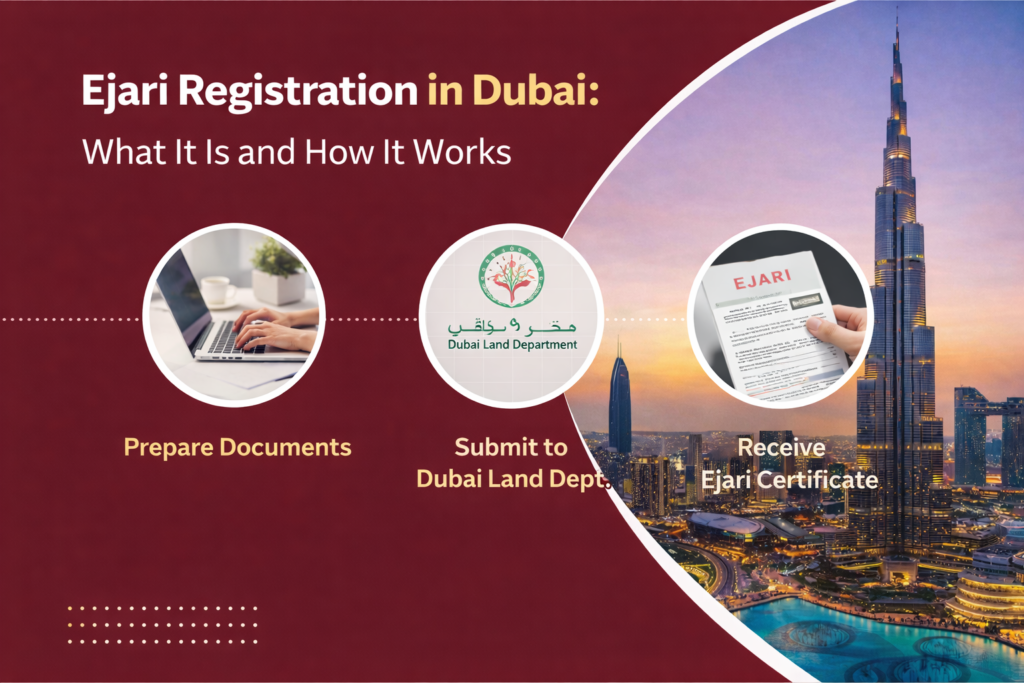
Ejari — which means ‘my rent’ in Arabic — is the official tenancy contract registration system operated by the Dubai Land Department (DLD). For mainland businesses, Ejari registration is not optional: it is a legal requirement that must be completed before a trade licence can be issued, visas can be processed, or utilities can be connected.
Why Ejari Is Required
The Ejari system creates an official, government-verified record of every tenancy contract in Dubai. This serves multiple purposes for businesses:
- Trade licence issuance: The Department of Economy and Tourism (DET) requires a valid Ejari certificate to issue or renew a mainland trade licence
- Visa applications: The General Directorate of Residency and Foreigners Affairs (GDRFA) requires Ejari as part of employee and investor visa processing
- DEWA connection: Dubai Electricity and Water Authority (DEWA) requires Ejari to activate electricity and water connections
- Banking: Many UAE banks request Ejari as part of their corporate account opening documentation
Step-by-Step Ejari Registration Process
Step 1:
Sign the tenancy agreement: Your landlord or business centre provides a tenancy contract compliant with RERA (Real Estate Regulatory Agency) requirements.
Step 2:
Gather required documents: Collect your trade licence (or company incorporation documents for new setups), passport copies of all shareholders, Emirates ID copies where applicable, and the original signed tenancy agreement.
Step 3 :
Submit via Ejari portal or approved typing centre: Registration can be completed online through the Ejari portal or in person at an approved Real Estate Services Trustee Centre.
Step 4:
Pay the registration fee: The fee is approximately AED 220 for new registrations.
Step 5:
Receive the Ejari certificate: Once verified, you receive an official Ejari certificate with a unique registration number. This certificate is then submitted to DET, GDRFA, DEWA, and your bank as required.
TAP Fiscal coordinates the entire Ejari registration process on behalf of clients, ensuring all documentation is correct and submissions are made promptly to avoid delays in trade licence or visa processing.
Free Zone Offices and Ejari
Free zone offices do not require Ejari registration. Each free zone authority operates its own lease registration system. For example, DMCC registers leases through its internal portal, DIFC uses its own tenancy management system, and Dubai South has its own authority registration. TAP Fiscal is experienced with the lease registration requirements of all major Dubai free zones.
Mainland vs Free Zone Office Rentals: Key Differences
One of the most important decisions businesses face in Dubai is choosing between a mainland office and a free zone office. Each jurisdiction has distinct rules, advantages, and restrictions that affect your office choice, licensing, and operations.
| Factor | Mainland Office | Free Zone Office |
| Licensing Authority | Department of Economy and Tourism (DET) | Individual free zone authority (e.g., DMCC, DIFC, JAFZA) |
| Ejari Required? | Yes — mandatory for trade licence and visas | No — each free zone has its own lease registration |
| Foreign Ownership | 100% foreign ownership available across most activities | 100% foreign ownership standard |
| Market Access | Full UAE market access — can trade directly with any UAE entity | Primarily free zone / international trade; mainland trade requires a distributor or mainland entity |
| Office Address Flexibility | Wide range of addresses across Dubai | Must be within the specific free zone geography |
| Visa Processing | Through GDRFA (mainland immigration) | Through the free zone authority |
| Typical Minimum Office | Physical office or flexi-desk is accepted by some DET activities | Flexi-desk accepted for most free zone licences |
The critical rule to remember: your office address must match the jurisdiction of your trade licence. A DMCC-licensed company cannot use a Business Bay address, and a DET mainland company cannot register at a DMCC address. Mismatches result in licence rejections and significant delays. TAP Fiscal ensures jurisdiction alignment before any lease is signed.
How Office Type Affects Your Visa Quota in Dubai
One of the most searched and most misunderstood aspects of Dubai office rentals is how your chosen office type determines how many employees and investors you can sponsor for UAE residence visas. This is known as your visa quota.
Visa quotas are set by the relevant licensing authority and are directly linked to your office type, office size, and business activity. Choosing an office that is too small for your team can severely limit your growth.
Typical Visa Quota Allocations
| Office Type | Typical Visa Quota | Notes |
| Virtual Office | 0 visas (address use only) | Not eligible for visa issuance in most cases |
| Flexi-Desk (free zone) | 1–2 visas | Standard allocation for single-desk arrangements |
| Co-working Desk (mainland) | 1 visa (activity dependent) | Some DET activities do not accept co-working addresses |
| Small Office (200–300 sq.ft.) | 2–4 visas | Varies by authority and business activity |
| Mid-size Office (300–500 sq.ft.) | 4–6 visas | Standard for SMEs |
| Large Office (500–1,000 sq.ft.) | 6–12 visas | Higher allocations for larger spaces |
| Commercial Office (1,000+ sq.ft.) | 12+ visas (based on headcount formula) | Mainland: typically 1 visa per 9 sq.m. of office space |
Note: Visa quotas are indicative and vary by free zone authority, business activity, and individual case assessment. TAP Fiscal verifies the exact visa quota available for your specific office before you commit to a lease.
Mainland Visa Quota Formula
For mainland DET-licensed companies, the standard formula used by the Ministry of Human Resources and Emiratisation (MOHRE) is approximately one visa per 9 square metres of net office space. However, this can vary by business activity — some professional service activities have different formulas, and certain activities require a minimum number of employees to be UAE nationals (Emiratisation quotas).
Increasing Your Visa Quota
If your business grows beyond your initial visa quota, you have two options: upgrade to a larger office to increase your allocation or establish an additional entity with its own office and license. TAP Fiscal helps businesses plan their visa quota requirements from the start to avoid bottlenecks as they scale.
Using a Rented Office for Company Registration and Trade Licence in Dubai
A valid rented office or desk space is a prerequisite for company registration and trade license issuance in Dubai. However, not every type of office is accepted for every type of business registration. Understanding the rules upfront saves significant time and cost.
Which Office Types Are Accepted for Trade Licence Registration?
| Office Type | Mainland (DET) Licence | Free Zone Licence |
| Flexi-Desk | Accepted for some activities only — check with TAP Fiscal | Widely accepted for most free zone licences |
| Serviced Office | Accepted — must have valid Ejari | Accepted with free zone lease registration |
| Private Office | Accepted — requires Ejari registration | Accepted with free zone lease registration |
| Commercial Office (leased) | Accepted — requires Ejari registration | Accepted with free zone lease registration |
| Virtual Office (address only) | Accepted in few cases — generally physical address required | Accepted for some free zone activities (no visa issuance) |
| Co-working Desk | Activity-dependent —some DET activities require dedicated space | Generally accepted for free zone formation |
New Company Formation: Step-by-Step
Step 1: Choose your business activity: Your trade licence activity determines which licensing authority has jurisdiction and what type of office is acceptable.
Step 2: Select mainland or free zone: Based on your activity, target market, and ownership preferences, TAP Fiscal advises on the appropriate jurisdiction.
Step 3: Identify and lease a suitable office: TAP Fiscal sources office options that meet the licensing authority’s specific requirements for your activity.
Step 4: Register the tenancy (Ejari for mainland, free zone lease registration for free zones): TAP Fiscal handles all registration documentation.
Step 5: Submit the office documentation with your licence application: The tenancy certificate is submitted to DET or the free zone authority as part of the company formation package.
Step 6: Receive your trade licence: Once the office is verified and all other requirements are met, the trade licence is issued.
Documents Required to Rent Office Space in Dubai
Whether renting a desk or a full commercial floor, businesses must provide a standard set of documents. Requirements may vary slightly between mainland and free zone landlords, and between business centres and standalone commercial buildings.
For Existing Companies
- Valid trade licence (current copy)
- Memorandum of Association or Articles of Association
- Passport copies of all shareholders and authorised signatories
- Emirates ID copies (for UAE residents)
- Power of attorney (if signing on behalf of the company)
- Company bank details (some business centres require this)
For New Company Formation
- Passport copies of all shareholders
- Passport copies of proposed company directors and managers
- No-objection letter (if the shareholder is employed in the UAE)
- Business plan or activity description (required by some authorities)
- Initial approval from the relevant licensing authority
TAP Fiscal coordinates all document collection, verification, and submission, ensuring that nothing is missing and that the process moves forward without unnecessary delays.
Office Space for Specific Industries in Dubai
Different industries have specific office requirements — both in terms of location and regulatory compliance. Here is a guide to the most common industry-specific workspace needs.
| Industry | Recommended Zone / Office Type | Key Requirement |
| Financial Services & Funds | DIFC — Grade A private office | DFSA licence requires physical DIFC presence |
| IT & Technology | Dubai Internet City or DMCC | Sector-specific free zone licence |
| Media & Advertising | Dubai Media City | DMC licence required for media activities |
| Trading (General / Commodities) | DMCC, JAFZA, or mainland DET | Activity determines mainland vs free zone suitability |
| Real Estate | Mainland DET (RERA licensed) | Physical mainland office required for RERA brokerage |
| Consultancy / Professional Services | Business Bay, DIFC, or any mainland location | Activity determines minimum office size |
| Logistics & Freight | Dubai South or JAFZA | Proximity to airport/port; warehousing often required |
| E-commerce | Any free zone or mainland | Virtual offices are accepted by some; physical preferred |
| Healthcare | Mainland DET or Dubai Healthcare City (DHC) | DHA licence requires regulated facility standards |
| Education & Training | TECOM or mainland | KHDA approval requires appropriate classroom space |
How to Choose the Right Office Space in Dubai: A Decision Framework
With so many options available, choosing the right workspace for your business requires a structured approach. Rushing this decision is one of the most common — and most costly — mistakes businesses make when setting up in Dubai.
Step 1: Define Your Business Activity and Licensing Requirements
Before looking at any office, confirm your business activity and which licensing authority has jurisdiction. The authority dictates the minimum office requirements — some activities require a dedicated physical office, while others can be registered with a flexi-desk.
Step 2: Determine Your Team Size and Visa Quota Needs
Work out how many employees, managers, and investors will need UAE residence visas now and within the next two years. Select an office that supports your current headcount plus reasonable growth, as upgrading mid-year can be disruptive and costly.
Step 3: Set Your Total Occupancy Budget
Do not focus only on headline rent. Calculate your total occupancy cost, including rent, deposit, service charges, Ejari or registration fees, utilities, fit-out (if unfurnished), and any shared facility charges. TAP Fiscal provides a complete cost breakdown before you commit.
Step 4: Choose the Right Location for Your Business Model
Consider where your clients are, whether you need proximity to specific government offices, and whether a prestigious address adds value to your business. A startup focused on international clients may not need a DIFC address, while a financial services firm almost certainly does.
Step 5: Verify Regulatory Compliance Before Signing
Never sign a lease before confirming that the office type and address are accepted by your licensing authority. TAP Fiscal conducts this verification as part of every client engagement, preventing expensive mistakes.
Common Challenges When Renting Office Space in Dubai and How to Avoid Them
1. Jurisdiction Mismatch
The most common and costly mistake: renting an office in a location that does not match the jurisdiction of your trade licence. This results in licence rejections and wasted rental deposits. TAP Fiscal prevents this through upfront jurisdiction verification.
2. Underestimating Visa Quota Requirements
Businesses frequently choose the cheapest office option — a flexi-desk or virtual office — only to discover it limits them to one or two visas. If you plan to hire, ensure your office supports your staffing plan from the start.
3. Hidden Service Charges and Additional Fees
Quoted rents in Dubai often exclude service charges, DEWA deposits, municipality fees, and Ejari costs. TAP Fiscal itemises every component of the total occupancy cost so there are no surprises.
4. Signing Long Leases Without Flexibility
Annual leases in Dubai are typically paid by post-dated cheques covering the full year, which can create significant cash flow pressure for startups. TAP Fiscal identifies serviced offices and business centres that offer monthly or quarterly payment terms for clients who need greater flexibility.
5. Choosing the Wrong Office Size
Oversizing leads to unnecessary cost; undersizing restricts your visa quota and growth. TAP Fiscal advises on the optimal office size based on your current team, planned hiring, and activity requirements.
Rental Offices in Dubai for Different Business Types: Recommended Workspace Solutions by Business Type
| Business Type | Recommended Office Solution | Why |
| Solo Freelancer | Flexi-desk or co-working space | Lowest cost, compliant address, networking access |
| Startup (1–3 people) | Flexi-desk or small private office | Balance of cost and visa quota flexibility |
| SME (4–15 people) | Serviced office or small commercial office | Supports team visas, professional client space |
| Growing Company (15–50 people) | Commercial leased office or Grade A serviced | Higher visa quota, branding, dedicated facilities |
| Corporate / MNC | Grade A commercial office or headquarters | Full customisation, premium address, unlimited quota |
| International Entry (no local team yet) | Virtual office or flexi-desk to start | Establish the address while assessing the market |
| E-commerce / Digital Business | Flexi-desk with free zone licence | Cost-effective, flexible, globally oriented |
Future Trends in Dubai Office Rentals
Dubai’s office market is evolving rapidly in response to changing work patterns, technology, and business needs. Businesses planning their workspace strategy should be aware of the following trends shaping the market in 2025 and beyond.
Flexible and Hybrid Leases Are the New Normal
The rigid annual lease model is increasingly giving way to hybrid arrangements — monthly serviced offices, quarterly renewals, and short-term commercial leases. Landlords and business centres have adapted to the post-pandemic reality that businesses need flexibility, not multi-year lock-ins. For startups and growing SMEs in particular, this shift opens up access to professional office space at better price points than ever before.
1. Technology-Driven Smart Offices
Dubai’s newer office developments are integrating building management systems, smart access controls, IoT-connected workspaces, and cloud-based facility management platforms. These features reduce operational overhead for tenants and align with Dubai’s Smart City agenda. Businesses selecting new office space should look for buildings with modern infrastructure to support remote working, video conferencing, and data security requirements.
2. Increased Demand for Serviced and Managed Offices
As businesses focus on their core operations rather than facility management, the demand for fully serviced, all-inclusive office environments continues to grow across Dubai. This has driven significant investment in new business centres and co-working spaces across districts like Business Bay, JLT, and TECOM, expanding the range and quality of options available.
3. Sector-Specific Ecosystem Hubs
Free zones continue to develop specialised ecosystems — clusters of complementary businesses in the same sector operating in proximity. For businesses in technology, media, financial services, or healthcare, locating within the right sector hub offers access to regulatory support, industry networking, and potential partnership opportunities that go beyond just having an office address.
Benefits of Choosing Rental Offices in Dubai
Selecting the right office space offers strategic advantages.
Key Benefits
- Professional business environment
- Legal compliance support
- Visa eligibility
- Enhanced brand image
- Flexible expansion options
Rental offices in Dubai enable businesses to operate efficiently and scale smoothly.
Conclusion – Why Choose TAP Fiscal?
Renting the right office space in Dubai is one of the most consequential decisions you will make when establishing or growing your business in the UAE. It affects your trade licence, your visa quota, your banking eligibility, your professional credibility, and your total operating cost — all at once.
The Dubai office market offers an extraordinary choice — from AED 500-per-month co-working desks to Grade A commercial floors in DIFC and Downtown. But that choice comes with complexity: jurisdiction matching, Ejari compliance, visa quota planning, and licensing authority requirements all need to be navigated correctly from the start.
TAP Fiscal Corporate Services brings the expertise, local knowledge, and authority relationships to ensure your office selection is not just convenient — but fully compliant, cost-optimised, and strategically aligned with your business goals. From initial workspace shortlisting and Ejari registration to trade licence coordination and visa quota planning, we manage the entire process so you can focus on what matters: building your business in Dubai.
Ready to find the right office space for your business in Dubai? Contact TAP Fiscal today for a free consultation
Call: +971502890630
WhatsApp: +971502890630
Email: Aina.k@tapfiscal.com
Frequently Asked Questions (FAQs)
1. What are rental offices and desk spaces in Dubai?
Rental offices and desk spaces in Dubai are flexible workspace solutions that allow businesses and professionals to operate without purchasing property. They include private offices, shared desks, co-working spaces, and serviced offices, offering professional environments with varying levels of facilities and lease flexibility.
2. Who can rent office or desk space in Dubai?
Office or desk space in Dubai can be rented by startups, freelancers, SMEs, large corporations, consultants, and international companies. Both UAE residents and foreign entrepreneurs can legally rent workspace, provided they meet licensing and documentation requirements set by authorities or landlords.
3. What types of office and desk rentals are available in Dubai?
Dubai offers small offices for rent, furnished and fully furnished offices, serviced offices, commercial offices, private office spaces, co-working desks, meeting rooms, event spaces, and virtual offices. These options cater to different budgets, team sizes, and business activities.
4. What is the difference between a serviced office and a co-working desk?
A serviced office is a private, fully managed workspace with dedicated facilities, while a co-working desk is a shared workspace in a communal environment. Serviced offices offer more privacy, whereas co-working desks are more affordable and networking-oriented.
5. Are rental offices in Dubai fully furnished?
Many rental offices in Dubai are fully furnished or furnished, including desks, chairs, storage, internet, and utilities. However, unfurnished options are also available for businesses that prefer customized interiors. Furnishing depends on the office type and rental agreement.
6. Can I use a rented office or desk for company registration?
Yes, rented offices and desks can be used for company registration in Dubai, provided they meet the legal requirements of the licensing authority. Flexi-desks, serviced offices, and private offices are commonly accepted for trade license issuance.
7. What is the minimum rental period for office or desk space?
The minimum rental period varies depending on the office type. Co-working desks and serviced offices may offer monthly or even daily plans, while traditional commercial offices usually require annual lease agreements with fixed contract terms.
8. How much does it cost to rent an office or desk in Dubai?
Co-working desks start from approximately AED 500 per month. Flexi-desks in free zones typically cost AED 5,000 to AED 15,000 per year. Serviced private offices range from AED 4,000 to AED 15,000 per month, depending on size and location. Commercial office rents vary from AED 50 per square foot per year in Dubai South to AED 350 per square foot in DIFC.
9. Do rental offices in Dubai include Ejari?
Most mainland rental offices include Ejari registration as part of the tenancy agreement, which is mandatory for legal compliance. Some serviced offices and free zone workspaces may not require Ejari, depending on the jurisdiction and licensing authority.
10. Are rental offices available in free zones and mainland Dubai?
Yes, rental offices are available in both free zones and mainland Dubai. Free zones often provide flexible office packages, while mainland offices offer a wider operational scope within the UAE market. The choice depends on business activity and licensing needs.
11. Is a rental desk suitable for startups and freelancers?
Rental desks are highly suitable for startups and freelancers due to their low cost, flexibility, and networking opportunities. Co-working spaces allow professionals to work in a collaborative environment while maintaining a professional business address.
12. Why choose professional rental office and desk services in Dubai?
Professional rental office and desk services help businesses find suitable workspaces, handle documentation, ensure compliance, and avoid hidden costs. Expert assistance saves time, reduces risk, and ensures the selected office supports business operations and future growth.
13. What are the key differences between mainland and free zone office rentals?
Mainland offices require Ejari registration and offer unlimited UAE market access but follow DET regulations, while free zone offices use zone-specific lease systems with 100% foreign ownership benefits but restrict direct mainland trading. Office choice must match your trade licence jurisdiction.
14. How does office type affect visa quotas and company registration?
Flexi-desks and virtual offices typically support 1-2 visas maximum and basic licensing, while physical offices enable higher employee quotas based on space allocation. Licensing authorities specify minimum office requirements by business activity, and the office address must match the licence jurisdiction.
15. How does office size affect visa quotas in Dubai?
For mainland companies, the standard formula is approximately one visa per 9 square metres of net office space. Flexi-desks typically support 1 to 2 visas. Free zone visa quotas depend on the authority and package type. TAP Fiscal calculates the exact visa quota available for any office before you sign a lease.
16. What is the difference between mainland and free zone office rentals?
Mainland offices require Ejari registration, offer full UAE market access, and are licensed through DET. Free zone offices use zone-specific lease registration, offer 100% foreign ownership as standard, and primarily support international or free-zone-to-free-zone trade. Your office address must match your trade licence jurisdiction — they are not interchangeable.
17. Can a virtual office be used for company registration in Dubai?
Virtual offices are accepted by some free zone authorities for company registration purposes, but they do not support visa issuance. Mainland DET licences generally require a physically verifiable office address. The acceptability of a virtual office depends entirely on your specific business activity and chosen licensing authority.
18. What documents do I need to rent an office in Dubai?
Existing companies need their trade licence, company incorporation documents, passport copies of shareholders and signatories, and Emirates IDs where applicable. New companies require passport copies of shareholders, proposed directors, any required NOC letters, and initial authority approval. TAP Fiscal manages all document coordination.
19. How long does it take to set up an office in Dubai?
A serviced or furnished office can typically be operational within 24 to 48 hours of lease signing. Ejari registration takes 1 to 3 business days. Company formation with a new office — including trade licence issuance — typically takes 5 to 15 working days depending on the jurisdiction and activity. TAP Fiscal works to the fastest possible timeline for all setups.
20. Are rental offices available in both free zones and mainland Dubai?
Yes. Rental offices, desks, and business centres are available across both mainland Dubai and all major free zones. The right choice depends on your business activity, target market, and licensing requirements. TAP Fiscal advises on the optimal jurisdiction based on a detailed assessment of your business needs.
21. Which free zones offer the most affordable office space in Dubai?
Dubai South, JAFZA, and IFZA (International Free Zone Authority) offer some of the most affordable free zone office and flexi-desk packages, starting from around AED 5,000 to AED 10,000 per year. DMCC and DIFC are at the premium end of the free zone market but offer significant reputational and regulatory advantages for the right business types.
22. What should I look for in a shared office space in Dubai?
Key factors include: whether the address is accepted by your licensing authority, the quality of internet and IT infrastructure, the availability of meeting rooms, the size and professionalism of the community, the flexibility of membership terms, the included visa quota, and the proximity to your clients or relevant government offices.