
The United Arab Emirates has established a robust and transparent taxation framework that supports its growing economy while ensuring regulatory compliance for businesses. Dubai, as a global commercial hub, attracts companies from around the world, including a significant number of Indian businesses. To operate legally and efficiently, businesses must understand and comply with local tax regulations, making tax services in Dubai essential.
Taxation and VAT compliance require proper planning, accurate documentation, and timely filings. Businesses often rely on professional taxation and vat services in Dubai to manage compliance obligations, reduce tax risks, and avoid penalties. With evolving tax laws such as corporate tax (9%) and 5% value-added tax, the demand for VAT services in Dubai and tax consultancy services in Dubai has increased significantly.
What is VAT in Dubai?
Value Added Tax (VAT) is an indirect tax introduced in the UAE in 2018. It is levied on the supply of goods and services at each stage of the supply chain. Businesses act as tax collectors on behalf of the government by charging VAT to customers and remitting it to the authorities via the Emara Tax Platform.
VAT in Dubai is charged at a standard rate of 5%, making it one of the lowest VAT rates globally. However, compliance requirements are strict, and errors can lead to financial penalties. Recently, the FTA introduced a 5-year statutory limit on VAT refund claims, making businesses more proactive than ever. Businesses exceeding the mandatory threshold must complete VAT registration in Dubai to operate legally.
Key features of VAT in Dubai include the following:
- Registration requirements based on turnover
- Periodic VAT return filing via the Emara Tax Portal
- Input tax recovery eligibility (subject to strict timelines)
- Mandatory record keeping for at least 5-7 years
To meet these obligations efficiently, many businesses seek support from VAT consultants in Dubai who specialise in VAT compliance and advisory services.
VAT Registration in Dubai: Who Needs to Register?

Businesses operating in the UAE must register for VAT if their taxable supplies and imports exceed the mandatory registration threshold. VAT registration applies to mainland businesses, free zone entities, and foreign companies conducting taxable activities in the UAE.
Registration Type | Threshold | Who It Applies To |
Mandatory Registration | AED 375,000+ taxable turnover | All UAE businesses exceeding threshold |
Voluntary Registration | AED 187,500+ taxable turnover | Businesses below mandatory threshold |
| Foreign Entity Registration | No threshold — immediate | Non-resident businesses supplying UAE |
| Group VAT Registration | AED 375,000+ combined | Related entities under common ownership |
Documents Required for VAT Registration
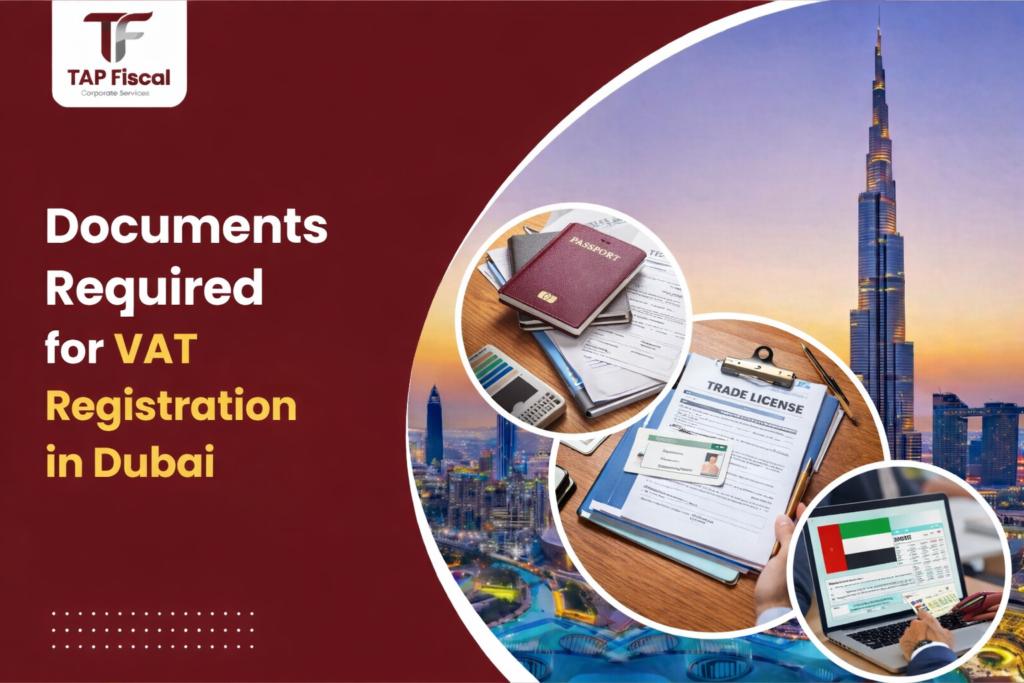
- Valid trade license (UAE)
- Passport and Emirates ID copies of all owners/directors
- Detailed description of business activities
- Financial records confirming turnover (bank statements, invoices)
- Bank account details (UAE bank)
- Estimated or actual turnover figures
- Proof of business address
- For Indian companies: parent company registration documents and power of attorney
How Long Does VAT Registration Take?
VAT registration in the UAE typically takes between 5 to 20 working days, depending on the accuracy of submitted documents and the FTA’s review timeline. Delays may occur if additional information is requested. Working with experienced VAT consultants in Dubai significantly reduces the risk of rejection or delays.
UAE Corporate Tax 2025-2026: What Every Business Must Know

The UAE introduced Federal Corporate Tax, effective from June 2023. This is a landmark change in the UAE’s tax landscape and affects virtually every business operating in the country. Understanding your corporate tax obligations is not optional — and ignorance is not a valid defense before the FTA.
Corporate Tax Factor | Details |
Standard Rate | 9% on taxable business profits |
Tax-Free Threshold | First AED 375,000 of profit is at 0% |
Small Business Relief | Revenue under AED 3 million treated as zero taxable income until end of 2026 |
Registration Obligation | ALL businesses must register — even those with zero profit |
| Late Registration Penalty | AED 10,000 fixed penalty for failure to register on time |
| Tax Period | Based on the business’s financial year |
| Filing Deadline | 9 months after the end of the relevant tax period |
| Qualifying Free Zone Rate | 0% on qualifying income for QFZP entities |
Do Free Zone Companies Pay Corporate Tax?
Free zone companies may benefit from a 0% corporate tax rate on qualifying income if they meet the criteria to be classified as a Qualifying Free Zone Person (QFZP). However, non-qualifying income — such as income from mainland UAE transactions — may still be subject to the standard 9% rate. Proper classification and compliance documentation are essential, and businesses should consult a corporate tax consultant in Dubai to assess their position.
Who is Exempt from UAE Corporate Tax?
- UAE and Emirate government entities
- Government-controlled entities meeting specific conditions
- Extractive businesses (subject to Emirate-level taxation)
- Non-extractive natural resource businesses
- Qualifying public benefit organisations
- Investment funds meeting relevant conditions
- UAE pension and social security funds
Transfer Pricing and Corporate Tax
The UAE Corporate Tax Law includes transfer pricing rules aligned with OECD guidelines. Businesses with related-party transactions must ensure these are conducted at arm’s length and must maintain transfer pricing documentation. Failure to comply can result in significant adjustments and penalties. Businesses engaged in cross-border transactions — including Indian parent-subsidiary relationships — must pay particular attention to these rules.
How UAE Tax Laws Apply to Indian Businesses

Indian businesses operating in Dubai or engaging in cross-border transactions with the UAE are subject to local VAT and Corporate Tax laws under specific conditions. Understanding how UAE tax obligations interact with Indian tax requirements, particularly under the Double Taxation Avoidance Agreement (DTAA), is critical for Indian entrepreneurs and multinationals.
When Does UAE VAT Apply to Indian Companies?
- Have a physical presence in Dubai
- Supply taxable goods or services within the UAE
- Import goods into the UAE
- Operate through branches or subsidiaries
For such businesses, vat registration services in dubai become mandatory once taxable turnover crosses the prescribed threshold. Additionally, Indian companies must ensure compliance with VAT invoicing, reporting, and record-keeping requirements.
Understanding local tax laws can be challenging for foreign entities. This is why many Indian businesses rely on tax advisor vat consultants in Dubai, professionals who understand both Indian and UAE taxation frameworks, including the Double Taxation Avoidance Agreement (DTAA).
UAE Corporate Tax for Indian Entities
Under the UAE Corporate Tax Law, Indian entities operating in the UAE must now manage a 9% tax on UAE-sourced profits exceeding AED 375,000. Indian companies with permanent establishments in the UAE are taxable on UAE-sourced income. Additionally, Indian SMEs should be aware of Small Business Relief, which allows businesses with revenue under AED 3 million to be treated as having no taxable income until the end of 2026.
DTAA: The India-UAE Double Taxation Avoidance Agreement
The DTAA between India and the UAE prevents the same income from being taxed twice. For Indian businesses operating in Dubai, this agreement determines where tax is payable on various income streams including dividends, royalties, capital gains, and business profits. Navigating the DTAA correctly can result in significant tax savings, but requires specialist knowledge of both Indian and UAE tax law. TAP Fiscal’s tax advisors understand both frameworks and can guide Indian businesses through the treaty’s provisions.
GST vs UAE VAT: Key Differences for Indian Businesses
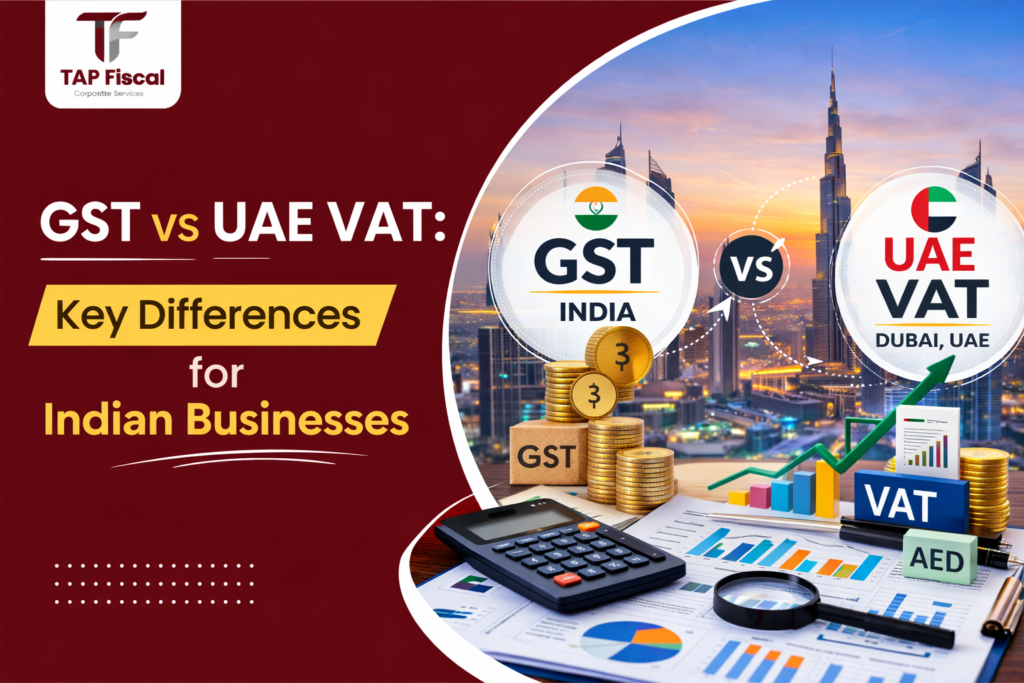
VAT Treatment Difference (India vs. UAE)
Although both India and the UAE follow VAT-based taxation systems, there are key differences in their structure and implementation.
VAT in India
- Known as Goods and Services Tax (GST)
- Multiple tax slabs (0%, 5%, 12%, 18%, 28%)
- Complex compliance requirements
- Separate state and central filings
- Extensive documentation and reconciliation
VAT in UAE
- Single standard rate of 5%
- Simpler compliance structure
- Centralized administration
- Clear guidelines for exemptions and zero-rated supplies
| Feature | India (GST) | UAE (VAT) |
Tax Name | Goods and Services Tax (GST) | Value Added Tax (VAT) |
Tax Rates | Multiple slabs: 0%, 5%, 12%, 18%, 28% | Single standard rate of 5% |
Complexity | High — multiple rates, HSN codes, reconciliations | Relatively simple structure |
Filing | Multiple monthly/quarterly state + central returns | Single periodic return via EmaraTax |
| Input Tax Credit | Eligible with matching conditions (GSTR-2B) | Eligible subject to 5-year timeline |
| Corporate Income Tax | 30% (companies) with surcharges | 9% (profits over AED 375,000) |
| Threshold | INR 20-40 lakh | AED 375,000 (mandatory) |
| Administration | GST Council, CBIC | Federal Tax Authority (FTA) |
Due to these differences, Indian businesses operating in Dubai often require vat consultancy services in dubai to understand VAT treatment, input tax recovery, and cross-border implications accurately.
UAE VAT Penalties: What You Risk Without Compliance

Non-compliance with UAE VAT laws is expensive. The FTA applies administrative penalties for a wide range of violations. Understanding these penalties underscores why investing in professional VAT consultancy services is far more cost-effective than attempting to manage compliance independently.
Violation | Penalty Amount |
Failure to register for VAT on time | AED 20,000 |
Failure to submit VAT return on time | AED 1,000 (first offence); AED 2,000 (repeat within 24 months) |
Late payment of VAT due | 2% immediately + 4% after 7 days + 1% daily (capped at 300%) |
Failure to display prices inclusive of VAT | AED 15,000 |
| Failure to maintain proper VAT records | AED 10,000 (first offence); AED 50,000 (repeat) |
Submitting an incorrect VAT return | 50% of unpaid or over-claimed tax |
Tax evasion | Up to 5x the evaded tax amount |
Failure to issue a proper tax invoice | AED 5,000 per invoice |
| Corporate Tax late registration | AED 10,000 fixed penalty |
VAT for E-Commerce and Digital Businesses in Dubai
The UAE’s VAT framework applies to digital and e-commerce businesses, including those selling goods or services online to UAE consumers. This is a rapidly growing area of FTA scrutiny, particularly as cross-border digital commerce has expanded significantly since 2020.
What are VAT Consultancy Services in the UAE
VAT consultancy services in the UAE provide expert guidance to businesses on VAT compliance, planning, and reporting. These services are designed to help companies meet regulatory obligations while optimizing tax efficiency.
Core services offered under VAT consultancy include:
- VAT registration and deregistration
- VAT return filing and reconciliation
- VAT compliance audits
- Input tax recovery advisory
- VAT impact assessment
Best vat consultants in dubai ensure businesses stay compliant with evolving tax laws and reduce exposure to penalties. These services are especially valuable for foreign-owned companies unfamiliar with UAE regulations.Do Indian Companies Need VAT Consultancy Services in UAE?
Yes, Indian companies operating in Dubai or conducting taxable transactions in the UAE significantly benefit from VAT consultancy services. Navigating UAE tax laws without professional assistance can result in errors, delays, or non-compliance.
Indian businesses often require:
- Guidance on VAT applicability
- Support with vat registration dubai
- Assistance with VAT filings and documentation
- Advisory on cross-border transactions
Engaging vat consultancy services in dubai ensures Indian companies understand local compliance requirements and avoid costly mistakes. Additionally, support from a corporate tax consultant in Dubai becomes essential when managing both VAT and corporate tax obligations.
Benefits of VAT Consultancy Services in the UAE

Navigating the tax landscape in Dubai requires precision and a deep understanding of local regulations. Engaging professional VAT consultancy services offers several strategic and operational advantages:
1. Ensuring Accurate VAT Compliance
Professional consultants ensure businesses strictly adhere to Federal Tax Authority (FTA) laws. This includes:
- Correct VAT registration and deregistration.
- Accurate filing and reporting of returns.
- Significant reduction in the risk of heavy penalties and legal disputes.
2. Strategic Resource Management
- Saves Time: Outsourcing allows management to focus on core business growth while experts handle the technicalities of tax obligations.
- Reduces Financial Risk: Expert oversight prevents common pitfalls such as overpayment, underpayment, or clerical errors in filings.
3. Optimizing Financial Health
- Improved Cash Flow: Consultants assist in the accurate recovery of input tax, ensuring your capital isn’t unnecessarily tied up.
- Expert Guidance: Advisors stay ahead of regulatory shifts, providing proactive advice rather than reactive fixes.
4. Integrated Tax Support
The best firms provide a holistic approach to your finances:
- Corporate Tax Alignment: Seamlessly bridging the gap between VAT and the newer Corporate Tax requirements in the UAE.
- Simplified Documentation: Guidance on maintaining meticulous records, which reduces the administrative burden during potential audits.
Conclusion
For both Indian entrepreneurs and international corporations, managing UAE tax obligations without professional support is a high-stakes gamble. As regulations continue to evolve, being proactive is the only way to ensure long-term sustainability.
TAP Fiscal provides the reliable expertise needed to navigate these requirements with confidence. From VAT registration and assistance in return filing to corporate tax compliance, our team of qualified tax professionals ensures your business remains fully compliant while you focus on growth.
Book a Free Consultation with TAP Fiscal Today
Don’t risk penalties with DIY compliance. Contact TAP Fiscal’s UAE tax experts before your next filing deadline.
Call: +971502890630
WhatsApp: +971502890630
Email: Aina.k@tapfiscal.com
Frequently Asked Questions (FAQs)
What tax services are available in Dubai, UAE?
Tax services in Dubai include VAT registration, Corporate Tax registration, tax compliance management, and audit support. In 2026, this also includes advising on Small Business Relief and managing the EmaraTax portal.
Is VAT applicable in Dubai and the UAE?
Yes, VAT is applicable across Dubai and the UAE. Introduced in 2018, VAT is charged at a standard rate of 5% on most goods and services. Businesses meeting the registration threshold must comply with VAT registration, filing, and reporting requirements.
Who needs to register for VAT in the UAE?
Businesses must register for VAT if their taxable supplies and imports exceed the mandatory registration threshold. Voluntary registration is also available for eligible businesses. VAT registration applies to mainland, free zone, and foreign entities conducting taxable activities in the UAE.
What documents are required for VAT registration in Dubai?
VAT registration requires trade licenses, passport and Emirates ID copies of owners, business activity details, financial records, bank account details, estimated turnover, and proof of business address. Accurate documentation is essential for successful VAT registration approval.
How long does VAT registration take in the UAE?
VAT registration in the UAE typically takes between 5 to 20 working days, depending on the accuracy of submitted documents and regulatory review timelines. Delays may occur if additional information or clarification is requested by the authorities.
What is corporate tax in the UAE?
It is a 9% tax on business profits exceeding AED 375,000. All businesses, including those with zero profit, must register to avoid the AED 10,000 late registration penalty.
Do free zone companies need to pay corporate tax?
Free zone companies may benefit from corporate tax exemptions if they meet qualifying criteria and comply with regulatory conditions. However, non-qualifying income may still be subject to corporate tax, making compliance and proper classification essential.
What are VAT return filing requirements in Dubai?
VAT-registered businesses must file VAT returns periodically, usually quarterly or monthly. Returns must include taxable supplies, input VAT, output VAT, and net VAT payable. Accurate reporting and timely submission are mandatory to avoid penalties.
What happens if VAT returns are filed late?
Late VAT return filing can result in financial penalties, administrative fines, and increased scrutiny from authorities. Continuous delays may lead to audits or compliance actions. Timely filing is essential to avoid unnecessary costs and regulatory issues.
Can VAT be claimed back in the UAE?
Yes, businesses can reclaim VAT paid on eligible business expenses, subject to compliance rules. Input VAT recovery depends on proper documentation, valid tax invoices, and the nature of business activities, including whether supplies are taxable or exempt. Under the 2026 laws, businesses must submit refund claims within 5 years of the relevant tax period, or the credit will expire permanently.
What is VAT deregistration and when is it required?
VAT deregistration is the process of canceling a VAT registration when a business no longer meets registration requirements or ceases operations. It must be completed within prescribed timelines to avoid penalties and ensure proper closure of tax obligations.
How can tax consultants help businesses in Dubai?
Tax consultants assist businesses with VAT and corporate tax compliance, registration, filing, advisory services, documentation, and audit support. Their expertise helps reduce compliance risks, avoid penalties, and ensure adherence to UAE tax laws and regulatory updates.
What is an FTA tax audit?
An FTA tax audit is a review conducted by the tax authority to assess a business’s compliance with tax laws. It examines records, returns, and transactions to verify accuracy and ensure taxes are correctly calculated and reported.
Are individuals required to pay income tax in Dubai?
No, individuals in Dubai are not required to pay personal income tax. The UAE does not levy income tax on salaries or wages, making it an attractive destination for professionals and entrepreneurs. However, other taxes may apply to businesses.
Why should businesses outsource taxation and VAT services in Dubai?
Outsourcing taxation and VAT services helps businesses ensure compliance, reduce errors, save time, and manage regulatory changes efficiently. Professional support minimizes financial risks, improves accuracy, and allows businesses to focus on growth and core operations.