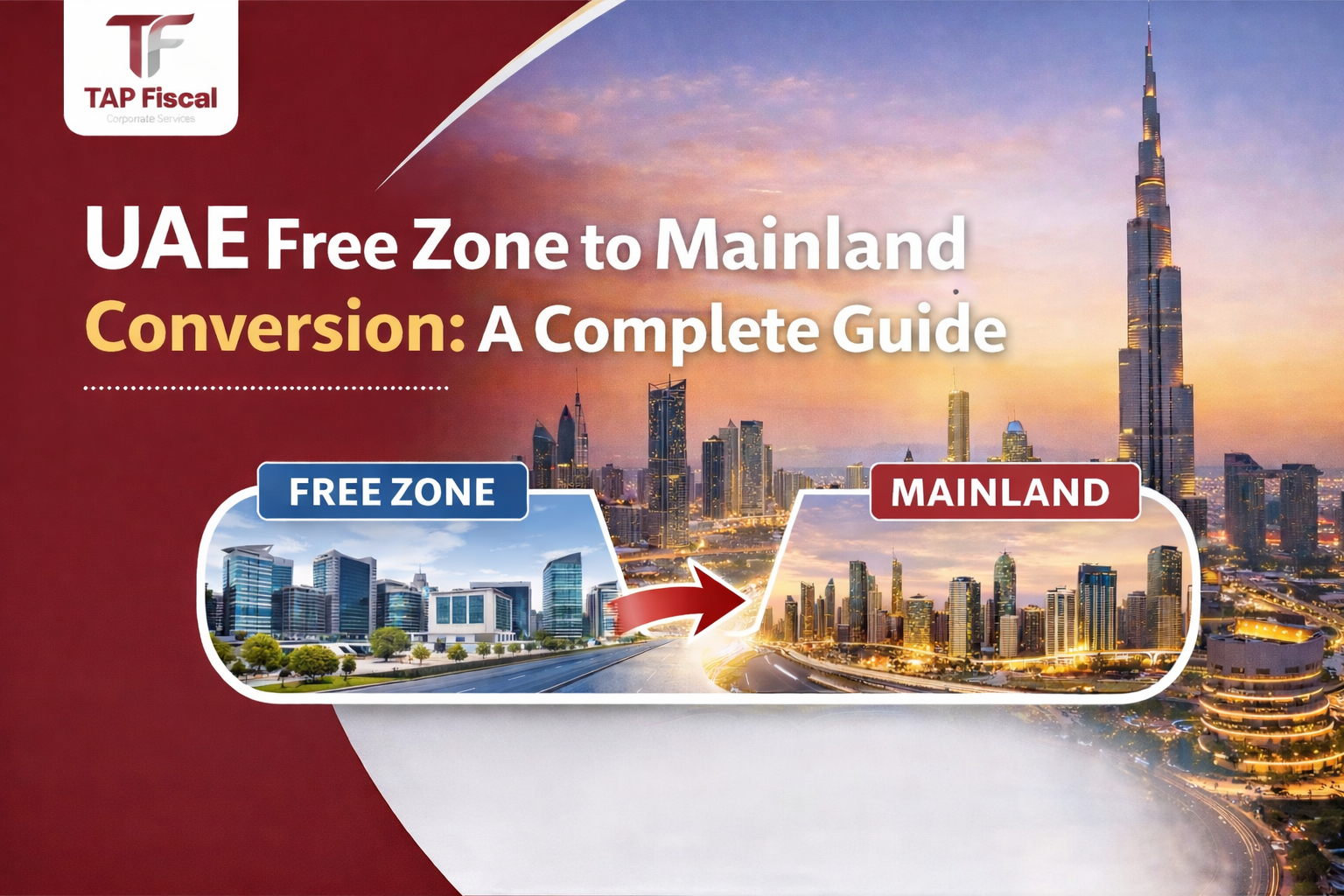
UAE businesses increasingly seek free zone to mainland conversion to access local markets while retaining operational continuity. Recent 2025 regulatory updates enable structured transitions through established procedures involving multiple authorities, requiring careful coordination to preserve company history, contracts, and banking relationships. This guide addresses eligibility for free zone to mainland conversion, free zone to mainland conversion costs, step-by-step processes, and compliance requirements for business owners navigating these complex procedures.
TAP Fiscal provides comprehensive support for free zone to mainland conversion, coordinating requirements across DED/DET, GDRFA, free zone authorities, and FTA.
Eligibility for Free Zone to Mainland Conversion
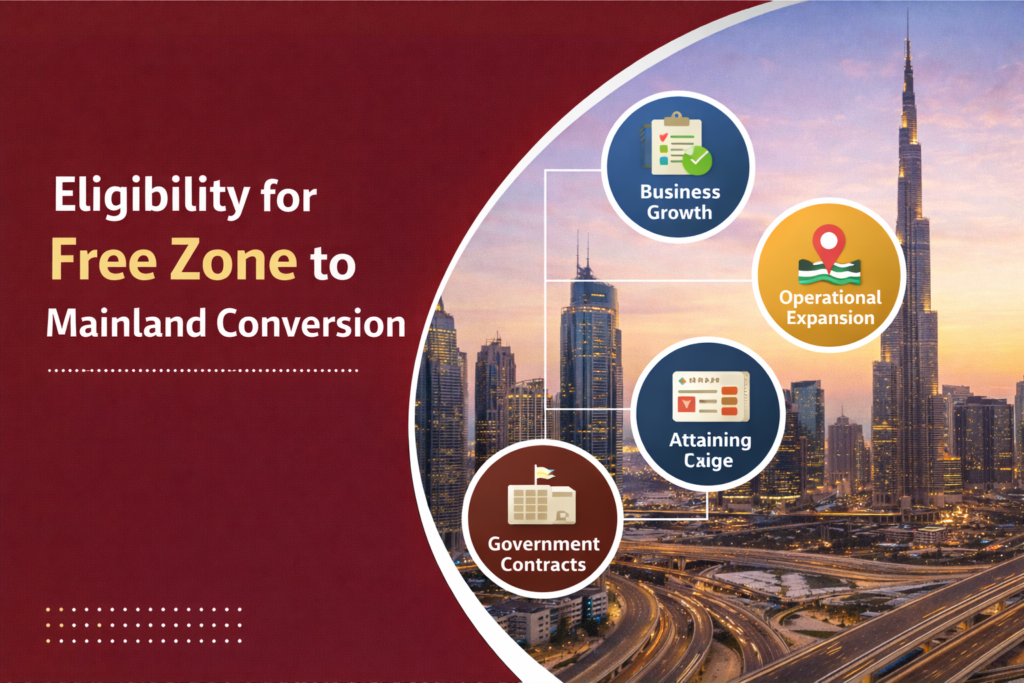
Not all free zone companies qualify automatically. Meeting eligibility criteria for free zone to mainland conversion requires the following:
- Active free zone trade license with all outstanding fines, dues, and disputes cleared
- Business activities approved for mainland operations (verify via DED activity list)
- Full compliance with UAE Commercial Companies Law, Federal Decree-Law No. 32 of 2021
- Clear financial statements and a tax clearance certificate from the free zone authority
- For regulated sectors (healthcare, education, finance): additional ministry approvals from DHA, KHDA, or the UAE Central Bank
100% foreign ownership remains available for most activities post-conversion. TAP Fiscal conducts detailed eligibility assessments to identify potential obstacles before proceeding.
Free Zone to Mainland Conversion Costs (2026 Breakdown)
Free zone to mainland conversion costs typically range from AED 25,000 to AED 50,000+, depending on free zone origin, visa transfers, office requirements, and regulatory approvals. Here’s the detailed breakdown:
Cost Component | Range (AED) | Notes |
Free Zone NOC | 2,000-6,000 | Clearance from IFZA/RAKEZ is typically cheaper than DMCC |
Mainland License Fees | 8,000-15,000 | DED/DET registration + trade name reservation |
Office Lease + Ejari | 10,000-25,000 | Mandatory physical space requirement |
MOA/AOA Notarization | 2,000-4,000 | Legal documentation preparation |
Visa Transfers | 3,000-7,000 per visa | GDRFA processing coordination |
TAP Fiscal Services | 3,000-7,000 | Complete process management |
Banking Updates | 1,000-3,000 | KYC documentation requirements |
| Total | 25,000-50,000+ | Excludes annual office renewal (~AED 20k+) |
Important: IFZA and RAKEZ conversions average AED 25k; DMCC/JAFZA approach AED 45k+. Hidden costs include potential fine clearances, and regulatory delays.
Step-by-Step Free Zone to Mainland Conversion Process
The process spans 2-6 weeks minimum and requires coordination across multiple government departments:
1. Confirm Eligibility & Clear All Free Zone Obligations
Assess mainland revenue potential vs. free zone export focus. TAP Fiscal identifies documentation gaps and outstanding liabilities.
3. Obtain Free Zone No Objection Certificate (NOC)
Settle ALL free zone dues (license fees, utilities, and penalties). Request NOC—processing takes 3-10 business days, depending on the compliance record.
4. Secure Mainland Trade Name Reservation
Submit 3-5 name options through authorized channels. Names must exactly align with business activities and comply with naming restrictions.
5. Establish Physical Office & Complete Ejari Registration
Lease commercial premises (minimum 200 sq. ft. required). Register a tenancy contract through the Ejari system—mandatory for license approval.
6. Prepare Legal Documentation
Draft new MOA/AOA for mainland LLC structure. Notarization is required by a public notary.
7. Submit Mainland Trade License Application
Complete package to the Department of Economic Development (DED/DET):
- Free zone NOC (original)
- Ejari tenancy contract (approved)
- Shareholder passports (6+ months validity) + Emirates ID
- Notarized MOA/AOA
- Business plan (regulated activities)
- Sector-specific approvals (if applicable)
8. Coordinate Employee Visa Transfers
Cancel free zone visas and reapply under mainland sponsorship. Timing is critical to avoid employment gaps.
9. Complete Banking & Compliance Updates
Update the corporate bank KYC with the new license. VAT registration is mandatory if turnover exceeds AED 375,000.
Required Documents for Free Zone to Mainland Conversion
Incomplete documentation causes 80% of delays:
- Free zone trade license (valid copy)
- No Objection Certificate (NOC) from the free zone authority
- Shareholder passports (minimum 6 months’ validity) + photographs
- Emirates ID copies (UAE residents)
- Ejari registered a tenancy contract
- Notarized MOA/AOA
- Board resolution authorizing conversion
- Financial statements (last 2 years)
- Tax clearance certificate
- Business plan (regulated sectors only)
Free Zone vs Mainland: Critical Post-Conversion Differences
Feature | Free Zone | Mainland |
UAE Market Access | Limited/dual license | Full access |
Office Requirements | Flexi-desk permitted | Physical + Ejari |
| Corporate Tax | 0% qualifying (QFZP) | 9% standard |
| Government Tenders | Restricted | Full eligibility |
| Employee Visas | Zone quota limits | Office size-based |
Key Challenges in Free Zone to Mainland Conversion
- Visa transfer timing—employees cannot work during gaps
- Banking KYC delays—some banks require 2-4 weeks of processing
- Free zone dues clearance—unexpected penalties are common
- Office space compliance—Ejari rejections are frequent
- Regulated sector approvals—DHA/KHDA processing varies widely
Partner with TAP Fiscal for Risk-Free Conversion
Free zone to mainland conversion requires coordination across multiple government authorities. TAP Fiscal has successfully managed hundreds of transitions with proven expertise across DED/DET, GDRFA, free zone authorities, and banking compliance.
- Free zone NOC procurement (including fine negotiations)
- DED/DET application coordination
- Ejari compliance verification
- GDRFA visa transfer scheduling
- Banking KYC facilitation
- VAT/ESR compliance setup
Contact TAP Fiscal today for a confidential eligibility assessment and precise cost estimate. Navigate complexity with proven expertise—your UAE expansion deserves proper execution.
Frequently Asked Questions
1. Is direct conversion possible without liquidation?
No full legal merger. New mainland entity established with asset transfer preserves continuity.
2. Which free zones have the smoothest conversions?
IFZA/RAKEZ is more efficient; DMCC/JAFZA involves higher NOC fees.
3. What causes most conversion delays?
Incomplete NOC clearance (45%), Ejari issues (25%), documentation gaps (20%).
4. Can existing bank accounts transfer seamlessly?
KYC update processing varies by bank (1-4 weeks).
5. When should conversion be considered?
Local UAE revenue >30% or pursuing government contracts.