
As crypto demands increase globally, Dubai has established regulations for crypto-related activities. The growth of exchanges, token projects, and Web3 companies has raised Financial risks, and that’s where VARA comes in. Virtual Assets Regulatory Authority (VARA), which was launched in 2022, works as the singular authority for crypto and blockchain-related businesses. In this guide, we will discuss the VARA regulations in Dubai in detail.
Understanding What VARA Actually Does
As we pointed out earlier, VARA is the dedicated regulator in Dubai for virtual assets, and the list includes cryptocurrencies, tokens, stablecoins, and NFTs used for investment or trading.
VARA works as the sole authority for approving who can avail trade licenses relating to crypto and blockchain activities in Dubai, closely monitoring such business functions, and protecting customers from deceptive practices with the goal of countering money laundering and fraud. VARA is unlike other authorities in the financial sector and focuses only on crypto activities. All VARA regulations are drafted for the protection of customers of these businesses and have no direct connection with existing banking laws.
Reviewing VARA Authority at a Glance
VARA is the authority for regulating crypto activity in Mainland Dubai and most other free zones like DMCC, DWTC, and DAFZA. VARA is, however, under the Dubai International Financial Centre (DIFC), and such businesses are regulated by the DIFC/ DFSA authority. VARA jurisdiction covers businesses that operate from Dubai or are engaged in marketing to users/consumers in Dubai or the UAE. Note that even if a business is offshore but is aiming to cater to customers here, the VARA regulations in Dubai still apply to them.
How VARA Decides on Regulation?
VARA is the authority for regulating activities, and not companies. It asks what a business does with tokens or user funds, and a singular company may fall under many regulated activities. Businesses that have more control over user assets are subject to stricter rules of VARA regulations.
Crypto Activities That Require Full Licensing

Crypto activities in Dubai that require licensing under VARA include:
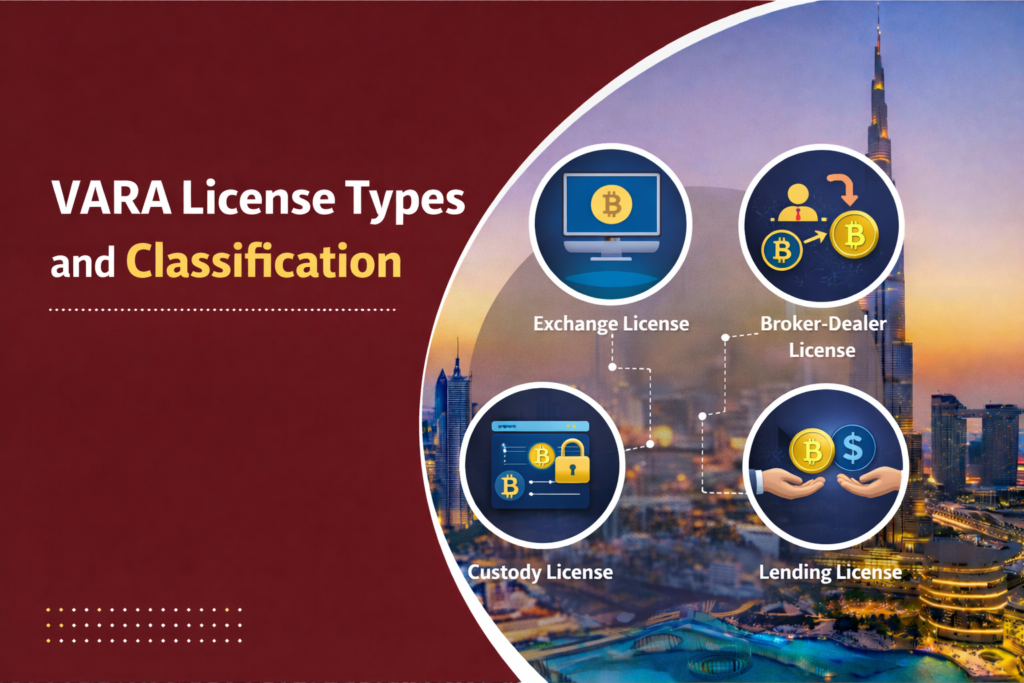
- Exchanges and Trading Platforms: These are platforms that allow users to sell and buy crypto, trade tokens against each other, and match buyers and sellers. Rules apply to both centralised and decentralised platforms that have user-facing interfaces. These platforms are regulated to control price discovery and user access, and the added risk of market manipulation without supervision.
- Broker-Dealers and OTC Desks: These refer to businesses that buy or sell virtual assets or crypto on behalf of clients or arrange large private trades outside public exchanges. VARA is concerned about these companies as they handle money, may have conflicts of interest, and can risk price transparency.
- Custody Providers: These businesses are the ones that hold crypto or private keys for users or control access to funds owned by users. The VARA regulations in Dubai: are considerably higher, as there are risks associated with loss or misuse of funds that can directly harm customers. Requirements include asset segregation, security audits, and higher capital buffers.
- Lending, Borrowing, and Yield Products: These are platforms that could be engaged in activities like interest on crypto deposits, crypto-backed loans, and staking or yield programs. VARA remains involved as users hand over assets to these businesses in the hope of returns. There is also a risk of collapse if funds are mismanaged.
- Crypto Advisory Services: These businesses are also regulated by VARA, as they are responsible for advising on investment strategies, token recommendations, and portfolio guidance involving crypto.
Some businesses aren’t standard “crypto companies” but still fall under VARA regulations Dubai, such as fintech apps that offer crypto alongside traditional payments, banks that add crypto buying or custody features, and real estate or asset tokenisation projects. DAOs or Web3 projects with teams operating from Dubai or the UAE and front-end platforms accessible to users in the UAE/Dubai also fall under VARA regulations.
Activities That May Not Need a Full License

There are some exceptions to a license. Here is a quick list:
Proprietary trading firms that are trading only their own money and have no clients involved may not need a direct license but will be monitored by VARA. Such businesses usually need a formal acknowledgement (NOC) and must adhere to reporting norms.
High-volume individual or entity traders are also subject to VARA regulations Dubai but may not require a full license. These companies/traders usually have volumes above USD 250 million per month and must be registered, even when they don’t offer services to other users. The goal of VARA regulations for such companies is to ensure market stability and prevent market manipulation due to the sheer volume.
Technology and infrastructure providers also may not need a full license but must sync with other VARA rules. These providers/companies may offer non-custodial wallets, blockchain tools, and analytics and compliance software. These are exempt if they don’t control user funds and or execute trades, although VARA needs confirmation to prevent misuse.
NFT marketplaces that allow buying and selling for profit are treated like exchanges. NFTs that are sold only as art for use entirely inside games may not require a license, as there is no investment intent, but VARA still checks if users can reasonably expect financial returns.
VARA License Types and Classification
Main license categories under VARA include:
- Advisory
- Broker / Exchange
- Custody
- Lending & Borrowing
- Token Issuance
- Asset Management
Multi-activity businesses are required to disclose all regulated activities and pay fees as per the highest-risk function. License scope under VARA regulations in Dubai directly determines capital requirements, depth of audits, and ongoing intensity of supervision. Check the VARA license Dubai cost below:
License Type | Application Fee (One-time) | Annual Supervision Fee (Recurring) |
Advisory Services | AED 40,000 | AED 80,000 |
Broker-Dealer / Exchange | AED 100,000 | AED 200,000 |
Custody Services | AED 100,000 | AED 200,000 |
| Lending & Borrowing | AED 100,000 | AED 200,000 |
| Exchange / Trading / Virtual-Asset Exchange Services | AED 100,000 | AED 200,000/year |
| Token Issuance / Virtual-Asset Issuance (Category 1 VA Issuance | AED 100,000 | AED 200,000/year |
| VA Management and Investment Services | AED 100,000 | AED200,000 |
Share Capital Requirements for VARA
This is not a fee, but the capital requirements that must be locked in the bank account of the company to prove solvency.
| License Type | Paid-up capital |
| Advisory Services | AED 100,000 |
| Broker-Dealer / Exchange | Higher of AED 400,000 or 15% of fixed annual overheads. Else: higher of AED 600,000 or 25% of fixed annual overheads. |
| Custody Services | Higher of AED 600,000 or 25% of fixed annual overheads. |
| Lending & Borrowing | Higher of AED 500,000 or 25% of fixed annual overheads |
| Exchange / Trading / Virtual-Asset Exchange Services | If using a licensed custodian: higher of AED 800,000 or 15% of fixed annual overheads; otherwise: higher of AED 1,500,000 or 25% of fixed annual overheads. |
| Token Issuance / Virtual-Asset Issuance (Category 1 VA Issuance | At least AED 1,500,000, or — where applicable — 2% of the value of reserve assets (whichever is higher). |
| VA Management and Investment Services | If custody-provider approved: higher of AED 280,000 or 15% of fixed annual overheads; otherwise: higher of AED 500,000 or 25% of fixed annual overheads |
Operational & Setup Costs
There are also additional costs like:
- Legal & Consultancy: $30,000 – $80,000 USD for drafting required policy manuals.
- Staffing: Appointment of two “Responsible Individuals” (Compliance Officer and a Senior Manager).
- Tech Audits: Third-party security audits can cost AED 50,000 or more.
Total Estimated Budget for 1 Year
- Light License (Advisory):~$60,000 USD and above
- Heavy License (Exchange/Custody):~$150,000 USD and above
Marketing Rules That Many Businesses Misunderstand
VARA regulations are rather strict and focus on what a business can openly advertise and not just what it does. In other words, a company may have to adhere to VARA if it is located overseas or is only engaged in digital marketing of virtual assets. VARA also prohibits certain kinds of messaging, such as terms like “risk-free profits”, “guaranteed returns”, and suggesting certain performance claims. VARA requires such companies to have disclosures, such as clear risk warnings, volatility statements, and clarity on licensing status. Incentives that remain under scrutiny of VARA regulations in Dubai include sign-up bonuses, referral rewards, and free trading credits.
So, how are these regulations enforced? VARA may issue fines, shut down campaigns and further issue public warnings.
AML and KYC: VARA Cares About Where Money Comes From
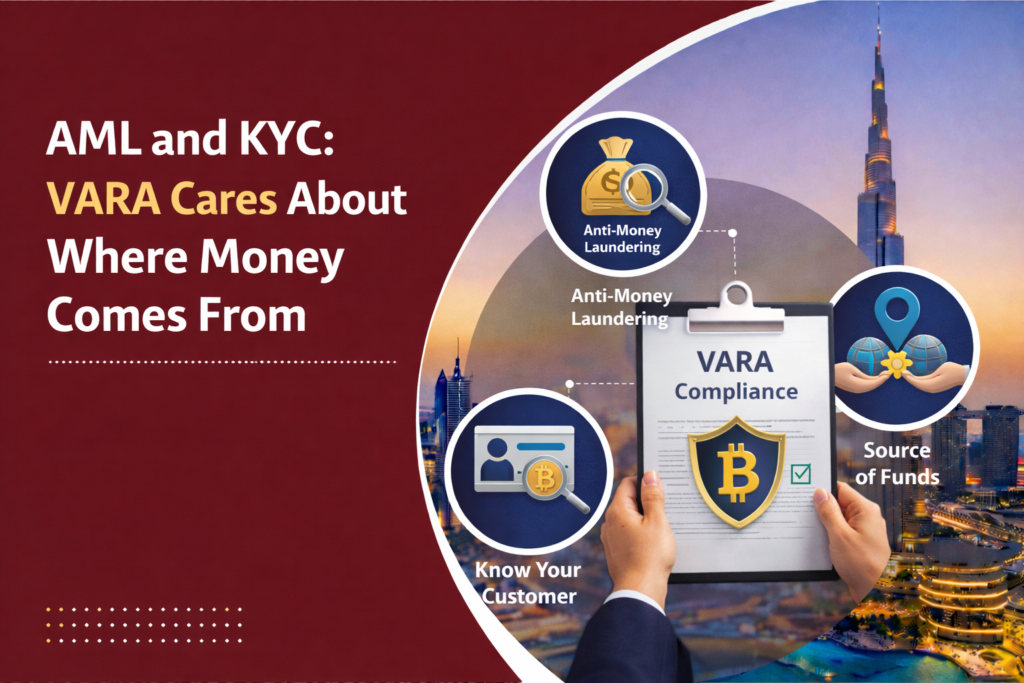
Considering that now crypto and virtual assets are traded globally, there are higher risks of money laundering, fraud, and exposure to terror financing. VARA cares about where the money comes from, which is why there are mandatory requirements like:
- Identity verification
- Beneficial ownership checks
- Ongoing transaction monitoring
There is also the Travel Rule, which outlines that sender and receiver details must travel with large transactions, and the threshold is around AED 3,500.
Compliance expectations include a dedicated compliance officer and documented AML procedures. Businesses are also required to conduct regular internal reviews.
VARA Effect: Changing Reality for Crypto Exchanges by 2026
VARA regulations in Dubai have made it mandatory for exchanges to prove financial stability, operational resilience, and customer fund protection. Systems have been developed for detecting market manipulation and incident response planning, besides business continuity plans. Product restrictions are also extremely defined, with leverage and derivatives closely monitored and scrutiny of stablecoin. As a direct result of VARA, 2026 will be more about fewer exchanges but more high-quality operators.
VARA License Costs at a Glance
VARA application fees are based on activity type, but there is also an annual supervision fee that must be paid, regardless of profitability. Capital Requirements are different for different companies. Advisory businesses, for example, have lower capital thresholds, while for exchanges and custody providers, the capital requirements are linked to operating costs. Buffers are higher if the company is holding user assets. Token issuers require large upfront capital, which is a must for proving project solvency. There are operational costs applicable to legal and compliance advisors, along with expenses for security and code audits. Costs also include senior compliance staff and ongoing reporting infrastructure.
Day-to-Day Reality of VARA Compliance
Dealing in virtual assets and crypto in Dubai or the UAE means compliance with VARA, and that is a continuous process and not a one-time thing. Businesses have to ensure compliance with periodic audits and regulatory reporting, and banking access depends on VARA approval and a clean compliance record. Not complying means fines, risk of license suspension, and damage to reputation.
What VARA Truly Means for Crypto Businesses in 2026?
VARA is a real, defined reflection of Dubai’s decision to allow crypto but also control risks and attract serious capital. Regulations under VARA are meant to work for competitive advantage instead of being barriers to trading, buying, and selling virtual assets. Businesses that understand, respect, and adhere to VARA will have no problems with scaling, can operate longer, and access the benefits of institutional trust.
Choose Tap Fiscal as Your Partner
Have questions about VARA regulations in Dubai? Tap Fiscal allows you to understand and make the most of the existing system, ensuring you never miss compliance and related aspects. With years of experience, experts from Tap Fiscal ensure your business doesn’t have to deal with fines and other consequences that result from non-compliance. We will be here right from the first step, ensuring your crypto business remains in sync with rules and continues to market services and offerings in line with VARA norms.
Learn more about VARA regulations in Dubai with Tap Fiscal today!
Call: +971502890630
WhatsApp: +971502890630
Email: Aina.k@tapfiscal.com
Frequently Asked Questions (FAQs)
What is VARA, and why was it established?
The Virtual Assets Regulatory Authority (VARA) was created under Dubai Law No. 4 of 2022 to govern businesses related to trading and dealing with crypto and virtual assets. VARA was established to ensure clarity, safety, and accountability and protect consumers and users. VARA’s purpose is also to prevent financial crime and support making Dubai a global Web3 hub.
Which crypto activities are regulated by VARA?
VARA is the authority for regulating crypto activities, not just companies. Regulated companies include operating exchanges, businesses engaged in facilitating crypto trading, companies holding crypto for users, those offering crypto loans or yield products, and platforms providing paid crypto investment advice and issuing tokens. NFT marketplaces and tokenised real-world assets can also fall under VARA regulations in Dubai, depending on whether there is trading or profit expectations.
Who needs a VARA license in Dubai?
Any business engaged in regulated crypto activities in Dubai, including those that target Dubai or UAE users, may need a VARA license. The list includes exchanges, brokers, custodians, advisory firms, lending platforms, and token issuers. Offshore companies can also fall under VARA if they are engaged in marketing or offering services to UAE users.
What are the main types of VARA licenses available?
VARA licenses are issued for activity. Categories include advisory services, broker-dealer/ exchange services, custody services, lending and borrowing, virtual asset issuance (token issuance), and virtual asset management/investment services.
Some businesses may need multiple licenses when engaged in multiple activities. Higher-risk activities, such as custody or operating an exchange, have stricter requirements and higher capital thresholds, coupled with intensive ongoing supervision.
What are the key compliance requirements under VARA regulations?
Licensed firms and businesses are required to adhere to strict compliance standards, which include customer identity verification (KYC), anti-money laundering (AML) controls, transaction monitoring, and record keeping. Businesses must also appoint qualified compliance officers, besides maintaining documentation of all policies and procedures. Client assets have to be separated and segregated from company funds, especially for custodians and exchanges. There are also strict cybersecurity controls, along with disclosure of risks and regular audits. Compliance is ongoing and not a singular step under the VARA regulations in Dubai.
How do VARA regulations impact crypto exchanges in 2026?
VARA regulations have set clear expectations for crypto exchanges as of 2026, including explaining and establishing financial stability, maintaining strong capital reserves, segregating customer funds and assets, and implementing systems to detect market manipulation. Some products, such as leverage, derivatives, and stablecoins, have to deal with closer scrutiny, while marketing claims are controlled accurately. Expectedly, there are fewer exchanges in Dubai, but these are better governed, more trusted by banks and institutional investors, and transparent in operations.
Are NFTs regulated under VARA?
NFTs are regulated by VARA depending on usage. NFTs that are traded on marketplaces, fractionalised, or marketed as investments with profit likelihood are regulated by VARA. NFT platforms may also require licensing. NFTs used as digital art or within games may not fall under the VARA regulations in Dubai.
Can foreign crypto companies operate in Dubai under VARA?
Yes, foreign crypto companies can operate in Dubai under VARA, but compliance is a must. If a company is offshore but targets UAE users through direct services or marketing, approval and licensing may be a must under VARA.
What penalties apply for non-compliance with VARA regulations?
Non-compliance with VARA can mean fines, license suspension, and a ban on marketing. VARA may also take public enforcement actions. Businesses may have to deal with additional audits, restrictions, and corrective steps. Breaches may affect banking relationships and damage reputation.
How long does it take to obtain a VARA license?
The process to get a VARA license can take many months, based on business complexity and other factors. Simple advisory or non-custodial businesses may get a license faster, while exchanges, custodians, or lending platforms have to deal with longer timelines. The process is staged, which means businesses must finish one stage before moving to the next as per VARA regulations Dubai.
How do VARA regulations benefit investors?
VARA enhances transparency, accountability, and safety, which are the exact things that investors need. There are reduced risks of misuse of funds, misleading marketing campaigns, and sudden collapses. Strong AML and governance requirements help prevent fraud and market manipulation.
Are VARA regulations expected to change in the future?
Yes, VARA regulations can change as the crypto industry is an evolving one, although these are likely to be refinements. With new technologies, VARA may update guidance or bring new rules. Everything is directed towards better supervision, consumer protection, and alignment with global standards.