
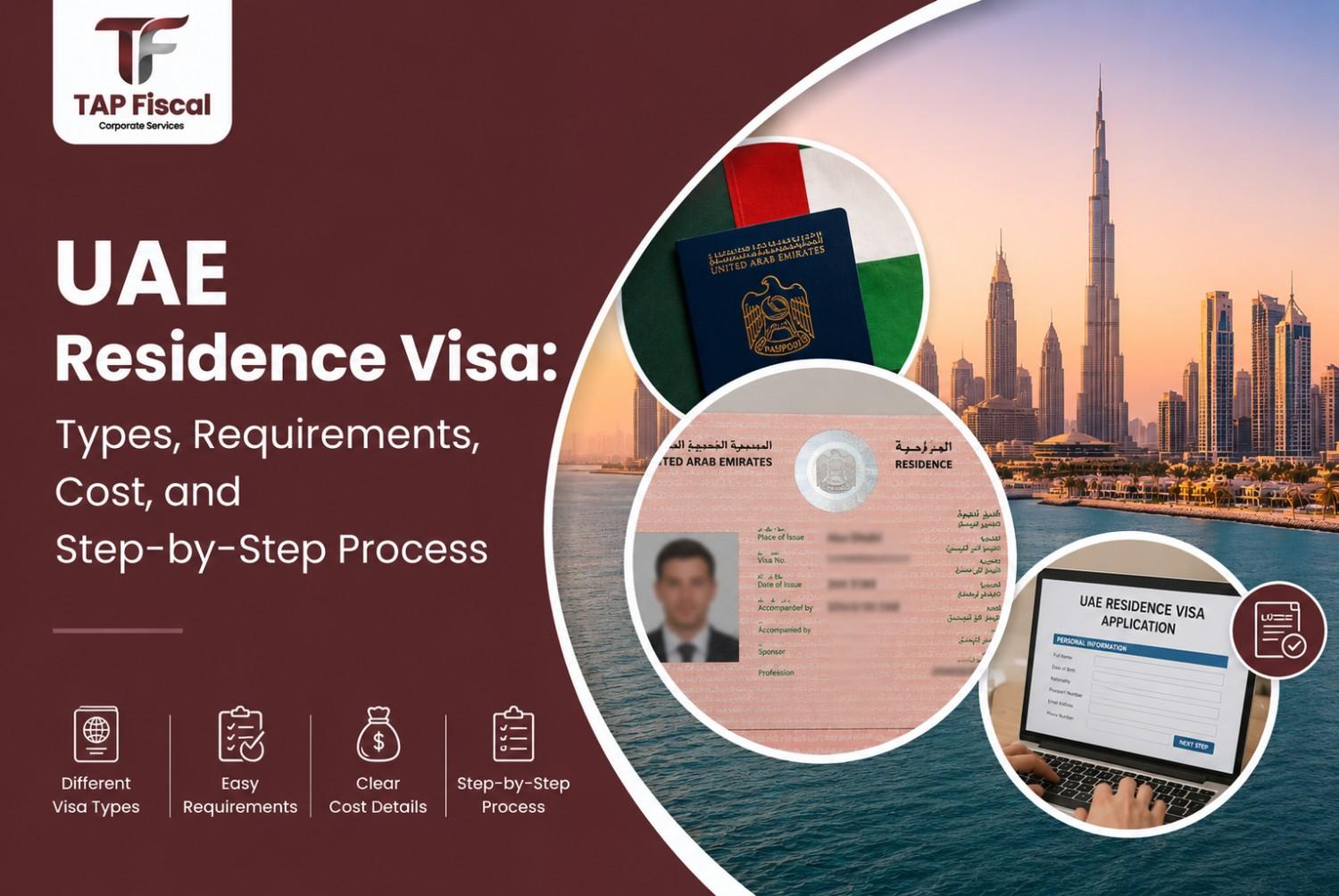
If you plan to live, work, or invest in the UAE, getting a UAE residence visa is your very first step. The UAE has become one of the most sought-after destinations for business owners, skilled professionals, and entrepreneurs from around the world. With world-class infrastructure, zero personal income tax, and a thriving economy, it is easy to see why over 8 million expatriates call the UAE home.
This guide covers everything you need to know, from the different types of resident visa options and eligibility requirements to a breakdown of costs and a step-by-step application process. Whether you are setting up a business or relocating your team, TAP Fiscal is here to help you navigate every stage smoothly and get it right from day one.
Overview: Understanding the UAE Residence Visa Landscape
The UAE residence visa (officially known as the UAE Residency Visa or UAE resident visa) gives foreign nationals the legal right to live, work, and access services within the country. It is issued by the General Directorate of Residency and Foreigners Affairs (GDRFA) and is typically linked to employment, business ownership, investment, or family sponsorship.
There are several types of UAE residence visas available today. The right one for you depends on your purpose of stay, your profession, and your financial standing. Here is a quick overview of the main categories:
- Employment Visa — sponsored by your UAE employer
- Investor / Partner Visa — for business owners registered in the UAE
- Golden Visa — for long-term investors, entrepreneurs, and exceptional talent
- Green Visa — for skilled workers and freelancers
- Student Visa — for those enrolled in UAE-accredited institutions
- Retirement Visa — for retirees above 55 years with qualifying assets
- Dependent Visa — for spouses, children, and parents of UAE residents
Understanding which visa applies to your situation can save you both time and money. TAP Fiscal helps businesses and professionals identify the correct visa category and manage the entire process from document preparation to final stamping.
Why Choose TAP Fiscal for Your UAE Residence Visa Process?
Navigating UAE immigration rules can be overwhelming, especially if you are new to the region. TAP Fiscal takes the complexity out of the equation. Here is what sets us apart:
Deep Expertise in UAE Business Setup and Residency
TAP Fiscal has assisted hundreds of companies and individuals in securing their UAE residence visa. Our team understands the end-to-end process – from free zone and mainland business setup to visa stamping and Emirates ID registration.
End-to-End Support
We don’t just hand you a checklist. We manage everything: document collection, PRO services, health insurance coordination, and follow-ups with government authorities. You focus on your business – we handle the paperwork.
Up-to-Date Regulatory Knowledge
UAE immigration policies evolve regularly. TAP Fiscal stays ahead of every update, ensuring your applications always comply with current rules. This dramatically reduces the risk of rejection or delays.
Transparent Pricing
No hidden fees. No surprises. We give you a clear breakdown of all UAE residence visa costs upfront – government fees, service charges, and medical test costs included.
Who Can Apply for a UAE Residence Visa?
The UAE residence visa is not limited to a specific group. A wide range of individuals qualify, making it one of the most accessible long-term visa systems in the region. Here is who can apply:
Business Owners and Entrepreneurs
If you have set up or are planning to set up a company in the UAE – whether in a free zone or on the mainland – you are eligible to apply for an investor or partner residence visa. This gives you the right to live and operate your business without annual renewals tied to employment contracts.
Employed Professionals and Expats
Most expatriates in the UAE hold an employment visa. If you have a job offer from a UAE-based company, your employer can sponsor your UAE resident visa. This is the most common visa pathway in the country.
High-Net-Worth Investors
Investors who commit AED 2 million or more in real estate or a UAE-based business can qualify for the Golden Visa – a 10-year renewable UAE residence visa with added benefits like no sponsor requirement and easier family sponsorship.
Freelancers and Skilled Workers
The Green Visa caters specifically to freelancers and self-employed professionals who hold a UAE freelance permit. It is valid for five years and does not require employer sponsorship.
Students and Dependents
Students enrolled in UAE universities and family members of existing UAE residents can also obtain a residence visa through sponsorship. Family sponsorship is one of the most common uses of the dependent UAE resident visa.
UAE Residence Visa Benefits: Why It Matters for Businesses and Professionals
A UAE residence visa unlocks a host of privileges that go well beyond just the right to stay in the country. Here are the key UAE residence visa benefits:
- Access to UAE Banking — Open a personal or corporate bank account with ease
- Emirates ID — Required for all government transactions, healthcare, and telecom contracts
- Driving Licence — Convert your home-country licence to a UAE driving licence
- Healthcare Access — Enrol in government and private health insurance schemes
- Sponsor Family Members — Bring your spouse, children, and parents to the UAE legally
- Business Continuity — Operate your company without residency interruptions
- Travel Freedom — UAE residents enjoy visa-on-arrival in many countries
- Property Ownership — Some emirates allow property ownership tied to residency
- Tax Residency — Establish UAE tax residency and benefit from zero personal income tax
ALSO READ: All About Corporate Tax Services in Dubai
For businesses, keeping your key staff on valid UAE resident visas also means stable operations and easier scaling. It avoids the risk of talent leaving due to visa expiry and reduces HR disruptions significantly.
UAE Residence Visa Requirements: What You Need to Prepare
While requirements vary slightly by visa type, the core UAE residence visa requirements remain consistent. Here is what most applicants will need:
General Documents Required
- Valid passport with at least 6 months remaining validity
- Passport-size photographs (white background, biometric format)
- Health/medical fitness certificate from a MOHAP-approved centre
- Emirates ID application form
- Valid health insurance policy
- Entry permit (initial visa approval – obtained before medical and stamping)
For Employment Visa
- Labour contract signed by the employer and the employee
- Educational certificate (attested if required by the role)
- ILOE (Involuntary Loss of Employment Insurance) subscription proof
For Investor / Partner Visa
- Trade license of the company in the UAE
- Memorandum of Association or establishment card
- Proof of investment or share certificate
For Golden Visa
- Proof of property purchase worth AED 2 million or more (Title deed)
- Bank statements or proof of qualifying business investment
- Approval letter from the relevant authority (ICP, MOHRE, or Free Zone)
TAP Fiscal performs a full document audit before submission to make sure nothing is missing – a step that prevents the most common rejection causes.
UAE Residence Visa Types: Cost, Validity & Best Use – Quick Comparison
Use this reference table to quickly compare your visa options before making a decision:
| Visa Type | Validity | Best For |
Approx. Cost (AED) |
|
Employment Visa |
2–3 Years | Company employees & expats | 5,000 – 8,000 |
|
Investor/Partner Visa |
3 Years | Business owners & shareholders | 5,000 – 8,000 |
|
Golden Visa |
10 Years | Investors, talent, entrepreneurs | 14,000 – 18,000 |
|
Student Visa |
1 Year (renewable) | Students enrolled in UAE universities |
2,000 – 3,500 |
| Retirement Visa | 5 Years | Retirees aged 55+ with savings/property |
8,000 – 12,000 |
| Green Visa | 5 Years | Skilled workers & freelancers |
4,000 – 6,000 |
| Dependent Visa | Tied to sponsor | Spouse, children, parents |
2,500 – 4,000 |
Note: Costs are approximate and include government fees, medical tests, and Emirates ID. Actual costs may vary based on applicant profile, free zone, and additional services required.
UAE Residence Visa Process: Step-by-Step Guide
The UAE residence visa process follows a structured sequence of steps. Here is a simple, clear breakdown of how it works:
Step 1: Determine the Right Visa Category
Before you do anything, confirm which visa category applies to you. Your purpose of stay, occupation, and investment level all influence this. TAP Fiscal can help you make this assessment.
Step 2: Obtain an Entry Permit
The entry permit (also called an “employment” or “investor” entry permit) is your initial authorization to enter the UAE for visa stamping. The application is submitted to the relevant immigration authority, GDRFA for Dubai or ICA for other emirates, and must include the correct supporting documents for the visa category. Errors or missing documents at this stage delay the entire process. TAP Fiscal submits the entry permit application on behalf of clients, ensuring it is complete and correctly formatted for first-time approval.
Step 3: Undergo Medical Fitness Testing
All applicants aged 18 and above must complete a medical fitness test at an approved MOHAP centre. This includes a blood test and chest X-ray to screen for communicable diseases.
Step 4: Apply for an Emirates ID
Simultaneously, you submit your Emirates ID application to the Federal Authority for Identity, Citizenship, Customs and Ports Security (ICP). Your biometrics are captured at this stage.
Step 5: Obtain Valid Health Insurance
Health insurance is mandatory for all UAE residents. In Dubai, it is a legal requirement for employers to provide it. Make sure your policy is active before your visa is stamped.
Step 6: Visa Stamping
Once your medical test is clear and your Emirates ID application is submitted, your UAE residence visa is stamped into your passport by the immigration authority. The visa is now officially active.
Step 7: Collect Emirates ID
Your Emirates ID card is printed and delivered, typically within 3–5 working days after visa stamping. This card is your primary identity document in the UAE.
TAP Fiscal manages every single one of these steps on your behalf. From entry permit application to Emirates ID collection, we coordinate everything so you experience zero friction.
Why UAE Residence Visa Management Matters for Enterprises
For companies operating in the UAE, keeping your team’s visas in order is not optional — it is a business-critical function. Delayed visas mean delayed work permits. Expired residencies put employees at risk of fines or overstay penalties. Here is why enterprises partner with TAP Fiscal for visa management:
- Bulk visa processing for multiple employees at once
- Proactive renewal reminders to avoid expiry penalties
- Compliance with MOHRE, GDRFA, and free zone regulations
- Dedicated PRO team for government liaison
- Scalable support as your headcount grows
Companies that handle visa management in-house often face delays, errors, and unnecessary costs. Outsourcing this to TAP Fiscal means your HR team can focus on talent, not paperwork.
Common Mistakes to Avoid During the UAE Residence Visa Process
Even small errors can delay or derail your application. Here are the most frequent mistakes applicants make — and how to avoid them:
- Submitting a passport with less than 6 months validity — always check before applying
- Choosing the wrong visa category — misclassification leads to rejection
- Skipping health insurance — your visa cannot be stamped without a valid policy
- Using unattempted medical centres — only MOHAP-approved centres are valid
- Not attesting educational certificates when required for skilled professional visas
- Ignoring grace periods after visa expiry — overstaying leads to fines and bans
- Applying for dependents before the sponsor’s visa is fully stamped
TAP Fiscal reviews every application before submission, catching these issues before they become problems.
Why Choose TAP Fiscal for UAE Residence Visa Services?
TAP Fiscal is a trusted business setup and PRO services partner in the UAE. We work with startups, SMEs, and multinational companies across free zones and mainland jurisdictions. Here is what you get when you work with us:
- One dedicated point of contact for all your visa needs
- Experienced PRO team with deep knowledge of GDRFA, ICP, and MOHRE processes
- Full-service support from entry permit to Emirates ID collection
- Transparent, all-inclusive pricing with no hidden government fee surprises
- Fast turnaround — we prioritise urgent cases and have established relationships with authorities
- Ongoing compliance monitoring — we track visa expiry dates and send proactive renewal alerts
- Group visa solutions for businesses onboarding multiple employees at once
Whether you are applying for your first UAE resident visa or managing a team of 50, TAP Fiscal has the expertise and systems to deliver a smooth, compliant result every time.
Conclusion
Securing a UAE residence visa opens the door to one of the world’s most dynamic economies. Whether you are an entrepreneur building a business, a professional pursuing a career, or an investor growing your portfolio, having the right UAE resident visa gives you the foundation to operate confidently and legally.
ALSO READ: Business Setup Process in Dubai
The process does not have to be complicated. With the right support, you can get your UAE residence visa sorted quickly, compliantly, and without the usual stress. TAP Fiscal is your trusted partner every step of the way – from understanding UAE residence visa requirements to collecting your Emirates ID.
Ready to get started? Contact TAP Fiscal today for a free consultation and let our experts handle your UAE residence visa from start to finish.
Contact TAP Fiscal today for a free assessment.
Website: https://tapfiscal.com/
Phone / WhatsApp: +971 50 289 0630
Email: [email protected]
Frequently Asked Questions (FAQs)
Q1: What is a UAE residence visa, and who needs it?
A UAE residence visa is a legal permit that allows foreign nationals to live, work, and access services in the UAE. Anyone planning to stay in the UAE for more than 90 days — whether as an employee, business owner, investor, student, or family member — needs a UAE residence visa.
Q2: What is the UAE residence visa cost in 2024–2025?
The UAE residence visa cost varies by visa type. An employment visa typically costs between AED 3,000 and AED 5,000, while a Golden Visa can range from AED 14,000 to AED 18,000. Costs include government fees, medical tests, GDRFA and all government approvals, and Emirates ID charges. TAP Fiscal provides a full cost breakdown before you start.
Q3: What are the key UAE residence visa requirements?
The core UAE residence visa requirements include a valid passport (6+ months), passport photos, a medical fitness certificate, an Emirates ID application, valid health insurance, and an entry permit. Additional documents depend on your visa category — such as a trade license for investors or a labor contract for employees.
Q4: How long does the UAE residence visa process take?
The standard UAE residence visa process takes approximately 2 to 4 weeks from the entry permit stage to final visa stamping and Emirates ID collection. Processing times can vary based on visa type, emirate, and document completeness. TAP Fiscal expedites the process where possible.
Q5: How do I apply for a UAE residence visa?
To apply for a UAE residence visa, you first obtain an entry permit through your sponsor (employer, company, or free zone). Then you complete a medical fitness test, submit an Emirates ID application, secure health insurance, and proceed to visa stamping. TAP Fiscal manages this entire flow on your behalf.
Q6: What are the main UAE residence visa benefits for business owners?
Business owners benefit from UAE residence visa privileges such as UAE banking access, Emirates ID, the ability to sponsor dependents, tax residency, property ownership eligibility, and the freedom to operate their business without interruption. Long-term visas like the Golden Visa offer additional security and stability.
Q7: Can I sponsor my family on a UAE residence visa?
Yes. UAE residents earning a minimum monthly salary of AED 4,000 (or AED 3,000 for specific cases) can sponsor their spouse and children. Business owners and Golden Visa holders have more flexible family sponsorship criteria. TAP Fiscal handles dependent visa applications alongside the primary applicant’s visa process.
Q8: What happens if my UAE residence visa expires?
If your UAE residence visa expires, you enter a grace period—typically 30 days – during which you can renew or exit without penalty. After the grace period, daily fines apply. Repeated overstays can lead to entry bans. TAP Fiscal sends renewal alerts and manages the renewal process well before expiry.