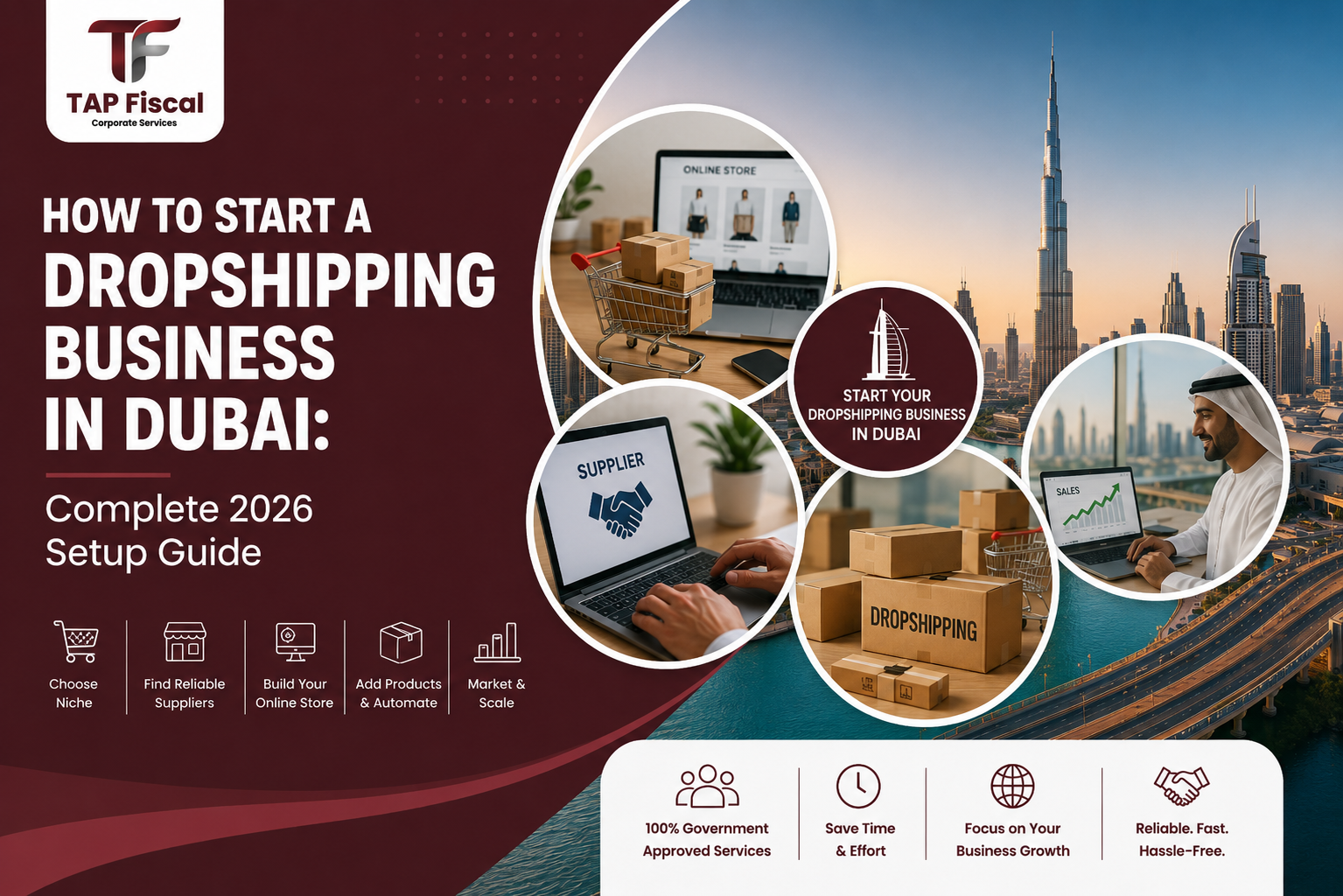
Dubai has become one of the fastest-growing destinations for dropshipping businesses. The UAE e-commerce market reached around USD 12.3 billion in 2026 and is projected to reach USD 21 billion by 2031.
But here is the catch most guides skip: knowing how to start a dropshipping business in Dubai legally is what separates the stores that scale from the ones that get shut down. The wrong license—or no license—is the fastest way to kill a promising store. TAP Fiscal, a Dubai-based business setup consultancy, specializes in dropshipping company registration in Dubai, helping founders choose the right license, open corporate bank accounts, and stay compliant from day one.
This guide walks you through everything: the license options, real 2026 costs, free zone versus mainland, and a clear step-by-step setup. Let’s build it properly.
What Is a Dropshipping Business in Dubai?
Dropshipping is an e-commerce model where you sell products online without holding inventory. When a customer places an order, your supplier ships the product directly to them. You never touch the stock yourself.
Who should choose this? First-time e-commerce founders, entrepreneurs with limited capital, expats looking for a low-overhead online business, and anyone who wants to test product markets before investing in inventory. It suits both UAE residents and foreign founders.
Key features of the dropshipping model:
- No upfront stock investment or warehouse cost
- You only pay the supplier after the customer pays you
- Fully legal in Dubai under UAE commercial licensing rules, with the e‑commerce environment governed in part by Federal Decree‑Law No. 14 of 2023, provided you hold a valid license
- Can be run from anywhere in the world once set up
- Works across platforms like Shopify and WooCommerce with UAE-compatible payment gateways
Yes, dropshipping is fully legal in Dubai, as long as you hold a valid e-commerce or trade license. Operating without one breaches UAE commercial law and can lead to fines, account suspension, and legal action.
Dropshipping Market Insights Data (2026 – 2033)

The Numbers Behind the Boom: Dropshipping Market Insights (2026 – 2033)
If you think the dropshipping market is saturated, the latest industry statistics tell a completely different story. According to recent data from Grand View Research, the rapid expansion of e-commerce and the integration of advanced AI tools are driving the industry toward record-breaking growth.
To understand the massive potential of this business model in the coming years, take a look at these key market statistics:
- Global Market Size (2026): The global dropshipping market is estimated to reach an impressive USD 583.5 billion in 2026.
- Future Forecast (2033): The industry is projected to grow significantly, reaching a market value of USD 2,180.8 billion (USD 2.18 trillion) by 2033.
- Annual Growth Rate (CAGR): The market is expected to grow at a Compound Annual Growth Rate (CAGR) of 20.7% between 2026 and 2033.
- Regional Dominance: The Asia Pacific (APAC) region currently holds the largest market share, accounting for 36% of global revenue, creating strong product sourcing opportunities for entrepreneurs based in Dubai and the UAE.
Key Factors Driving This Massive Growth
This boom is not just a passing trend; it is backed by fundamental shifts in how modern e-commerce operates:
-
AI & Automation Integration: Modern AI-powered tools have streamlined product selection, automated inventory synchronization, and optimized order fulfillment, significantly reducing operational costs and human error.
-
The Rise of Social Commerce: With platforms like Instagram, TikTok, and Facebook Shops enabling direct-to-consumer sales, dropshipping brands can reach highly targeted audiences at a much lower customer acquisition cost (CAC).
-
Low Financial Risk & Scalability: Entrepreneurs are increasingly choosing this asset-light model because it allows them to build and scale a global brand without investing heavily in upfront stock or warehouse management.
Dubai Business Tip: Because Dubai and the wider UAE offer one of the most advanced digital payment and e-commerce infrastructures globally, there is no better time to capitalize on this global growth. Just ensure your setup is fully compliant by securing a valid e-commerce or trade license first!
Data sourced from: Dropshipping Market Size & Forecast (2026 – 2033)
Benefits of a Dropshipping Business in Dubai
Benefit 1: Zero Inventory Risk
You only purchase stock after a customer has already paid. There is no risk of unsold products and no storage costs. This makes dropshipping one of the lowest-risk e-commerce models available.
Benefit 2: Low Startup Cost
With a free-zone e-commerce license starting at around AED 5,750, you can launch a global-facing online store for well under AED 10,000. No warehouse, no stock, no logistics infrastructure required from day one. [CAUTION: A realistic all‑in free‑zone setup with flexi‑desk and one investor visa usually lands in the AED 10,000–15,000 range.]
Benefit 3: Tax Advantages
The UAE has zero personal income tax — there is no tax on personal earnings at any level for UAE residents. For your business entity, corporate tax at 9% applies to qualifying profits above AED 375,000, but Small Business Relief means the effective rate is 0% for businesses with annual revenue below AED 3 million until the end of 2026. VAT registration is mandatory once your annual turnover exceeds AED 375,000. Compared to running a dropshipping business from most other countries, the combined tax position is highly competitive. Once VAT‑registered, you may also need to account for import VAT and apply the correct place‑of‑supply rules for cross‑border sales.
Benefit 4: Access to a High-Spending Consumer Base
The UAE has one of the highest per-capita online spending rates in the Middle East. Shoppers here are mobile-first and accustomed to purchasing from global brands. A well-targeted store in this market converts at strong rates.
Benefit 5: Dubai’s Logistics Infrastructure
Dubai is one of the world’s top logistics hubs. With proximity to both East and West markets, strong courier networks, and growing UAE-based supplier options, fulfillment times for Gulf-facing stores are genuinely competitive.
Eligibility and Requirements
Required Documents
To register a dropshipping business in Dubai and obtain an e-commerce license, you will need the following:
- Passport copy (all pages)
- Passport-size photograph
- UAE visa copy (if already resident)
- Proposed trade name and business activity description
- Brief business plan (for some free zones and all mainland applications)
- No Objection Certificate (NOC) from current employer if you are on an employment visa
- For mainland setups, additional documents may include Ejari tenancy contract, TDRA/TRA approval (where applicable), and any sector‑specific approvals depending on your exact activity
Legal Requirements
- A valid e‑commerce or trade license is mandatory—operating without one breaches UAE commercial licensing rules and can lead to fines, platform suspension, and forced closure. The e‑commerce environment is governed in part by Federal Decree‑Law No. 14 of 2023, but the license requirement itself comes from the broader commercial licensing framework
- The E-Trader license (AED ~1,070/year) is restricted to UAE and GCC nationals only; expat founders cannot use it
- Foreign founders must register through a free zone or DET mainland
- VAT registration is required once annual turnover exceeds AED 375,000
- Corporate tax under Federal Decree-Law No. 47 of 2022 applies to qualifying profits above AED 375,000
Compliance Considerations
- Free zone companies cannot sell directly to UAE mainland consumers without appointing a mainland distributor or agent
- Payment gateways (Telr, PayTabs, Stripe) require a valid UAE business license and corporate bank account
- Product categories like food, health, beauty, and electronics may require additional approvals from regulatory bodies (ESMA, Ministry of Health)
- Annual license renewal is mandatory to remain operational
- Maintain proper books, contracts, invoices, and evidence of real commercial activity to support banking due diligence and regulatory compliance.
- UAE consumer protection rules require clear refund/return policies and proper invoicing for B2C sales, including distance selling and online transactions
Step-by-Step Process to Start a Dropshipping Business in Dubai
Step 1: Pick and Validate Your Niche
Use Google Trends, Amazon UAE bestsellers, and Noon rankings to confirm demand. Strong 2026 niches include beauty and skincare, electronics accessories, home decor, fitness gear, and fashion. Validate before you spend on setup — niche selection is the foundation of everything else.
Step 2: Choose Your Jurisdiction
Decide between a free zone and a mainland based on your target market. Free zones are better for global selling and have lower entry costs. Mainland is better if you plan to sell directly to UAE consumers. This decision affects your license cost, ownership structure, and banking options.
Step 3: Reserve Your Trade Name and Apply for the License
Submit your passport copy, a brief business plan, and your proposed activities. Be specific about your product categories — a vague activity description can cause friction with both the licensing authority and payment gateways. This is the first official step in your dropshipping company registration in Dubai.
Step 4: Complete Approvals and Premises Setup
For the mainland, secure the TDRA NOC and an Ejari-registered premises address. Free zones streamline this with flexi-desk packages that satisfy the address requirement without renting a full office. This is typically the fastest step if you are going the free zone route.
Step 5: Open a Corporate Bank Account
This step is essential. A corporate bank account lets you collect customer payments and pay suppliers in a clean, compliant way. Most free zones have banking partners to ease the process. Setting up a dropshipping business in Dubai without a business bank account limits your payment gateway options severely.
Step 6: Build Your Online Store
Set up on Shopify or WooCommerce. Make the store mobile-first — most UAE shoppers buy on their phones. Ensure your store shows prices in AED and supports Arabic where possible for stronger local conversion.
Step 7: Connect Suppliers
Choose platforms that ship reliably to the Gulf: AliExpress, CJ Dropshipping, Spocket, or AutoDS. Prioritize suppliers with UAE or regional stock to cut delivery times. Always order a sample to a UAE address before listing—photos lie, and one bad first order can damage your store’s reputation fast.
Step 8: Set Up a UAE-Compatible Payment Gateway
Connect Telr, PayTabs, or Stripe to enable secure customer payments. UAE shoppers also strongly prefer cash on delivery (COD) — ignoring COD as an option costs real sales. Set up a local logistics partner that handles COD fulfillment.
Step 9: Launch and Market
Drive traffic through SEO content, paid social ads, and influencer partnerships once your store is live. Validate your niche with a small ad budget before scaling spend. The UAE e-commerce market rewards focused, mobile-optimized marketing.
Looking to start your company? Explore our Business Setup Services in Dubai and get expert guidance for a smooth and hassle-free company formation process.
Which Free Zone Is Right for Your Dropshipping Business?
The free zone comparison table below covers costs and features. But the more useful question is which zone suits your specific business model. Here is the honest routing:
| • Shopify or WooCommerce store targeting international customers—IFZA or Meydan. Both are approved for Amazon.ae and Noon seller registration, have strong banking acceptance, and offer flexi-desk packages with remote setup. IFZA from AED 12,900; Meydan from AED 12,500.
• Logistics-intensive dropshipping with Gulf warehouse suppliers—Dubai CommerCity. Purpose-built for e-commerce, adjacent to Dubai airport, and designed around fulfillment logistics. Higher entry cost but genuine operational advantages for volume sellers. • Cost-first setup, no UAE address required—SHAMS (Sharjah Media City) from AED 5,750 or RAKEZ from AED 6,000. Strong for global-facing stores where a Dubai address is not a requirement. [CAUTION: These “from” prices are usually license‑only and exclude visa, flexi‑desk, and other setup costs.] • Selling directly to UAE mainland consumers—Mainland DET e-commerce license. The only clean option for direct UAE consumer sales. Free zone license alone is not sufficient without a mainland distributor arrangement. |
Costs and Fees
Government Fees
| License Option | Who It’s For | Approx. 2026 Cost (AED/year) |
|---|---|---|
|
Free zone e-commerce license |
Expat founders, global selling | 5,750 – 15,000 |
|
IFZA (Dubai address) |
Founders needing a Dubai base with Amazon/Noon access | from ~12,900 |
| Meydan Free Zone | Shopify/Amazon sellers, same-day license option |
from ~12,500 |
| Mainland DET e-commerce license | Selling directly to UAE consumers |
12,000 – 20,000+ |
| E-Trader license | UAE/GCC nationals only |
~1,070 + AED 300 chamber |
Service Charges
| Item | Approx. Cost (AED) |
|---|---|
| Trade name reservation |
600 – 900 |
|
Initial approval fee |
1,000 – 2,000 |
|
TDRA NOC (mainland only) |
500 – 1,000 |
|
Ejari registration (mainland only) |
150 – 300 |
Additional Expenses
- Domain and website hosting: AED 50 – 500/year
- Shopify or WooCommerce plan: AED 100 – 500/month
- Initial marketing/ad budget: AED 3,000 – 5,000 (recommended minimum)
- Payment gateway setup: typically free, with per-transaction fees
- Corporate bank account setup: varies by bank
Realistic all-in launch cost with a free zone license: from AED 5,750 (license only, no visa, cheapest free zone) to AED 12,000–15,000 for a standard free zone setup with flexi-desk and one investor visa. Most expat founders launching a practical operation land in the AED 10,000–15,000 range. The “from AED 5,750” figure is the license fee only — it excludes visa costs, flexi-desk, and any banking or professional fees.
Add website, payment gateway, and initial marketing costs, and you are looking at roughly AED 15,000–20,000+ for a fully operational free zone setup with at least one visa and basic marketing
Operating without a valid license can lead to substantial fines (often tens of thousands of dirhams), platform bans, and forced closure. Exact penalties depend on the authority and specific violation.
Common Challenges and Solutions
Challenge 1: Operating Without the Correct License
The problem: Many new dropshippers start selling before getting licensed, assuming they can formalize later. This is the most common and costly mistake. Operating without a valid e-commerce licence breaches UAE commercial law. Penalties include fines, platform bans, and forced shutdown of your store.
The solution: Get licensed first, even if you launch with just a handful of products. A free zone e-commerce licence starts from around AED 5,750 — which is less than most founders spend on their first month of ads. The licence also unlocks payment gateways and corporate banking, both of which you need to run the business properly.
Challenge 2: Cash on Delivery and High Return Rates
The problem: Cash on delivery is a dominant payment preference in the Gulf. Ignoring COD loses sales. But COD also brings higher return rates and failed-delivery rates, especially when using overseas suppliers with long shipping windows.
The solution: Work with a local UAE fulfilment or logistics partner that handles COD on your behalf. Prioritise suppliers with UAE or GCC-based stock to cut delivery times to 24–48 hours. Faster delivery dramatically reduces returns and failed COD collections.
Challenge 3: Choosing a Supplier Strategy Built for Europe, Not the Gulf
The problem: Many dropshipping courses teach strategies designed for US or European markets. Suppliers and fulfillment networks optimized for those markets often have 2–4 week delivery windows to the UAE, which kills conversion and trust with Gulf buyers.
The solution: Source from platforms with proven UAE and Gulf delivery performance: AliExpress suppliers with UAE stock, CJ Dropshipping’s regional warehouses, or Spocket suppliers that ship to MENA. Test every supplier with a real order to a UAE address before listing their products. Your customer experience depends on this one decision more than any other.
Why Choose TAP Fiscal for Dropshipping Business Setup in Dubai?
Starting a dropshipping business in Dubai requires more than just building a Shopify store. The licensing, banking, and compliance steps are where most founders lose time and money. Here is how working with a specialist like TAP Fiscal makes a practical difference.
Faster processing: An experienced setup partner knows which free zone suits your business model, what documents are needed, and how to avoid the common delays that add weeks to the timeline. Most straightforward applications can be completed within 5 to 10 business days.
Documentation support: Your license application needs specific activity descriptions, correctly formatted documents, and, in some cases, a business plan. A setup partner prepares everything to the right standard, reducing back-and-forth with the authority.
Compliance guidance: Choosing the wrong license category, missing the VAT threshold, or misunderstanding the E-Trader restriction are all easy mistakes that carry real consequences. Professional guidance keeps your structure clean and compliant from the start. This includes advice on VAT place‑of‑supply, import VAT, and basic consumer protection requirements for online sales
Banking assistance: Corporate bank account opening in Dubai has its own process, and many founders find it unexpectedly difficult without support. TAP Fiscal has established banking relationships and can navigate the account setup alongside your license—so your business is fully operational from day one.
Free Zone vs Mainland — Comparison Table
| Feature | Free Zone | Mainland (DET) |
|---|---|---|
|
Foreign ownership |
100% | 100% |
|
Sell to UAE mainland consumers directly |
⚠️ Needs agent/distributor | ✅ Yes |
|
Sell to global customers |
✅ Yes | ✅ Yes |
|
Physical office required |
❌ Flexi-desk available | ✅ Ejari required |
|
TDRA NOC required |
❌ No |
✅ Yes |
| Approximate licence cost 2026 | AED 5,750 – 15,000/year |
AED 12,000 – 20,000+/year |
| Corporate bank account eligible | ✅ Yes | ✅ Yes |
| Visa sponsorship | ✅ Yes |
✅ Yes |
| Best for | Global stores, expat founders, low-cost launch |
UAE-focused stores, direct local consumer sales |
| Recommended free zones | IFZA, Meydan, SHAMS, RAKEZ, Dubai CommerCity |
N/A (DET is the authority) |
Verdict: For most expat founders running a Shopify store aimed at a broad market, a free zone license is the right starting point. If your primary audience is UAE mainland consumers, a DET license is cleaner long-term.
Conclusion
Starting a dropshipping business in Dubai is genuinely accessible if you handle the legal side first. Get the right license, pick the correct jurisdiction for your business model, and you can launch a global store for AED 5,750 in license fees (or AED 10,000–15,000 all-in with a flexi-desk and one visa) with no inventory risk.
Remember the three traps that sink most stores: operating without a license, ignoring cash on delivery, and using a supplier strategy built for Europe instead of the Gulf. Avoid those, and the market is wide open.
If you want your start dropshipping in dubai journey handled correctly—from dropshipping business setup in Dubai and banking to ongoing compliance — TAP Fiscal can set it all up so you can focus on selling. Learn more about how TAP Fiscal gets your store live the right way.
Frequently Asked Questions (FAQs)
What is a dropshipping business in Dubai?
Dropshipping is an e-commerce model where you sell products online, and your supplier ships directly to the customer. You hold no stock and only pay the supplier after the customer pays you. In Dubai, it is fully legal under Federal Decree-Law No. 14 of 2023 as long as you hold a valid e-commerce or trade license.
Is dropshipping legal in Dubai?
Yes. Dropshipping is fully legal in Dubai, provided you hold a valid e-commerce or trade licence. Operating without one breaches UAE commercial law and risks fines of AED 10,000 to AED 50,000 per violation, platform suspension, and forced closure. You can register with the DET on the mainland or in a free zone such as IFZA or SHAMS.
Do I need a business license for dropshipping in Dubai?
Yes. Every dropshipping seller operating from Dubai, or targeting UAE customers, needs a valid e-commerce or trade license. The E-Trader license is available only to UAE and GCC nationals. Expat founders must use a free zone e-commerce license or a DET mainland license.
How much does it cost to start a dropshipping business in Dubai?
A free zone e-commerce license starts from AED 5,750 per year (license only, no visa). A more typical all-in setup—including a flexi-desk and one investor visa — runs AED 10,000 to AED 15,000. A mainland DET license runs from AED 12,000 to AED 20,000+. Add website, payment gateway, and initial marketing costs and you are looking at AED 15,000–20,000 for a fully operational free zone setup.
Which license is required for a dropshipping business in Dubai?
You need an e-commerce license, either from a free zone (IFZA, SHAMS, RAKEZ, or Dubai CommerCity) or from the DET on the mainland. The E-Trader license is restricted to UAE and GCC nationals and cannot be used by foreign founders for commercial dropshipping.
Can foreigners start a dropshipping business in Dubai?
Yes. Expats can set up through a free zone e-commerce license with 100% foreign ownership or through a mainland DET license. The cheaper E-Trader licence is restricted to UAE and GCC nationals only. This is a common myth that misleads expat founders.
What are the benefits of starting a dropshipping business in Dubai?
Key benefits include zero inventory risk, low startup cost (license from AED 5,750), zero personal income tax, corporate tax at 0% under Small Business Relief for revenue up to AED 3 million until the end of 2026, access to a high-spending UAE consumer base, and Dubai’s world-class logistics infrastructure.
Which free zone is best for dropshipping in Dubai?
IFZA and Meydan are best for Shopify and Amazon/Noon sellers because both are approved for marketplace registration and have strong banking relationships. Dubai CommerCity is best for logistics-intensive operations near the airport. SHAMS and RAKEZ are best for cost-conscious founders who don’t need a Dubai address. The right choice depends on your business model, not just price.
How long does it take to register a dropshipping business in Dubai?
A free zone e-commerce license can typically be issued within 5 to 10 business days with clean documentation. Mainland DET applications may take 2 to 3 weeks. The full setup, including corporate banking, usually takes 2 to 4 weeks from start to operational.
Do I need a UAE residence visa to run a dropshipping business?
No. You can hold a UAE e-commerce licence without a UAE residence visa, as some free zones allow non-resident licence holders. However, a residence visa gives you access to UAE banking, payment gateways, and local logistics partners, making it significantly easier to run your business.
What products can I sell through a dropshipping business in Dubai?
You can sell most consumer products, including fashion, electronics, accessories, home décor, beauty products, fitness gear, and more. Regulated categories such as food, health supplements, cosmetics, and electronics may require additional approvals from UAE regulatory bodies such as ESMA or the Ministry of Health. Check your product category before listing.
Is VAT applicable to dropshipping businesses in Dubai?
VAT registration is mandatory once your annual turnover exceeds AED 375,000. Below that threshold, registration is voluntary. Corporate tax under Federal Decree-Law No. 47 of 2022 may also apply to qualifying profits. Keep clean records from day one so compliance is straightforward when you reach the threshold.
How can I find reliable dropshipping suppliers for my Dubai business?
Reliable platforms for Gulf-facing stores include AliExpress, CJ Dropshipping, Spocket, and AutoDS. Prioritize suppliers with UAE or regional warehouses to reduce delivery times. Always order a sample to a UAE address before listing products. Faster and more reliable delivery is one of the biggest factors in customer satisfaction.
What are the common challenges of running a dropshipping business in Dubai?
The three most common challenges are operating without the correct license, ignoring cash on delivery (COD), which is a major payment preference in the Gulf, and relying on overseas suppliers with long shipping times. Getting licensed first, enabling COD, and working with UAE- or GCC-based suppliers help overcome these issues.
How can I scale a dropshipping business in Dubai successfully?
Scale by validating your niche with a small advertising budget before increasing spend, adding UAE-based supplier options to improve delivery times, enabling COD fulfillment through a local logistics partner, and expanding into two or three complementary product categories. Once your annual revenue approaches AED 375,000, register for VAT proactively and review your corporate structure with a business advisor.